
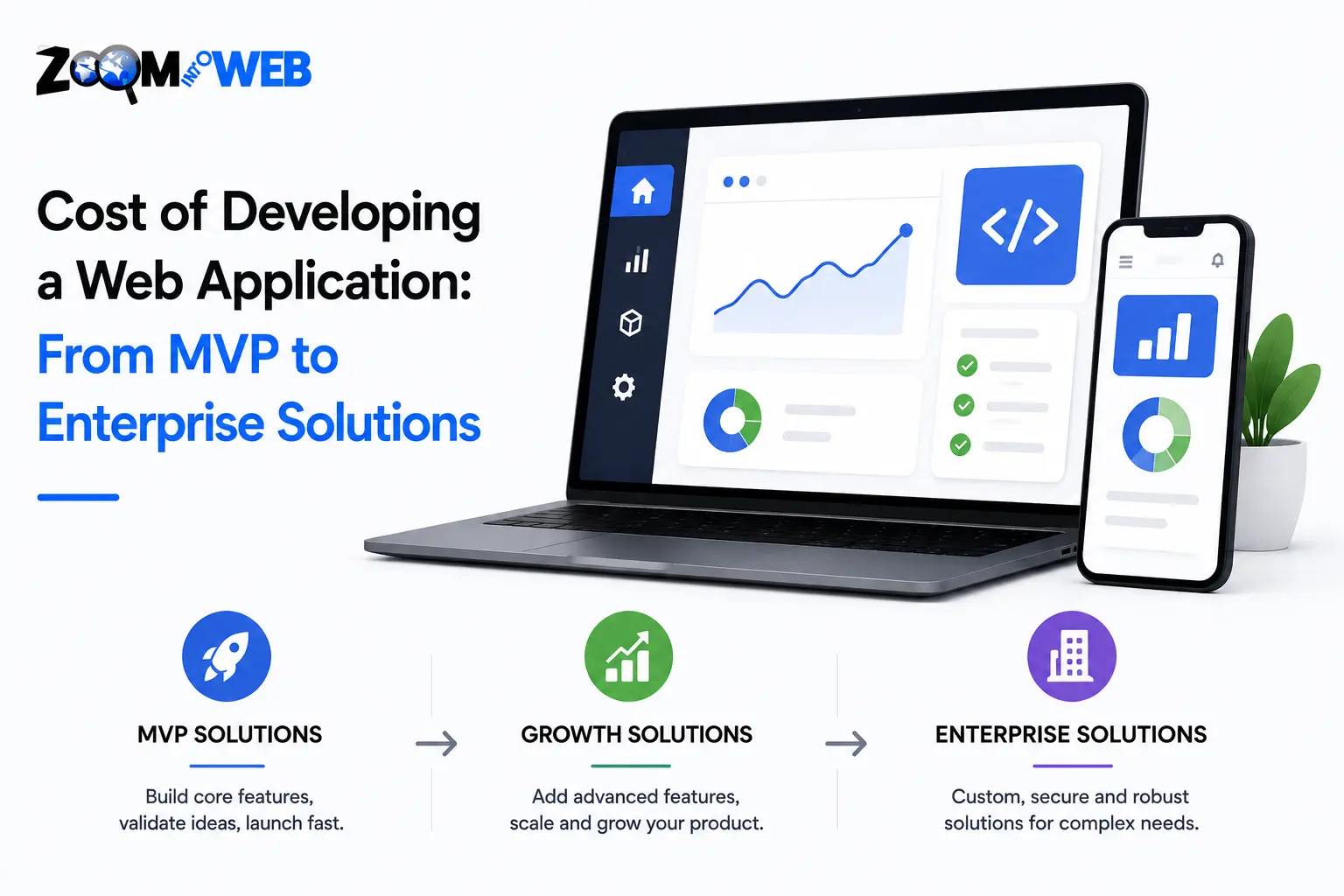
Web application development is hardly ever a universal investment decision. While a minimum viable product (MVP) made in order to test the feasibility of the idea requires an inexpensive budget, a mid-size business application needs considerably more time and features. An enterprise solution can cost even several times more, taking into account all of its components, integrations, security, and infrastructure expenses.
At Zoom Into Web, we scope and build web applications depending on each particular case. However, one of the most often asked questions by our clients is not “How expensive is a web application?” But, “Why does it cost so much more than I thought?” It all depends on the nature of the project itself. This article will help you understand the costs of web application development.
Why Two “Web Apps” Can Cost Wildly Different Amounts
Read this: mobile app development services
There is a large variety of web applications. Thus, naming it does not give much information about the costs of its development. For example, a simple form that will collect submissions and then send them via email can be developed quickly. However, a scheduling system for many users with the capability to use various user roles, permissions, real-time interaction, third-party integration, and other features can take many months to develop.
Three important aspects usually have a great impact on the cost of web application development:
- Complexity of backend: simple content and functionality are relatively easy to implement. Real-time capabilities, custom workflow, data storage, and permission system increase the amount of work that needs to be done.
- Integration with third-party services: Integration of a web application with payment gateways, CRM, API, analytics, and other services requires additional effort from developers.
- Number of user types: development of a web application for one kind of user is easier than for administrators, employees, vendors, customers, and other kinds of users who will have different access rights.
It is similar to requesting the price for “building” from a contractor without telling him what you want to get.
Cost by Project Type
The cost of web applications is quite variable and depends upon the scope and complexity of the project. The MVP (minimum viable product) is usually what is called for when trying to test the idea—it focuses on the key features that will make the application valid. These kinds of projects are executed in weeks, not in months, and consist of a basic interface, one user role, and limited integration options.
A small application for a business would be the next level. Its development could take several months and include features such as booking, scheduling, an admin panel, a management system, and one or two integrations with other platforms. The increased number of features and business logic will definitely add to the amount of work and cost of the development process.
A mid-size SaaS platform would require much bigger investments. It takes six months to develop an application that consists of multiple user accounts, billing, analytics, and API integrations.
Enterprise-level solutions occupy the top positions in the price range. It may take up to a year or even more to develop such a platform with complicated permissions, compliance needs, high availability, custom infrastructure, and numerous integrations. Such development requires more preparation, coding, testing, security measures, and technical support.
It is good to know the approximate price range of different types of projects. But you should keep in mind that this classification is only an approximation. The total cost of your web application will depend on the required functionality and complexity of the project.
Cost by Industry
The industry for which your web application is developed can influence the costs considerably, especially in case you deal with the processing of confidential information and strict compliance regulations. The development of the application for healthcare and fintech industries usually costs more since it includes security, data storage, audits, and other features to satisfy all the regulations.
The creation of the e-commerce and EdTech applications implies a considerable increase in cost. The e-commerce platform needs the integration of a payment gateway, order tracking, and management systems, while the EdTech platform needs several user roles and WCAG standards. The internal business tools are cheaper because of their usage for the limited audience.
When you are going to develop an application for healthcare or finance, the compliance needs to be taken into consideration right from the beginning. It is much cheaper to build such features into the project from the beginning rather than implement them later.
What Actually Drives the Price
Think of Features’ Complexity Rather than Number of Features
Development price is much more affected by the complexity of features rather than their number. For example, a dashboard with a few elementary widgets will be easier to develop, and a single feature that demands a real-time data sync across different devices will take much more effort.
Maturity of Design
Using a standard/template design interface will save you from higher expenses on development. Additional costs will appear for conducting custom UX research, testing, responsive design, and custom design according to a specific brand.
Backend and Security Requirements
If the app deals with private information of the user, it should have a robust authentication and encryption process. This factor may seem to be invisible to the end-user; however, it includes important steps of development and testing and may represent a large percentage of the total budget.
Integration
The linking of the website application to any service providers like Stripe, Twilio, Salesforce, or internal APIs comes with its own development and testing processes. There is a need for appropriate configuration, handling of errors, and maintenance of the third-party integrations.
The Cost Nobody Budgets For: Total Cost of Ownership
The cost of the development quoted in the beginning is not the complete cost of developing the web application. After you go live with your application, you will have to spend money on hosting, monitoring, maintaining, securing, and improving the application. These expenditures may add to your first year’s expense, thereby making it even more than the development cost initially.
The cost of hosting and other infrastructure costs may increase with increased traffic and usage of the application. Similarly, third-party API costs may increase with the increase in users and transactions. Maintenance, bug fixing, security patches, and dependency updates are needed to keep your application secure and running smoothly.
You also have to be prepared for future requirements, and after launching your application, small requests for changes may soon become big development projects with user feedback and changing business requirements. This is the reason why the cost of ownership over several years is more realistic than just the development cost.
Why the Right Technology Stack Matters to Cost
The particular set of technologies used to build a web application might affect the cost associated with both development and maintenance of the application.
A selection of appropriate languages, frameworks, databases, hosting options, as well as third-party services affects not only the speed of development but also scalability opportunities that a certain tech stack provides.
If we consider building a minimum viable product (MVP), we might say that using well-known frameworks and third-party services would reduce the time needed to develop and also would ensure that the amount of money invested at the initial stage wouldn’t be too large.
As the web application scales, however, its technical demands might change, which means that the need for a more powerful infrastructure or additional programming work might arise.
It doesn’t mean that one should select the most advanced tech stack available.
Instead, it is better to select a tech stack that would fit today’s requirements of the web app as well as give some additional space for the future.
In-House vs. Freelancer vs. Agency
Selecting developers for your application can greatly affect costs and the delivery of the project. Your in-house team will give you the maximum control and allow you to keep your product knowledge in-house, but you will incur high fixed costs such as salaries, insurance, software, hardware, and recruitment. In-house development works best for funded start-ups or companies planning to develop and support the product in the future.
If we are talking about simple projects or clearly defined tasks, then a freelancer can be the most affordable and flexible solution for your business. However, there can be risks associated with a single person’s ability to be unavailable at times or not having the necessary competencies in some areas. The freelancer can be considered a good choice for developing simple applications, features, or development itself.
An agency provides you with a full-fledged team consisting of developers, designers, project managers, etc. The cost of services can be slightly higher than for a freelancer, but an agency may be a suitable choice for complex applications or projects that require various integrations.
What Businesses Often Overlook When Budgeting for a Web App
However, the development cost estimates mentioned above are only a portion of the total costs that a business is required to invest in its product. Many companies tend to underestimate such expenditures as integration, security measures, testing, infrastructure, maintenance, and further updates, which can have a serious effect on the budget overall, especially taking into account the growth of the application.
Using an MVP approach may allow reducing costs; however, making cuts at the expense of architecture or security is generally wrong. The idea is to cut down unnecessary functionality while maintaining the stability, security, and scalability of the application.
Another aspect of building a realistic budget is that some adjustments and updates may be needed after launching an app. User requirements, integrations, and business requirements may change. Thus, leaving some room for changes from the very beginning helps cope with such problems without influencing the whole project.
Thus, a realistic budget should take into account not only how much it costs to develop the product but also how much it costs to support and enhance it.
Mistakes That Quietly Blow Past Your Budget
Another common mistake is proceeding without carrying out a proper discovery and scoping phase. When there are no requirements set out from the very beginning, it means that new details will come up during the development process, creating additional work, delays, and extra expenses.
The change of the main requirements while the development process is still going on could also cause issues similar to those described above. It is natural to have new ideas all the time, but constant addition of new features may interfere with the initial plan. Let’s maintain a list of future features and discuss them in the second development phase.
Choosing the least expensive offer without taking into account the previous experience of the team is another common mistake. A low price at first may turn out to be much more expensive in the end, resulting in poor coding or unmet requirements and other issues.
Yet another mistake many people make is forgetting about maintenance and further expenses while budgeting. Maintenance, upgrades, hosting services, third-party integration, and other expenses related to improving the product need to be accounted for. At the same time, creating enterprise-grade infrastructure ahead of time without having enough users could turn into a waste of money.
Lastly, do not sign contracts with unclear feature descriptions. The requirements have to be clear and specific for everyone to know what is expected of each side.
How to Budget a Web App Without Guessing
First of all, it is important to define the problem your web application should solve instead of listing the features you would like to have. The definition of the goal allows you to identify the required features and those that can be added in later stages. Features that do not play any role in the achievement of the main goal can be included in future phases of the project.
Second, it is recommended to divide all the features into required ones and nice-to-have ones. It will allow focusing on the most important ones and shorten the development period. Later, the user feedback can be used for the selection of the next features to implement.
It is also beneficial to collect quotes from several development options. The quotes of freelancers, agencies, and in-house development should be compared on the basis of the whole range of parameters, not just the price.
Make sure that there is some contingency in your budget, too. It could be the case that your requirements change, your integration takes more time than expected, or any technical issue might crop up. It will help you to have some money lying around to deal with these issues without hampering the overall process.
Don’t forget to budget for post-development expenses, too. Hosting, maintenance, updates, bug fixes, services, and future changes could go on even after development is done. Lastly, don’t forget to study the contract properly, especially the parts dealing with changes in scope of work and extra work.
Web App Development Cost FAQs
How much does web application development cost?
Costs depend on many factors, including application size, features, integrations, design, security needs, etc. Building an MVP costs significantly less compared to a mid-sized SaaS platform or enterprise solution.
How long does it take to develop a web application?
Developing an MVP may take from several weeks to several months, while business-oriented applications may take several months to build. Enterprise platforms may take more than a year.
What are the main determinants of web application development prices?
Feature complexity, backend development, custom design, integration with other services, security needs, user roles and permissions, and scalability are among the top ones. However, the number of features alone is not the determining factor.
Which is more cost-effective, employing a freelancer or an agency?
It is usually cheaper to employ a freelancer in case of smaller tasks that have clear boundaries. Agencies are more expensive; however, they have a wider range of specialists and project management, which makes agencies more suitable for larger and more complicated applications.
Are maintenance costs included in web application development?
In most cases, the cost of development doesn’t cover any further expenses. It is necessary to take into account hosting fees, security, fixing bugs, integration with external systems, monitoring, and further feature development.
Final Verdict
There is no ideal price for a web application – there is just the right price for the scope that has been clearly outlined. Make sure to get the MVP feature list nailed down before getting any bids, and then make sure to analyze each bid in detail rather than simply comparing the bottom line amount. This will mean the difference between getting a comfortable estimate versus a nasty surprise.
Not quite sure what a web app like yours costs? With Zoom Into Web, all of our projects are scoped out in advance of coding.
Written by the Zoom Into Web Team
This content was written by the Zoom Into Web team, combining hands-on experience in web development, software solutions, and digital marketing. We create accurate, practical, and up-to-date content to help businesses make informed technology decisions.

Web App Development Cost Breakdown: Every Cost Explained
[…] cost of developing a web application is influenced by several factors, and there is no single price that applies to every project. […]