
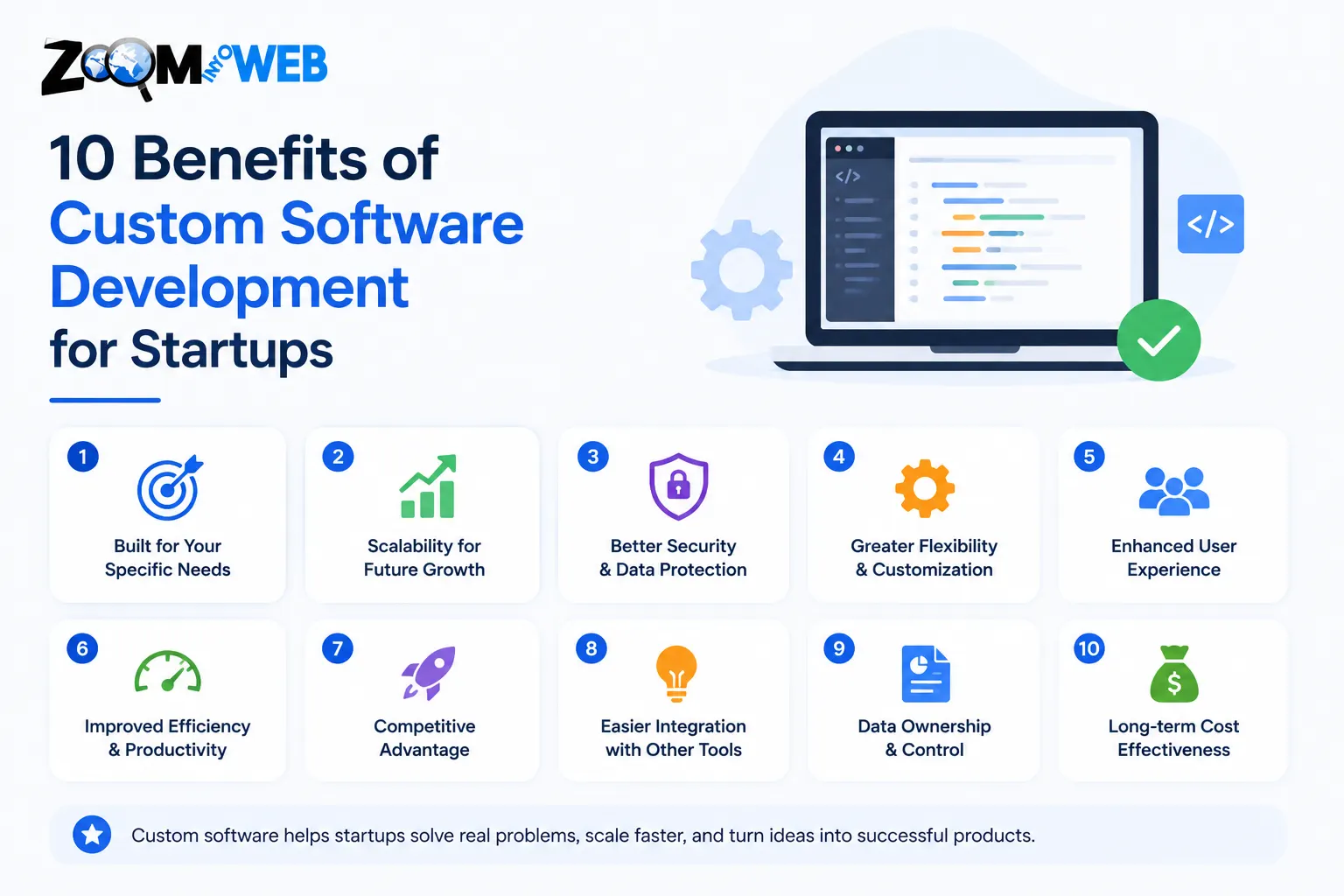
Starting a new business is an exhilarating venture that requires much more than a unique idea to be successful. With business growth, the need to accommodate new customers and business processes involves having the right software. Off-the-shelf software helps you start fast but is inflexible and often lacks the tools and capabilities that the business demands to grow.
Custom software development alters the game from the fit of business processes to the software. It offers a great opportunity to provide a custom solution that creates competitive differentiators, improves processes, and reduces operational costs.
This article will provide the numerous benefits of custom software development for startups to explain further why custom software is a great investment to help startups grow and achieve the success that is desired.
What is Custom Software Development
Custom software development involves building, designing, and maintaining software that is specific and proprietary to a business or enterprise. Unlike bespoke software, provided solutions are proprietary to a business and specific to the industry and business functions.
For startups, this development is much more useful than building proprietary processes around existing software.
Let’s look into some ways custom software can benefit startups:
Custom software lets you:
- Build and target unique customer journeys.
- Scale without consideration to growth, with new features, improvements, and updates released as you grow.
- Increase efficiency across different operations.
- Safeguard your startup data.
- Maintain your first-mover advantage.
1) Incorporates Your Business Needs
The number of features and their interoperability vary across different software. Prepackaged software often comes with various features, the majority of which you may have no use for, while important features you may be absent. When packaged solutions fail to meet your requirements, you must adapt your business processes to accommodate the software. Custom software addresses this challenge. It provides flexibility for your employees to create custom and personalized software workflows.
2) Grows With Your Startup
Every startup’s focus is growth. Custom software offers the ability to add features and modules as your business requires them. The custom software also allows placement of virtual workforce boundaries by enabling the addition of user limits.
3) Outperform Competition
Every startup’s focus is on growth. This is best accomplished when you are able to differentiate yourself from the rest of the players in the industry. Custom software offers the ability to add unique features, which are not available to competitors that rely on off-the-shelf software. Some of the ways you could consider automating include personalized dashboards, recommendations, and customer journeys.
4. Better Integration with Existing Tools
Most startups require a suite of business tools consisting of
- Accountancy Software
- Payment Systems
- Inventory Solutions
- Business Communication Tools
Custom software that integrates with your business systems means less manual work and more efficient business operations.
You get a more connected workflow across all business functions.
5. Added Security
Cyber threats are ever-increasing and constant.
Because shelf software is used by many people, it is frequently targeted by hackers.
Custom software is more secure because it has:
- Role-Based Access Controls
- Encrypted Data
- Multi-Factor Authentication
- Legislative Compliance
All of these help to keep your customers and your business protected.
6. Savings in the Long Run
Custom software costs more to develop and implement, but typically, the long-term benefits have the greater overall value.
Businesses save money because they do not incur:
- Monthly Subscription Costs
- Licensing Fees
- Costs for Unused Features
- Disconnected Software Tools
Business efficiency combined with software automation will also reduce the overall cost of running the business.
7. Increased Productivity from Automation
Custom business software allows the automation of manual and repetitive tasks which carry a greater risk of human error. Some tasks that are automated can include:
- Customer Onboarding
- Invoice Generation
- Inventory Management
- Report Creation
- Email Notifications
- Workflow Approvals
Custom Software empowers your employees and increases business productivity because they can now focus their time on meaningful analysis rather than performing repetitive administrative tasks.
8. Full Ownership and Control
Third-party software means that you’re at the mercy of other companies’ pricing, updates, and roadmaps, as well as their policies. Custom software means that your startup owns the source code and has full control over future updates, new features, and security. Additionally, you control your users and where the software is hosted. Custom software provides flexibility for any future growth your company envisions.
9. Faster Response to Market Changes
The market and customer expectations and industry standards shift. Anticipating and reacting to these changes is a defining characteristic of a successful business. With custom software, you can easily provide your customers with new and improved features, interfaces, and processes, as well as compliance and security updates. Software vendors need to push their own updates. Custom software means that you are no longer waiting for them to meet your business’s needs.
10. Higher Return on Investment (ROI)
Custom software improves the efficiency of your operations. Frequent updates, new features, and even security upgrades improve customer satisfaction and help your business expand. You also save money on recurring software costs. Custom software needs to be viewed as an asset to your business rather than a sunk cost. The potential return will outdate the costs of designing and building the software.
Custom vs Off-the-Shelf Software
| Feature | Custom Software | Off-the-Shelf Software |
| Business Focus | ✅ Yes | ❌ No |
| Scalability | ✅ High | ⚠️ Limited |
| Security | ✅ Advanced | ⚠️ Standard |
| Ownership | ✅ Full Ownership | ❌ Vendor Controlled |
| Integrations | ✅ Fully Customizable | ⚠️ Limited |
| Monthly Licensing Fees | ❌ No | ✅ Yes |
| Competitive Advantage | ✅ High | ❌ Low |
When Should a Startup Invest in Custom Software?
Startups are better off investing in custom software when the company:
- Has complex or unique business processes.
- Is planning for fast scaling.
- Is looking for a higher level of security.
- Is looking for higher levels of automation.
- Is looking for custom integrations.
- Is looking for full ownership.
- Wants a long-term competitive advantage.
Best Practices for Successful Custom Software Development
These best practices can help make the most of the custom software development:
- Have clearly defined business goals.
- Have a minimum viable product with the most important features.
- Choose a development team that has extensive experience.
- Business goals take priority over design.
- Scalability should be baked into the core architecture.
- Thorough testing should be done prior to the software being deployed.
- Be ready for a budget that allows for a healthy level of custom software maintenance and development.
Conclusion
Custom software development for startups builds a robust tech foundation for long-term business success.
Custom software development provides easily integrated, secure, and safe software that aligns with business goals. Custom software improves business operations and customer experience.
Even though the initial costs are higher, the benefits of custom software development startups are unlimited.
Investing in custom software development will create a strong foundation for your startup to expand rapidly and give your startup a competitive edge.
Frequently Asked Questions (People Also Ask)
1. How does a startup benefit from custom software development?
Startups specifically benefit from personalized solutions, custom designed systems, seamless integrations, stronger security, better automation, and almost complete ownership. All of which cumulate to stronger competitive advantage.
2. How bad is custom software for a startup?
Initial costs for custom software can be challenging, but a custom designed and developed software will also eliminate the need for further licensing costs, support business operations, and ultimately increase productivity.
3. How expensive is custom software for a startup?
Pricing is completely driven by the size and scope of the software. A simple custom software designed to be a Minimum Viable Product (MVP) can be an order of magnitude less costly than a full Enterprise Resource Planning (ERP) system. For a more accurate estimate, a software development company should be contacted.
4. How long to develop custom software?
The size and scope of the custom software will again drive the time to develop. A simple custom software MVP can take 2 to 4 months, while a feature rich custom software package can take more than a year.
5. For which industries is custom software valuable?
Custom software has value across all industries, particularly healthcare, education, manufacturing, logistics, and finance.
6. Is integration possible with existing business tools with custom software?
Definitely. CRMs, ERPs, payment gateways, accounting software, marketing, and cloud tools, as well as other third-party tools, can be integrated into custom software using APIs.
7. Are custom solutions built on proprietary software more secure compared to solutions on shelf?
The answer is most definitely yes. The security concerns of a specific business can be addressed using highly tailored custom software security solutions, including different layers of encryption, secure access, authenticated access, and other security measures.
8. Does custom software accommodate growth for a startup?
Definitely, yes. Custom software built for a startup incorporates a design that allows the addition of features, enables the software to support more users and incorporates tools for new markets and services that can be integrated and offered.
9. Distinguish custom software and software off the shelf?
Custom software is built on the requirements of a specific business providing custom flexibility, custom control, and custom scalable solutions, unlike software off the shelf that is built on a one-to-many business model. Custom software provides functionality that is specific to a business, while custom software may compress operations.
10. What is the reason for custom software for a development model of a startup?
Custom software provides a development model for a startup that supports business innovation, competitive advantage, the automation of business processes and improved customer satisfaction and retention over proprietary solutions when compared to solutions available on the market.
ABOUT THE AUTHOR
Content written by Saurabh Sharma
Saurabh is part of the expert content marketing team at ZoomIntoWeb. He has expertise in curating meaningful information that can be used by visitors in general. Saurabh is also involved in creating client-specific stories and blogs.

Custom ERP Software Development: Benefits & Guide | Zoom Into Web
[…] Custom ERP development can be programmed to exchange data with other applications, reducing the need to manually enter information into multiple systems. Integrations are one of the key advantages of custom software development. […]