
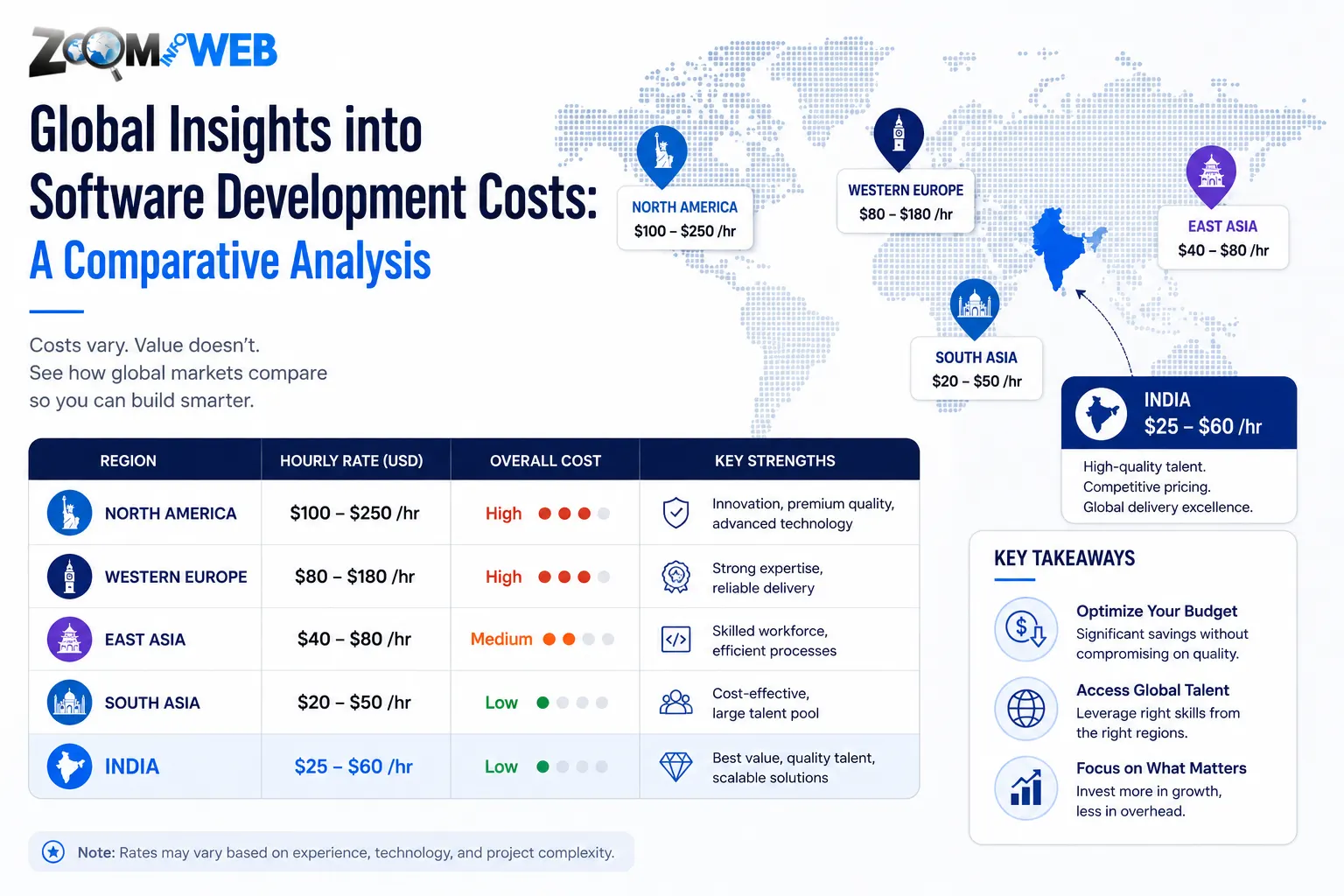
Ask ten business owners about software development costs, and you’ll get ten wildly different answers — anywhere from “$5,000 for a simple app” to “$2 million for an enterprise platform.” Both can be right. And this is why so many projects run over budget, over time, or both.
Software development costs are inherently variable. They are influenced by numerous factors, including, but not limited to, location, scope, staffing, stack, and several other factors most of the time estimators conveniently ignore.
This guide solves that. After reading, you’ll understand:
- The factors driving software development costs in 2026
- The real hourly rates for 12+ countries
- The cost of software development for different project types (MVP versus an enterprise application)
- The hidden costs of software development that inflate 80% of software budgets
- The way AI tools initiate the development of software and impact the costs of development
- The costs associated with developing the software in-house, outsourcing the project, or the combination of both
What Drives Software Development Costs?
To budget accurately, you need to understand cost drivers such as scope and team size in greater detail.
1. Nature of the Work and the Features Involved
This is the largest cost driver of the three. A basic business website offering a handful of standard pages sits on an entirely different level than a healthcare SaaS platform that meets the requirements of HIPAA, provides data that is automatically synced in real time, and includes a proprietary AI tool for guidance. The complexity and scope of your project determines how expensive and time consuming your project will be.
As a quick reference, every additional integration (a payment portal, a third party API, or syncing a CRM) costs an additional 40 to 120 hours of development time.
2. Choice of Technologies
The selection of a programming language and framework, a database, and a cloud platform can all impact cost considerably. Certain combinations may require more expensive, specialized skills, while others may create the potential for a large, fast developer hiring pool due to lower development costs.
- React + Node.js: large talent pool, moderate cost
- Swift/Kotlin (native mobile): smaller pool, higher rates
- Python + Django (AI/ML apps): in-demand, elevated rates in 2026
- Legacy stacks (COBOL, older Java EE): scarcity premium applies
3. Team Location and Hiring Model
This is where the greatest cost variation is most apparent. In the case of a senior developer, you will pay $150 to $200/hour in San Francisco. An equally-skilled developer in Bangalore or Warsaw would charge $25 to $60/hour and would deliver similarly skilled work. We will elaborate on this in greater detail.
4. Development Methodology
Choosing Agile vs. Waterfall is more than a method. It applies to budgets. Agile’s iterative sprints are more cost-effective because blunders are caught before they get worse. Waterfall is rigid, and discovering problems later in the process may require going back and rebuilding weeks worth of prior work. With all things considered, Agile is going to be the lower cost and lower risk approach.
5. Team Composition
A solo freelancer is cheaper, but they often don’t have the skills necessary to meet the demands of a complex project. An in-house team is more expensive, but you get control, and it’s flexible. A specialized software agency is a good option because you get full stack expertise, but it gets expensive. Your choice depends on your timeline, your support needs, and how sensitive your IP is.
6. Post-Launch Requirements
A lot of people don’t plan for this. Things like maintenance or the cost of scaling the server and adding more features can run you 25% of the original cost. You need to plan for the entire project, not just the launch.
Software Development Hourly Rates by Country (2026)
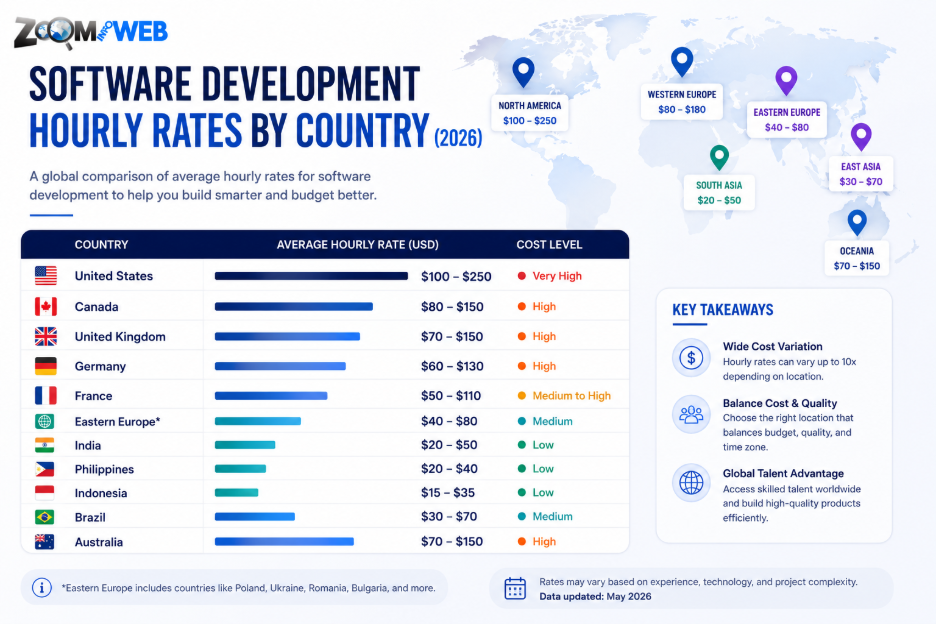
Based on data from markets, this is the most thorough rate table from country to country.
| Country | Junior Dev ($/hr) | Mid-Level Dev ($/hr) | Senior Dev ($/hr) | Typical Time Zone |
| 🇺🇸 USA | $75–$100 | $120–$160 | $160–$220 | EST / PST |
| 🇬🇧 GBR | $60–$90 | $100–$140 | $140–$200 | GMT |
| 🇩🇪 DEU | $55–$80 | $90–$130 | $130–$190 | CET |
| 🇦🇺 AUS | $60–$85 | $95–$135 | $140–$190 | AEST |
| 🇨🇦 CAN | $55–$80 | $95–$130 | $130–$175 | EST / PST |
| 🇵🇱 POL | $30–$50 | $50–$80 | $80–$120 | CET |
| 🇺🇦 UKR | $25–$45 | $45–$75 | $70–$110 | EET |
| 🇷🇴 ROU | $25–$45 | $45–$75 | $70–$105 | EET |
| 🇮🇳 IND | $15–$30 | $25–$55 | $45–$80 | IST |
| 🇵🇭 PHL | $15–$28 | $25–$45 | $40–$65 | PHT |
| 🇧🇷 BRA | $25–$45 | $45–$75 | $65–$100 | BRT |
| 🇲🇽 MEX | $25–$45 | $45–$75 | $65–$95 | CST |
| 🇻🇳 VNM | $15–$28 | $25–$45 | $40–$65 | ICT |
Key Takeaway: India and Southeast Asia offer the most attractive pricing. Eastern Europe, especially Poland and Romania, is a “nearshore” middle ground with favorable time zone proximity for European clients. Latin America’s price offerings (including Brazil and Mexico) have made them increasingly competitive as well.
Software Development Cost by Project Type
Basic Business Website
- Scope: 5–10 pages, contact page, simple CMS
- Projected Work: 80–200 hours
- Price Range: $2,000 – $15,000
- Best Model: Freelance or small team
Custom Web Application
- Scope: User log-in, dashboard, database, 3–5 primary features
- Projected Work: 500–1,500 hours
- Price Range: $25,000 – $120,000
- Best Model: A specialized agency or a dedicated team
Mobile Application (iOS and Android)
- Scope: Basic interface, backend with API, standard UI, and simple integrations
- Projected Work: 800–2,500 hours
- Price Range: $40,000 – $200,000
- Best Model: A specialized agency that deals with mobile apps
Minimum Viable Product (MVP)
- Scope: Core features for initial market launch
- Work Hours: 400–1,000 hours
- Price Range: $20,000 – $80,000
- Best Guidance: Focus on narrowing down scope to a single core feature to excel at
E-Commerce Site
- Scope: Shopping cart, product listing, payment processing, order management, admin features
- Work Hours: 600–2,000 hours
- Price Range: $30,000 – $150,000+
- Best Model: Specialized e-commerce agency
Enterprise Software / SaaS
- Scope: Multi-tenant software, sophisticated access controls, business metrics, API, and other services to meet legal and regulatory obligations
- Work Hours: 3,000–10,000 hours
- Price Range: $150,000 – $1,000,000+
- Best Model: Dedicated full-time team in collaboration with a specialized agency
AI Application
- Scope: Custom ML models and pipelines, training and inference backend services
- Work Hours: 1,500–8,000 hours
- Price Range: $80,000 – $500,000+
- Note: AI technology with routines like Large Language Models and other pre-trained models can greatly cut expenses at this level, but building custom AI solutions will still require a significant level of expertise.
Hidden Costs
Projects inevitably overspend due to the costs beyond the visible construction costs, often referred to as the iceberg principle. Below is a description of costs that go unnoticed and how to budget for them.
1. Unmanaged Changes (Scope Creep)
Research indicates that anywhere from 50% to 80% of software projects have unmanaged changes. Modifications made during a sprint are 3 to 5 times more costly to implement than if the change requests were made during the initial project. The solution is to ensure all aspects of the project were accounted for before development.
2. Fee for Third-Party Services
Services such as payment gateways, APIs, and mapping services all have licensing costs. For example, integrating payment systems via Stripe is free to develop, but costs 2.9% + $0.30 for each payment processed. Always account for the ongoing costs created by each third-party service.
3. Hosting and Infrastructure Costs
Your services and your costs scale the same way cloud usage does when using AWS, GCP, or Azure. The hosting fees for a simple application are about $50/month, but a larger high-traffic application can dramatically rise to $5,000–$50,000/month. The answer is to design your application to be as efficient as possible from day one.
4. QA and Testing Costs
Quality assurance is consistently cut from development budgets and consistently regretted, as development defects discovered in production are about 10 times more costly to resolve. It is recommended to budget 15% to 20% of the total development budget to QA.
5. Security and Compliance
GDPR, HIPAA, PCI-DSS, and SOC 2 regulations don’t make compliance optional across different industries and regions. Testing, auditing security, and obtaining certificates of compliance can cost a project $10,000 to $100,000. It’s better to arrange a budget for compliance from the onset, or pay for it afterwards to mitigate the damage caused by a security breach.
6. Maintenance and Updates
The annual cost of maintaining an application is usually 15–25% of the total cost of building it. In addition to routine maintenance, new OS updates, security upgrades, and new features requested by users will be required. It will cost between $15,000 and $25,000 annually to maintain a $100,000 project.
7. Knowledge Transfer and Documentation
If you switch vendors in the future or hire internal developers, you will pay a hefty price to understand undocumented code. Treating technical documentation as a deliverable — not an afterthought — is essential.
The Impact of AI on Software Development Costs in 2026
This is the section where most cost guides published prior to 2024 are most limited. AI-assisted development has significantly influenced cost structures in the industry.
Where AI Has a Cost Advantage
AI-assisted development tools like GitHub Copilot, Amazon CodeWhisperer, and Cursor allow developers’ productivity to increase by 20–40% and save time on routine tasks. For less complex projects, timelines and budgets become more manageable.
The cost of manual quality assurance also becomes more manageable due to the ability of AI to generate test cases and identify edge cases.
You don’t have to build out AI functionality from scratch anymore. Thanks to pre-trained AI models and various APIs like OpenAI, Anthropic, and Google Gemini, the deployment of features like chatbots, summarization, and image recognition is massively cheaper than it was in 2022.
Where AI Increases Costs
- Complexity of AI Integration — While cheaper than model building, AI APIs are complex. Proper integration (e.g., prompt engineering, rate limit handling, fallbacks) requires senior-level expertise.
- Data Infrastructure — Custom AI requires clean training data, which often demands substantial engineering work.
- AI Expertise Premium — AI and ML skills are highly in demand. Senior AI developers command rates that are 30–50% higher than other senior developers.
The cost to build standard business applications is 15–25% lower due to AI integration. The premium expertise for AI-native applications, however, keeps costs elevated.
In-House vs. Outsourcing vs. Hybrid: The Real Cost Comparison
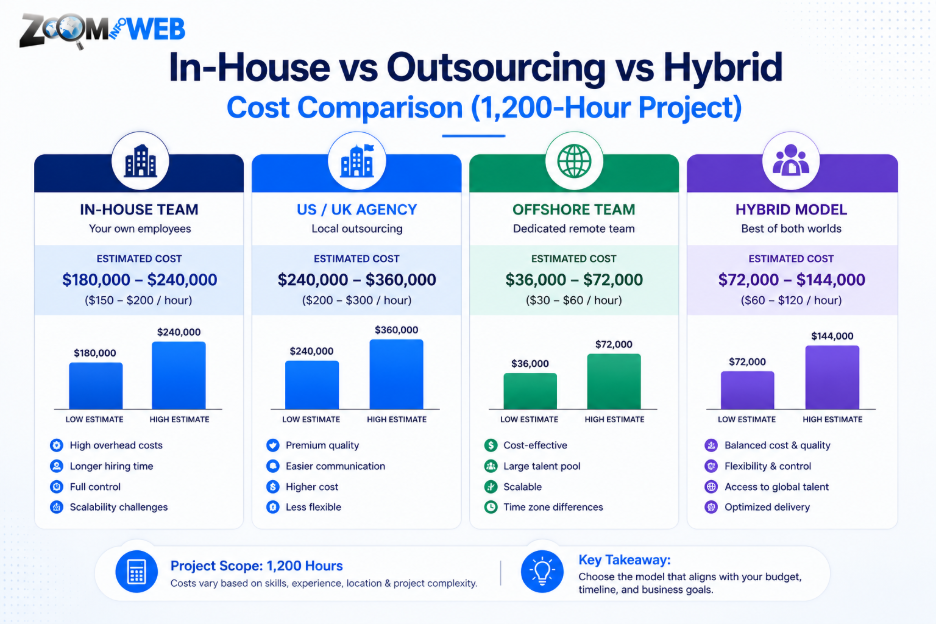
There is more to this decision than a simple pros/cons list. Here is a cost modeling framework for developing a mid-complexity web application at 1,200 work hours.
Option A — Building an In-House Team
Two developers are hired at $130,000 each, totaling $260,000 annually. After accounting for benefits, taxes, and equipment (adding 30%), the cost is $338,000 annually. Because the developers are not exclusively focused on this project, the effective cost for 1,200 hours of work is approximately $160,000 to $200,000. Hiring also takes 2–4 months, with long-term overhead costs.
Option B — Utilizing a US/UK Agency
The blended hourly rate of $140 for 1,200 hours amounts to $168,000. Adding project management overhead of 10–15% results in a total of approximately $185,000 to $195,000. Although this option starts fast, there will be high costs for every phase of the project, including the simpler ones.
Option C — Offshore Outsourcing (India-Based Agency)
The blended rate of $40/hour for 1,200 hours amounts to $48,000. After accounting for a communication buffer and oversight, total costs land in the $55,000 to $70,000 range. This option requires you to provide clear specifications and firm project management.
Option D — The Hybrid Model
Engineering costs range from $35 to $50/hour, while project management costs range from $80 to $100/hour, resulting in a total of $50,000 to $65,000. This option combines cost-efficiency with effective communication. The hybrid model consistently provides the greatest cost-to-quality ratio for companies that do not require constant real-time collaboration.
Evaluating a Software Development Quote
When reviewing a quote for a software project, consider more than just the total cost. Experienced project managers focus on:
✅ Is the scope clearly defined? A good quote will break costs down into individual components rather than broad phases. “Frontend development” tells you nothing. A breakdown of specific features and estimated hours tells you everything.
✅ Are discovery and design included? Be cautious of quotes that jump straight to development. The discovery phase sets the boundary for project scope by including requirements, wireframes, and technical architecture. Skipping it is how scope creep starts.
✅ What is the QA allocation? If QA is less than 15% of the quoted hours, ask why. Insufficiently allocated QA is a concern.
✅ Are third-party licenses and infrastructure costs separated? Quotes should separate developer hours from operational costs. A quote that bundles both does not show the true operational costs that will occur post-release.
✅ What are the payment milestones tied to? Payment milestones should be linked to deliverables (e.g., prototype complete, backend APIs tested, UAT passed), not arbitrary dates.
✅ What does post-launch support look like? Obtain maintenance and support terms prior to signing. What is the SLA for critical bug fixes? What is the monthly retainer for ongoing work?
Effective Budget Management Solutions
Invest in a Discovery Sprint
Investing $5,000–$15,000 in a 2–4 week discovery sprint prior to full development will yield detailed requirements, technical architecture, wireframes, and realistic project estimates. This investment prevents the most common reason for blown budgets — underspecified requirements.
Build an MVP and Iterate
An expensive, fully featured product build is the natural instinct but also the most risky. A minimum viable product that addresses the core user problem is the most valuable first product. Release it to users, then continue development based on their feedback.
Hold 15% of Your Total Budget as a Contingency Reserve
A lot can disrupt even the best-planned software project — a competitor launches a similar feature, a crucial integration proves more complex than anticipated, or a team member leaves. Allocate 15% of the budget as an unallocated contingency reserve.
Use Time-and-Material for Exploratory Work, Fixed-Price for Defined Scope
A fixed-price contract works well for features with well-defined scope and clear acceptance criteria. For research and development, AI testing, or phases where requirements are still evolving, use time-and-material contracts to avoid paying a premium for certainty you don’t yet have.
Review Burn Rate Weekly Instead of Monthly
By the time monthly reports are released, you will likely have already lost four weeks of runway. Conducting weekly burn rate reviews allows you to detect and address deviations from the plan before they compound.
Why India Remains the World’s Premier Software Outsourcing Location
India’s longstanding status as the top software outsourcing destination can be attributed to structural factors.
- Engineering Graduates: Over one million engineering graduates are produced in India annually, creating a strong and robust base of software programmers for the global market.
- Native Communication: India’s excellent command of English positions it above most other non-native English-speaking countries, greatly reducing communication friction.
- Geographical Advantage: India Standard Time (IST) is UTC+5:30, meaning Indian teams can overlap with European partners in the morning and U.S. East Coast partners in the evening.
- Mature Ecosystem: India’s entry into the global market in the 1990s gave it decades to develop robust project management processes and client engagement practices at scale.
- Cost Advantage: Indian developers are 60–75% cheaper than US and UK developers, and at the upper tier, there is no quality discrepancy.
Key Consideration: Quality is inconsistent. The Indian software market is a stark juxtaposition of world-class teams servicing Fortune 500 companies and low-end teams competing exclusively on price. Rigorous due diligence, portfolio review, client reference checks, and technical vetting are non-negotiable.
How to Make the Best Decision for Your Project
Use this framework to guide your sourcing decision:
Choose In-House if:
- You’re developing a system integral to your business that provides a key competitive advantage
- You need additional flexibility and ongoing refinement
- Maintaining confidentiality of proprietary information is a top priority
- You’re prepared to commit to long-term team investment
Choose an Offshore Agency if:
- Your project scope can be clearly defined upfront
- Speed to market is critical and cost is a concern
- You’re comfortable defining project scope and can successfully lead a remote team
Choose a Hybrid Model if:
- You want to strike the most effective balance between cost and quality
- Ongoing development is needed after your application goes live
- Your product warrants advanced design and development expertise
- Your platform needs to be extended over time with development across multiple areas
Frequently Asked Questions
What is the cost to build a software application in 2026?
Applications range from $5,000 for a simple application to more than $1,000,000 for a large enterprise platform. Typically, an application with moderate complexity and five to eight core features will cost between $40,000 and $120,000 to build. A mobile application will cost more than $40,000 to build on a single platform and likely $60,000+.
Is software development cheaper in India?
Yes, significantly. Development agencies in India charge, on average, between $25 and $80 per hour for their most senior developers, compared to an average of $130 to $200 in the U.S. For a typical project requiring 1,200 hours of development, the cost differential can be more than $120,000. That said, do not select an offshore agency based solely on cost — quality matters.
What is the best outsourcing software development model?
For most organizations, the best outsourcing model is a hybrid model where engineering resources develop the software offshore and project managers work onshore in a bilingual capacity. For clearly defined projects that don’t require much client collaboration, an offshore-only model is viable. An onshore-only model is best when Agile practices and IP-sensitive work require constant client involvement.
How do I keep my software project from going over budget?
The three best practices are: (1) invest in thorough discovery to define scope precisely before development begins, (2) hold a 15% contingency reserve, and (3) review the burn rate weekly instead of waiting for monthly reports. The biggest contributor to cost overruns is scope creep — combat it with change request protocols that require pricing approval before any change is granted.
What is the impact of AI on software development costs?
For standard business software, total project costs are typically reduced by 15–25% as a result of AI-assisted code generation. However, this saving is partially offset by the premium rates commanded by AI developers on higher-complexity projects. The tools are cheaper, but the quality of the developer team remains the most important factor.
How should I budget for software maintenance?
Plan for 15–25% of your initial development cost annually. A $100,000 piece of software will typically cost $15,000–$25,000 per year to update and maintain. Factor this into your business case from the very beginning.
Conclusion: Spend Smarter, Not Less
For software development, cost optimization means something different than finding the cheapest developers. It means working with the right team, being intentional about what you want from your software, and managing your funds properly throughout the build.
The businesses that get the most value from software development are not the most spend-thrifty. They are the most judicious with their funds, choose partners who best balance quality and efficiency, and keep developing their product iteratively rather than trying to get everything perfect the first time.
We offer a free 30-minute consultation where we’ll review your requirements, recommend the right development approach, and provide a realistic cost estimate, no obligations, no sales pressure.
Or explore our services:
ABOUT THE AUTHOR
content written by — Saurabh Sharma
Saurabh is part of the expert content marketing team at ZoomIntoWeb. He has expertise in curating meaningful information that can be used by visitors in general. Saurabh is also involved in creating client-specific stories and blogs.
