
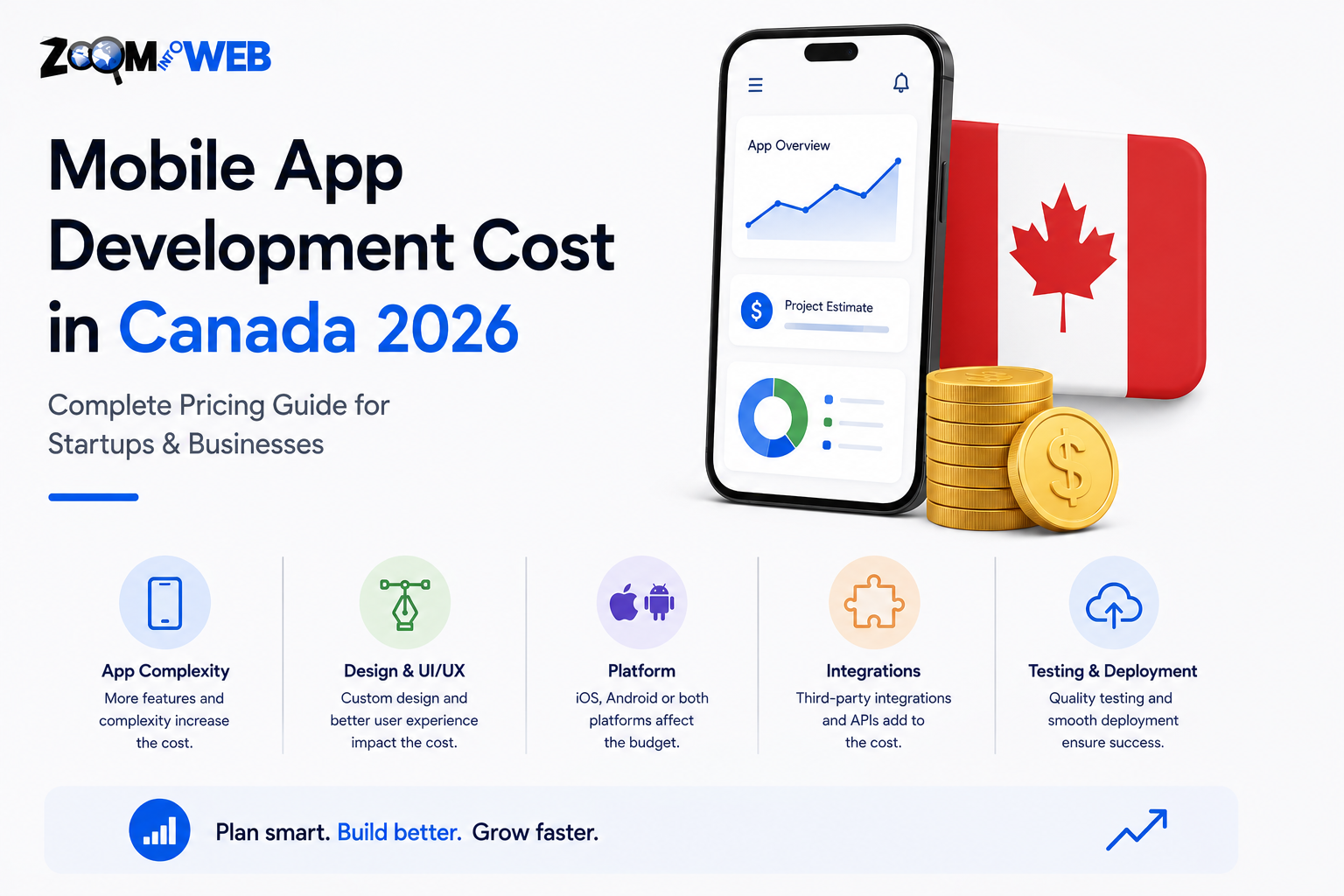
Creating an app in Canada can become a good way for entrepreneurs to invest money wisely and earn profits. However, prior to starting the development process, there are several questions that need to be answered. The most frequently asked question is, “How much does it cost to create a mobile app in Canada?”
There is no fixed price. Everything depends on many aspects such as the complexity of the project, its features, platforms on which it will work, user interface and user experience, backend solutions, integrations, and many other things.
The cost of creating an app can differ drastically depending on whether it is a simple app, a marketplace, an on-demand platform, or any other advanced solution. In our guide, we will talk about main aspects influencing the cost of creating apps in Canada in 2026.
How Much Does Mobile App Development Cost in Canada?
As a general planning framework, Canadian businesses can expect app development budgets to fall into these broad ranges:
| App Type | Typical Budget Range |
| Basic app / MVP | $15,000–$40,000+ CAD |
| Business or service app | $40,000–$80,000+ CAD |
| Marketplace / on-demand app | $75,000–$150,000+ CAD |
| Enterprise / advanced AI app | $100,000–$250,000+ CAD |
These are planning ranges, not fixed quotes. The actual cost can be lower or considerably higher depending on the scope, technology, integrations, and development team.
For example, an MVP with five simple screens is very different from an app that requires payments, real-time chat, GPS tracking, multiple user roles, and an administration panel.
Key Factors That Affect Mobile App Development Costs
1. Complexity of Application
The complexity of the application is one of the main cost influencers.
A simple app with minimum functionality and a small backend means lower efforts on design, development, and testing. More advanced applications may need several types of users, real-time interaction, advanced workflows, dashboards, and complex business logic.
2. iOS, Android or Both
Development for iOS and Android at once may mean additional efforts on development and testing, especially if there is a need to develop two separate native applications.
Frameworks like Flutter or React Native will help companies to reuse much of their code base for different platforms.
3. UI/UX Design
A plain and clear interface that is created using an already existing design system will be cheaper than a completely custom one.
Custom branding, prototyping, animation, interaction, accessibility, and usability testing might drive up the cost of the design but, at the same time, make the product better for the users.
4. Features and Functionality
The set of features that you include in your first product version will affect the budget greatly.
Some of the most common costly features are the following:
- User registration and profile management
- Payment systems
- Push notifications
- Geolocation/GPS
- Booking systems
- Chat in real-time
- Search and filters
- Admin panels
- Social logins
- AI-driven features
And many others.
5. Server Side, Database, and Integration
The mobile application is not only about what users see when they open it on their devices. There are many applications that need servers, databases, APIs, authentication, analytics, and integration with third-party services.
Payment gateways, CRM solutions, Google Maps integration, messengers, analytics, etc. can make the application develop longer and increase its operational expenses.
6. Security and Compliance Issues
Applications with sensitive data—either financial or medical—will need extra consideration of authentication issues, encryption, permissions, data storage, etc.
Your application works within a particular industry; you might have some compliance-related development work.
Mobile App Development Cost by Project Type
The most accurate way of estimating the budget would be based on what you need from the app.
Basic or MVP apps aim at proving ideas or solving a particular problem. These apps tend to have only a few screens and have fairly basic functionality.
Apps that are used by business owners have more features such as accounts, databases, booking or payment systems, notifications, and the administrator interface. Therefore, these apps tend to be larger than MVP apps.
Marketplace or on-demand apps tend to be larger because they have to accommodate several different users with different roles and features like payments, messaging capabilities, and real-time updates.
Enterprise and AI-powered apps may cost quite a bit of money due to integration and AI models involved.
Development Team: Freelancer vs. Agency vs. In-House
Also, who develops your application impacts the overall price.
Individuals could make good candidates if you have a limited and clear project. In the beginning, their prices might be more attractive, yet an individual developer will not cover the whole spectrum of the development process.
Development firms offer wider team resources within a framework of a single project. It could come in handy if your application requires UI/UX design, development, QA, backend development, and support. That’s exactly what Zoom Into Web does.
On the one hand, in-house teams give companies full control over the development process; on the other hand, they require constant salary costs and other expenses such as recruitment of developers, designers, QA experts, project managers, and technical leads.
That is why the most attractive quote does not necessarily guarantee you the most budget-friendly solution.
Native vs. Cross-Platform App Development
The chosen technology can impact your budget too.
Native development means that you will develop separate apps for iOS and Android. It guarantees great performance and full utilization of platform-specific features, but it also involves higher expenses due to having two different codebases.
Cross-platform development allows developers to use the same code on various platforms. Such an approach is a good balance of price, performance, and speed of development for many startups and businesses.
No-code and low-code platforms can work well for prototyping and building internal tools. However, they might not be enough when it comes to customization or advanced integrations.
The best solution depends on your product, not only on which technology is cheaper.
Additional Costs After Launch
The budget for the first development is only a part of the total ownership cost of your application.
Other items to be included in the budget may include:
- Hosting/cloud service
- Fixes for bugs
- Security updates
- Updates to OS compatibility
- Changes in third-party APIs
- Requirements of the App Store/Google Play
- Performance monitoring
- Updates to features and improvements
The cost of publishing also has platform-specific costs. At present, Apple charges $99 annually for its Apple Developer Program, and Google Play has a one-time registration fee of $25 for a Google Play Console developer account.
A separate budget must be made for the maintenance cost of the application, as it depends on the complexity of the application.
How to Keep Your App Development Budget Under Control
A realistic budget begins with a clear scope.
Before sending out requests for quotation:
- Define the core goal of the application.
- Prepare a list of features necessary for the first version of the application.
- Choose either iOS or Android or both.
- Identify necessary integrations.
- Decide on the need for a custom backend.
- Set security and compliance requirements.
- Get detailed estimates from several development teams.
- Compare what is covered by each estimate and what is not.
Most importantly, distinguish must-have MVP features from features that can be implemented in the future. Attempting to implement all features in version one might significantly raise the price of development and prove useless.
How Zoom Into Web Prices Mobile App Projects
At Zoom Into Web, we begin our process with defining the business goal, target users, functionality, technical requirements, and budget of the application.
Unlike traditional methods where an application is considered a single piece of development, we split the development process into logical steps and estimate effort required for each step. In this way, we make sure that businesses will see where their money goes and where they can trim the scope.
Our goal is not just developing an app but rather setting a realistic scope of the development process.
FAQs About Mobile App Development Cost in Canada
What would be the approximate price for a simple app in Canada?
The price of a simple app or MVP may vary from $15,000-$40,000 CAD, depending on different features of the app.
Which option is more affordable—freelancers or an agency?
Freelancers tend to charge less upfront, whereas agencies offer a more diverse range of expertise. The decision depends on the complexity of the app and further maintenance of the app.
What is the duration of the mobile app development process?
Depending on whether the application is simple or rich in features, it can take anywhere between a few weeks and several months.
Should I go for iOS, Android, or both?
Consider your target audience and business objectives. If you require both operating systems within your budget, cross-platform development may be the way to go.
Does the development cost include maintenance?
Maintenance cost is generally quoted separately. It can consist of things like hosting, bug fixing, updates, compatibility, third-party integrations, and other things.
Final Verdict
The cost of creating a mobile app varies in Canada because the total cost will depend on the app itself and what features you need for it.
The best strategy for staying within budget would be to determine the scope of the project before development begins and choose the right proposals for implementation along with post-launch support.
If you are going to create a mobile app and want to have a more accurate estimate of the cost of your project, Zoom Into Web can offer you a free discovery session for discussion and estimation of your project.
Written by the Zoom Into Web Team
This content was written by the Zoom Into Web team, combining hands-on experience in web development, software solutions, and digital marketing. We create accurate, practical, and up-to-date content to help businesses make informed technology decisions.

Comments are closed