
Developing a web app requires more than just a good concept. Before you start developing an application, you should know what your project looks like, what degree of complexity it has, and how expensive it is expected to be. An approximate calculation performed from a brief description of your project could fail to take into account such important aspects of an app as user authentication, administrative features, third-party services, testing, security, and maintenance.
When it comes to estimating the cost of your future web application at Zoom Into Web, we consider a lot of factors that cannot be seen by an end-user but might greatly impact the budget of your app.
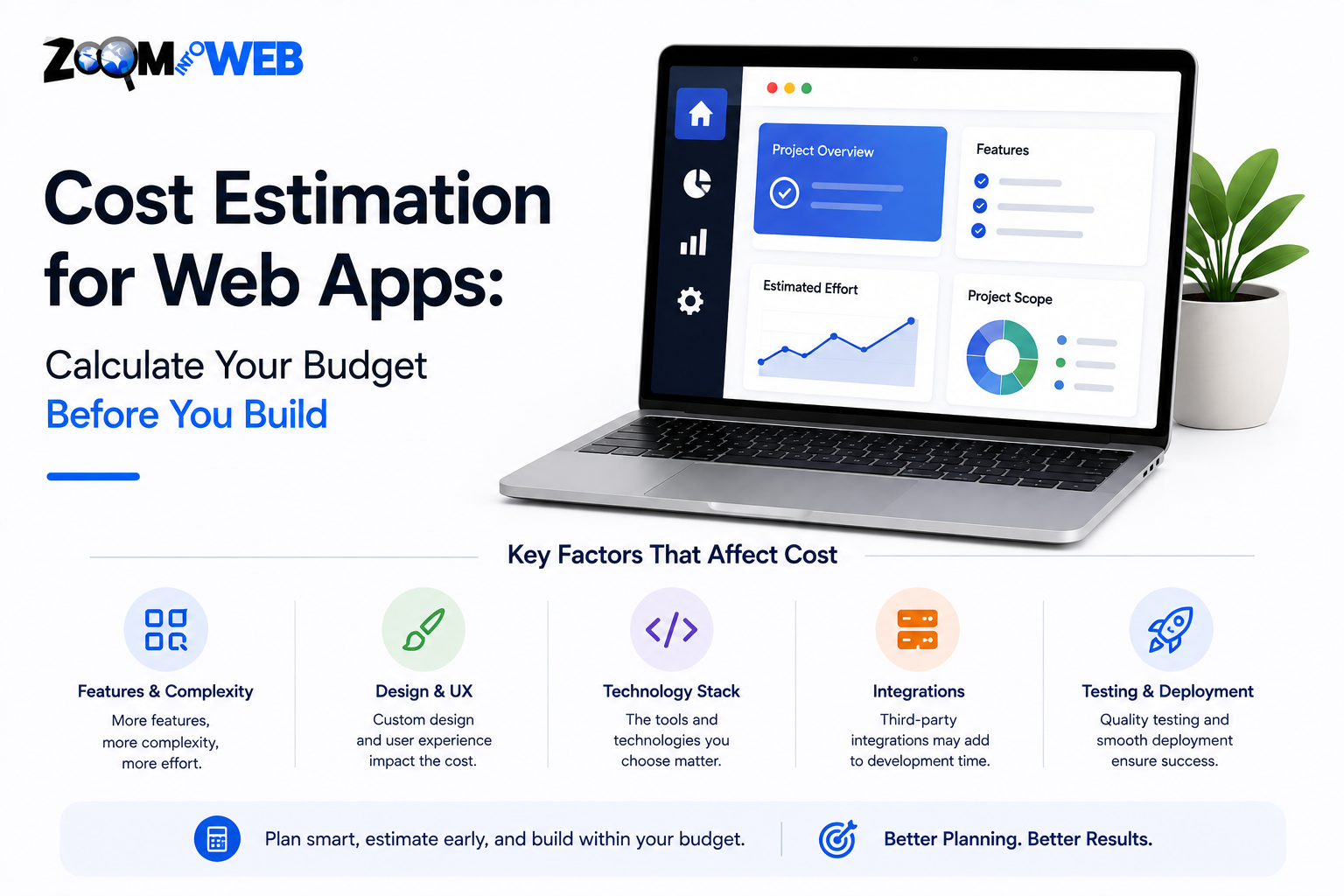
“Cost Estimation for Web Apps” depends on the technology stack, number of user roles, design, backend complexity, integrations, scalability, and time required for development. Analyzing these factors upfront allows identifying hidden costs and investing wisely.
Regardless of whether you want to develop an MVP, a customer-focused platform, or a complex SaaS product, knowing its cost in advance can be very helpful.
An estimate is an early, scope-flexible prediction made before requirements are finalized. A quote is a fixed price tied to an agreed-upon, defined scope—usually only possible after a discovery phase.
What Cost Estimation for Web Apps Really Means
Cost estimation in web apps refers to the act of predicting how long, costly, technologically intensive, and resource-demanding it is going to be to build a web application given its anticipated scope and needs.
It is not only about pricing an application. Estimating properly requires considering what is going to be developed, how complicated the particular functionality is, what tools are going to be necessary, how much time may be required, and what kind of resources will be required after the application is launched.
Another key point to make here is to distinguish an estimate from a quote. While a quote is typically a set price for a project scope that is clear and agreed upon, an estimate is done early in the process before the project becomes defined and features and functionalities are decided upon.
A well-done estimate gives you a real base to comprehend your possible investment. You can know about costly elements right away, prioritize your wishes, and find out if your first budget fits the project you think of.
So, for instance, a rather easy web application that consists of only several user interfaces needs minimum efforts from developers. But a web app that has different user roles, requires real-time performance, has a payment system, dashboards, APIs, and other complicated backend systems can need many more efforts from developers.
At Zoom Into Web, estimating means making the project clear at this stage. When we divide the project into smaller parts and analyze both obvious and hidden requirements, you get fewer surprises regarding budget, make the right technology choices, and develop the real plan for development.
In general, it does not mean that you have to predict all expenses for developing until you write a single line of code. It means that you will get the picture that allows you to make reliable decisions about project scope, budget, timeline, and priorities.
The Variables That Actually Move Your Price Up or Down
All web app estimations, irrespective of their scope, are determined by the same fundamental factors. If you know them, you can glance at any estimate and instantly see how realistic it is.
The complexity of features. A contact form and a real-time collaborative editor are both “features” but not necessarily comparable.
Design experience. An experienced design system and custom designing of an interface from scratch are two different approaches and hence have different costs. An experienced estimator will always ask which one is required.
Development team structure. A freelance developer, a small studio, and a large company may give very different estimates on the same specification due to differences in overhead and level of expertise.
Technical decision. Some frameworks allow a team to develop fast, while some others need specialized developers, although the product will be similar from a user’s point of view.
Integrations with external vendors. All these services will have their own learning curve, quirks, and sometimes licensing fees to pay.
Regulatory or compliance requirements. If you are dealing with health data, financial data, or any data of EU citizens, there will be some legal constraints, which means more security architecture, more reviews, and possibly some legal advice to account for.
Ongoing support. Post-launch maintenance, monitoring, bug fixes, and continuous improvement take place long after the launch date and should be accounted for from day one.
Industry trend to know about: Among the software purchasers we work with and the entire freelance/agency ecosystem, it seems that there are always just two root causes of budget overruns: scope creep that takes place after the estimation and underestimation of complexity. Neither of these are actually “development” issues. They are both estimation issues.
How to Build an Estimate You Can Trust
Start with writing out the actual feature set, not your dream version. Differentiate the minimum required functionality at launch from additional bells and whistles that would be great to have. Just this one step will do more to protect your budget than anything else here, as unclear scope definition is the most common reason behind inaccurate estimation.
List features in order of their complexity, not in the order of importance. The sign-in screen and the recommendation engine can seem equally “essential” to the entrepreneur, but the difference between their implementation costs can be huge. Rate features as simple, medium, and complex prior to estimation.
Decide whom you want to work with beforehand and price it accordingly. Freelancers, agencies, and in-house developers will all have different approaches towards the estimation of the same feature set, based on their own cost structure, specialization, and risk profile. Determine the pricing model to compare quotes.
Ask for hours per feature, not just an overall number. A total cost in one number will hide how those figures are allocated and make it impossible to reduce the price through eliminating non-critical features.
Factor in design, testing, and coordination in addition to actual build time. Hours for development are merely one step. Interface design, quality assurance, and project management are all distinct processes, and each has its own time considerations. Ignoring this part of the budget in the estimate is another easy way of making estimates that grow silently bigger down the road.
Estimate for what comes after release, not just the release itself. Maintaining a site, monitoring its uptime, security updates, and other small changes are recurring costs, not one-time costs. A budget estimate that stops at “release” is an incomplete estimate.
Add a buffer and expect it as normal. No well-experienced development team does not plan for some amount of scope creep. Planning for it in advance is simply good estimation, not bad project management.
Rule of thumb: budget a 15–20% contingency buffer on top of your initial feature-based estimate. (Placeholder benchmark — replace with a cited or verified figure before publishing.)
How to Build a Realistic Web App Budget
The realistic cost of web app development is supposed to depend on the purposes the application should fulfill, rather than on the number of pages or development team size. The most correct way to set the cost is to split the development process into individual elements and assess how much effort each of them demands.
Identify the Purpose First Find out the main problem your web application is supposed to solve and define its crucial features. This will help distinguish the features that are necessary and those that can wait.
Consider User Roles Think about the people who will use the app and what tasks each category of users will have to perform. Depending on whether you have customers, administrators, employees, vendors, or managers using the application, they might have different dashboards and permissions, and that would complicate the development process.
Divide the Application into Smaller Elements Do not think about the whole web application as one project. Rather, split the application into several smaller parts, including such components as authentication, user profiles, dashboards, payment processing, notifications, reporting, and administration.
Take into Account Non-Development Tasks Design, project management, quality assurance, deployment, security checks, documentation, and post-deployment work might also take up some time and efforts. Neglecting those would make the initial budget lower than the real cost of the project.
Think Ahead About Growth Consider not only the first version of your application but also the possible changes in the future. If the amount of users, transactions, or data is expected to grow in the future, then the application might have to be developed to accommodate those changes. Future requirements might influence the initial development budget.
At Zoom Into Web, our process of estimation allows you to convert the idea into a realistic development project. It would help the business to set realistic budgets for the project at an early stage.
Common Web App Estimation Mistakes That Can Increase Your Budget
Even if a web application estimate looks quite precise, there might be a lot of unknowns that will make development costlier than expected. Often, it’s not about the project getting unexpectedly expensive, but rather the fact that certain aspects weren’t considered while making an estimate in the first place. Being aware of these pitfalls will help you plan your budget realistically.
Estimate: According to a similar app, comparisons to existing applications such as “Our app should be something like Uber” or “It is going to be just like Airbnb” are not sufficient for making an estimate. Even though apps might look similar, their internal architecture, processes, integrations, and security requirements can differ drastically. Make estimates according to your features rather than other apps.
Avoiding Discovery Stage as an Expenditure The discovery process is often seen as unnecessary spending and skipped. In fact, discovery will help you learn the technical requirements, possible risks, user flows, and missing features prior to starting development.
Picking a Vendor Solely on the Basis of Price The lowest price doesn’t always translate to the best value proposition for your business. It could be a result of the exclusion of some critical features or even the process of designing and testing from the calculation. Pay attention to the vendor’s portfolio and previous work as well as their approach to development and their ability to justify the quote.
Not Accounting for Third-Party and Integration Expenses Such items as payment gateways, cloud services, communications, APIs, analytical solutions, and other third-party systems could bring extra expenses for development and ongoing maintenance. They need to be recognized during the estimation process and not brought as an addition to it unexpectedly.
Making the Scope Expand Without End There is nothing that could help a project to exceed the initial budget faster than constant expansion of its scope in the course of the development process. Such changes may influence the design, development, testing, timelines, etc.
At Zoom Into Web, recognizing such challenges early allows a business to start the process of software development with more awareness.
How to Keep Your Web App Budget on Track During Development
While an estimate provides a basis to start off, staying within budget during the entire course of development is key. This is because there might be changes in requirements, technical issues, or additional features that may come up during the course of the product’s development cycle.
Consider early estimates to be ranges. As long as the scope and requirements of the project are not fully established, it’s best to consider your estimates to be ranges that give you space to accommodate the unknowns without setting yourself up for unreasonable expectations.
Communicate New Features or Integrations Promptly Introducing new features, integrations, or other requirements can affect both the cost and the timeline of the project. It is important to make sure your development partner communicates these changes to you as they happen so that you can either continue on with the change, adjust your requirement, or postpone it to the next phase.
Compare Progress Against Estimates at Each Milestone Do not wait until the end of the project to review your spending. Comparing the development effort to your original estimate during each milestone will help you spot any potential budget differences.
Change Log Document important changes to the initial scope in terms of what has been changed, for what reason, and how the estimate was impacted by that change to make sure it is transparent and easier to understand how your project budget changes.
Connect the Budget to Priorities If there happens to be less budget than you initially anticipated, all features do not have to be dropped. Some of the less critical functionality may be deferred to future releases, leaving the core product intact and ready to be developed further.
Frequently Asked Questions
So what is the actual distinction between the estimate and the quote?
The estimate is an early prediction, performed during the definition of the scope and supposed to vary as the scope becomes clear. The quote is the price bound to the defined scope and is possible only after discovery has been performed.
Isn’t it better to pay less money for a freelancer than for an agency?
Yes, indeed, but you should know that an agency includes such aspects in their offer as project management, design, and quality assurance. Therefore, freelancers may charge for these things separately later as rework.
Will a web app cost calculator help me?
Sure, but take it just as an approximation. Calculators on the Internet cannot consider such aspects as feature complexity, integration, and compliance needs.
How long should the discovery phase take for me to get a proper estimate?
This depends on the complexity of the project, but it needs to last as long as needed for you to produce a feature list, a complexity estimate, and a sketch of an architecture, not merely a discussion. Hasty discoveries generally result in the same poor estimate that you were trying to avoid in the first place.
What is the most important thing I can do to increase my estimation accuracy?
Produce your own feature list in clear language prior to talking about prices. The more you know about what you are building, the less room there is for scope creep.
Final Verdict
A budget you can actually trust doesn’t come from a quick calculator or a one-paragraph description sent to a freelancer. “Cost Estimation for Web Apps” comes from a real feature list, an honest complexity assessment, and a team willing to break the figure down instead of handing you a single number and asking you to trust it. Founders who invest the time in proper estimation upfront consistently end up spending less, with fewer surprises, than those who rush to development and figure out the budget as they go.
Want a real, line-item estimate instead of a guess? Zoom Into Web runs a structured discovery and estimation process before any development begins, so you know exactly what you’re funding and why before you commit to a build.
Written by the Zoom Into Web Team This content was written by the Zoom Into Web team, combining hands-on experience in web development, software solutions, and digital marketing. We create accurate, practical, and up-to-date content to help businesses make informed technology decisions.

Comments are closed