
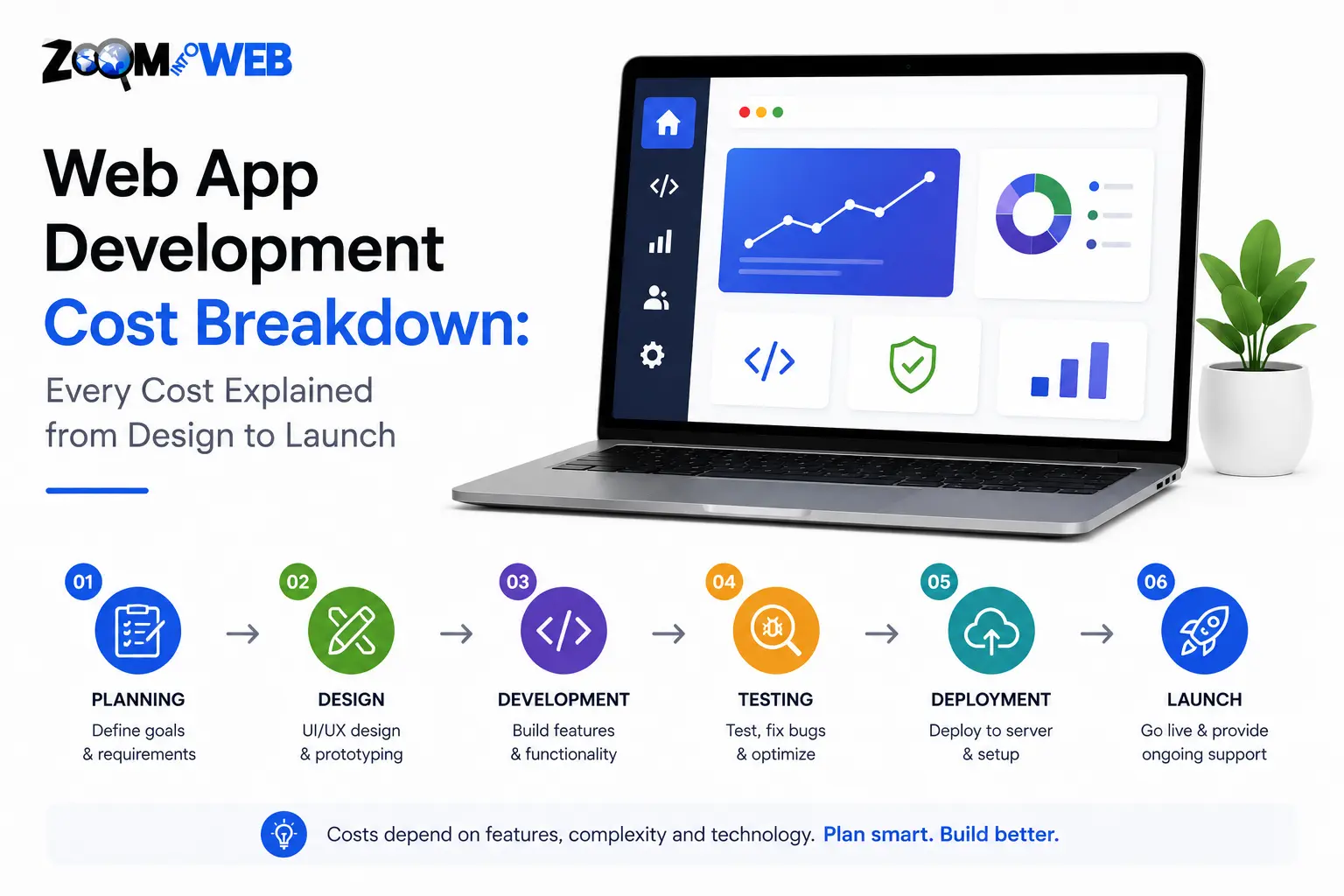
Creation of a web application involves a considerable amount of money, which has to be known before the process is initiated. Although it is assumed that creating a website is the costliest part of it, a web app involves investments throughout all its stages from the research and design of the user interface to development, testing, hosting, security, deployment, and maintenance. Depending on the complexity and features of the app, the cost might vary significantly.
Knowing about the “Web App Development Cost Breakdown” will be useful for businesses, since it helps to make a budget and plan for further expenses, select the most valuable features, etc. Whether it is a simple web application for a business or a complicated web application with multiple features, you will benefit from knowing about the cost breakdown.
At Zoom Into Web, we know that each web application has its own specifications and development requirements. This article provides a detailed cost breakdown of a web application development process from the initial planning and design up to development, testing, launching, and maintenance after the launch. You will learn more about the factors influencing the cost of a web application.
Where the Money Actually Goes: The Full Cost Breakdown
Discovery and Planning
Prior to the beginning of development, there is a need to set up the right direction of the work. In this case, it means analyzing user requirements, defining key features, mapping workflows, identifying data requirements, and choosing proper technical architecture. Adequate planning makes it possible to prevent scope changes and expensive reworks in the future.
UI/UX Design
UI/UX design does not mean only creating an appealing interface. UI/UX design defines the way users would navigate through the application, use the features, and complete tasks. The price can be different depending on the choice between using the existing design system or creating a completely customized interface with unique elements and interactions.
Front-End and Back-End Development
In most cases, development is one of the highest costs during the whole process. While front-end development deals with the part that will be seen and used by users, back-end development deals with databases, business logic, authentication, APIs, and other server-side issues.
Third-Party Integrations
Web applications often have to integrate with other third-party services such as payment gateways, CRMs, messaging apps, calendars, analytics platforms, or other APIs. Each integration will have its own setup, testing, and error-handling process and, in some cases, ongoing subscriptions or fees.
Quality Assurance and Testing
Testing is important to ensure that the application performs as expected on different devices, different browsers, different user paths, and different use cases. Quality assurance will find many functional, usability, security, and performance-related bugs before they affect the user. Testing during development makes debugging much easier.
Deployment and Release
After the application has been developed and tested, there will be a release phase where everything will be set up for production. This includes setting up servers, hosting, domains, SSL certificates, databases, deployments, backups, and monitoring.
Post-launch Hosting and Maintenance
Investments do not stop at launch time. Additional expenses may arise due to hosting, security updates, bug fixes, performance optimization, updates of dependencies, technical support, monitoring, and modifications that need to be made in case third-party services are updated. Such measures will help to ensure the security and stability of the web application.
What Determines the Cost of Web App Development?
The cost of developing a web application is influenced by several factors, and there is no single price that applies to every project. Understanding these factors can help you identify where your budget is likely to go and which areas require the most investment.
- Project Complexity: Building a web application that only has basic functions needs less development work than one with more than one workflow, advanced functions, or business logic.
- User interface/user experience (UI/UX) design: Unique interfaces, interactions, and user experience can make the UI/UX design process a little bit complicated.
- Functionality: Some of the functionalities, such as user accounts, dashboards, search, payments, booking systems, and real-time communications, can impact development.
- Integrations with third parties: Connecting your app to third-party services such as payment gateways, CRM, analytics services, or APIs will require extra development effort.
- Technology stack: The technologies used in the development of the application, like programming languages, frameworks, and databases, could influence development and cost in the future.
- Security considerations: Applications that store any user or company confidential information need some extra security measures and possibly other tasks related to authentication and monitoring.
- Testing and Quality Assurance: Testing in various browsers, devices, roles, and processes can be done in order to detect problems prior to going live but will be an additional development task.
- Hosting and Infrastructure: Hosting on servers with reliable databases, storage, backups, and other infrastructure will be required after the app goes live.
- Maintenance and Updates: Web applications demand continuous maintenance and updates after being deployed.
Ultimately, the more functionality, customization, scalability, and technical complexity a web app requires, the greater the development effort. A clear understanding of these factors can help you prioritize features and build a budget around your actual business needs.
Key Factors That Influence Web App Development Costs
Several factors can significantly affect the overall cost of a web application. Looking beyond the feature list helps you understand why two seemingly similar projects can have very different development budgets.
- Development team and its competence: The experience and skills of the development team, as well as their location, will impact the cost of development. It may seem that experienced developers will be expensive at first, but they will most probably save you money by minimizing rework and reducing the risks of delays during development.
- Project scope and project requirements: Well-defined project requirements help in estimating development costs. Unspecified features, changing requirements, and not all possible user scenarios considered will increase development time.
- Need for custom design: Use of ready-made design solutions makes the design easier, whereas a completely custom interface implies extra effort in research, prototyping, and design.
- Security and compliance requirements: In case you develop applications that process sensitive information about the business or your customers, you need additional authentication, encryption, security, accessibility, and compliance procedures.
- Technologies and infrastructure: The choice of technologies, frameworks, databases, APIs, cloud services, and infrastructure that will host the application can impact the development as well as the ongoing cost.
- Scalability in the future: Should the application be designed to cater to an increasing number of users, transactions, or data, then the application may have to be developed using a scalable architecture from the outset.
- Needs after launch: Development does not necessarily stop after the launch of the web application since maintenance, performance optimization, security patches, and feature development may add to the ongoing cost.
How to Plan Your Web App Development Budget
Prior to embarking on the development process, it is recommended that you allocate different budget items according to the factors that might affect your final investment.
Identify core features: Determine the features your users require and prioritize them before implementing any additional ones.
Choose appropriate technologies: Opt for a technology stack that can satisfy the needs of your application today and tomorrow.
Design considerations: Consider the type of design you need – either a minimalistic approach or a sophisticated design.
Integrations: Take into account any third-party services that may be required, such as payment gateways, APIs, analytics, or CRM systems.
Testing & Security: Allocate funds for quality assurance, data security, and performance testing.
Consideration of additional expenses: Estimate your hosting, maintenance, updates, technical support, and other expenses.
Having a thought-out budget will help you allocate the budget to features that provide real business/user value.
Mistakes That Quietly Inflate a Budget
- Cutting the discovery process to save one week and then having to pay for mid-project reconstruction that ends up costing much more than that one week.
- Thinking of the design as mere decoration rather than a blueprint that dictates the cost of the back end.
- Contracting with no margin of error and viewing all scope changes as an emergency rather than something expected.
- Delaying the choice of integrations until the architecture is set, which assumes something else.
- Choosing a vendor based on hourly rate rather than asking how an estimate on a previous project compared to its actual cost.
How Experienced Teams Keep Costs Under Control
- Require quotes per item, rather than a total package price — someone who can’t justify line-by-line expenses can’t justify line-by-line changes either.
- Build the most minimal version that will actually work, and grow from there based on actual user behavior, not what you expect the founding members to do.
- Use tested building blocks of technology—authentication, user interface libraries, and payment software development kits that have been used and tested successfully elsewhere—rather than building custom technology infrastructure that offers no unique value.
- Select infrastructure that will pay-per-use from the cloud rather than having to guess how much capacity you will need in the future.
- Build a margin of safety into the budget upfront, rather than assuming everything is going according to plan.
Final Verdict
Web application development has no standard cost since it is highly dependent on a number of aspects, including functionality, complexity, design, technologies used, integration, security, and future maintenance, among others. Apart from choosing the lowest quote, a business should consider defining its requirements, proper development, testing, and scalability.
At Zoom Into Web, we enable businesses to convert their vision into functional and user-friendly web applications using proper technologies and development techniques. Whether you want to develop a new web application or update your current one, our team is ready to assist you in defining the requirements and creating the solution.
Ready to start developing your web application? Contact Zoom Into Web and speak to our experts about your project.
FAQs: Web App Development Cost Breakdown
How much does web app development cost?
It all depends on the functionality, complexity, design, technology stack, integration, and development team of the app. The more sophisticated the web app is, the more time and money it requires for its creation.
What does web app development include?
There are a number of things that could be done during the development process, such as planning, designing, front-end and back-end development, database implementation, integration, testing, deployment, etc.
How long does it take to develop a web app?
The duration of the development process depends on how complicated the app is; the more complex the app, the more time it will take.
What are the elements that influence the expenses related to web application development?
The key cost elements comprise such aspects as feature set, design needs, technologies used, third-party services needed, security measures, the team itself, testing processes, hosting services, and maintenance.
Is web application development a process that requires maintenance?
Yes, web applications usually need maintenance once they have been launched.
Written by the Zoom Into Web Team
This content was written by the Zoom Into Web team, combining hands-on experience in web development, software solutions, and digital marketing. We create accurate, practical, and up-to-date content to help businesses make informed technology decisions.

Comments are closed