
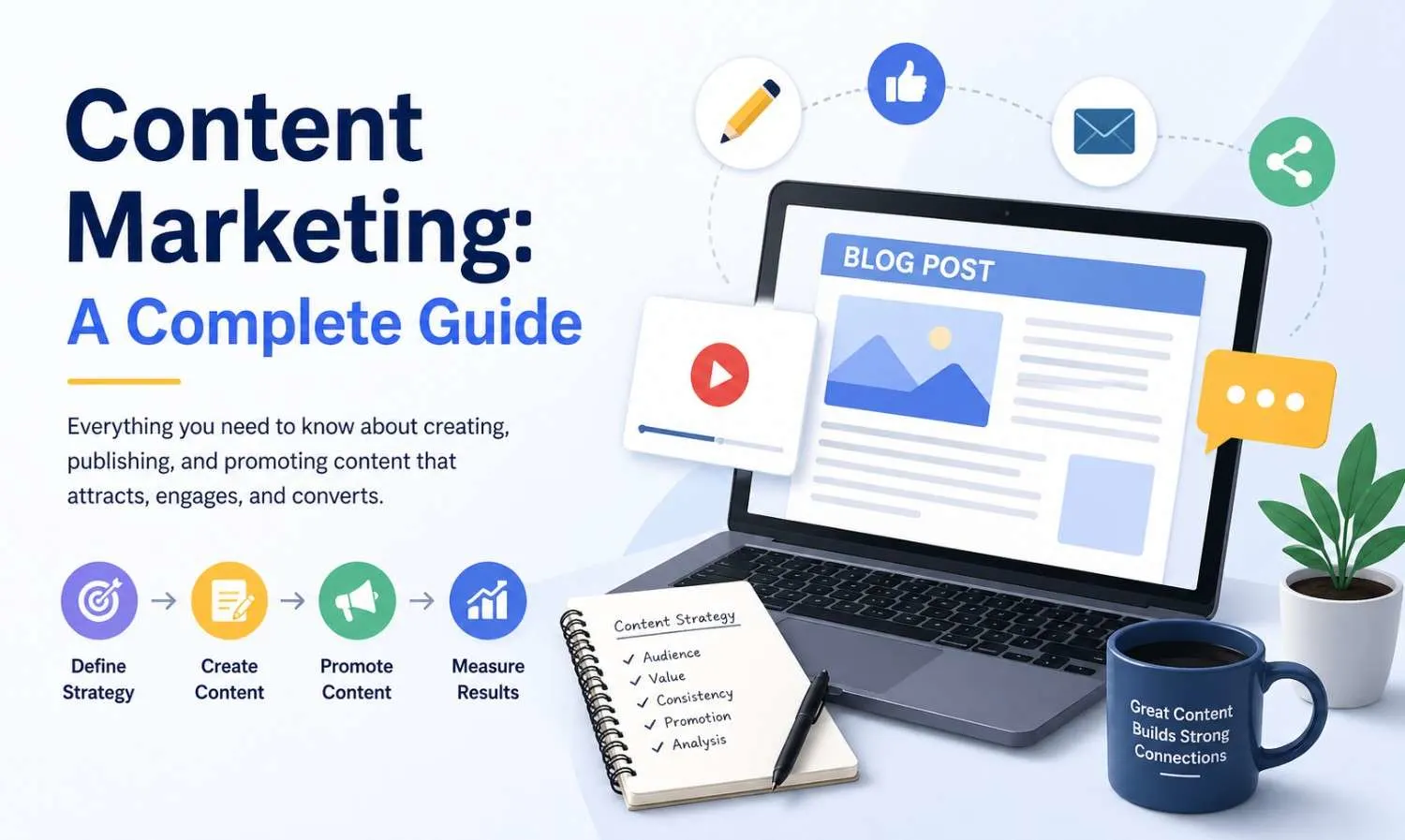
You can’t go five minutes without hearing content marketing. Most people don’t understand it. It focuses on information sharing rather than selling. Blogs, online guides, and tutorials are forms of content marketing.
This guide provides the building blocks for content marketing. Content marketing is valuable information that keeps the audience. Content marketing operates all year unlike traditional advertising, which is seasonal. It focuses on the value of content. First coined in 1996, content marketing is not that new.
To sell, you need to inform the furrow. Trust and information to the audience that is your ideal customer all year without a seasonal or traditional ad.
Content Marketing and Traditional Marketing
Content marketing is often best understood in relation to traditional advertising.
| Traditional Marketing | Content Marketing |
| Approach: Push (interrupt) | Pull (attract) |
| Message: “Buy our product” | “Here’s how to solve your problem” |
| Format: TV ads, cold calls, banners | Blog posts, videos, podcasts, guides |
| Audience relationship: One-way broadcast | Two-way, ongoing relationship |
| Lifespan: Short (campaign-based) | Long (evergreen content compounds) |
| Cost over time: Increases per impression | Decreases as content builds authority |
| Trust: Low (consumers are skeptical) | High (earned through value) |
Content marketing is an infinite asset, while traditional marketing is finite.
Content Marketing’s Impact
In 2026 and beyond, content marketing is needed, not desired, and here are the reasons companies invest in it:
1. Ads have never been more ineffective
Over 40% of internet users use an ad blocker. Even amongst those that don’t, traditional marketing has a higher incidence of banner blindness (scrolling past an ad) than 80%. With content marketing, you are achieving your goal while the audience is trying to avoid the traditional marketing goal.
2. Ads are a bottomless pit of money, and content marketing is a top of the funnel money maker
Blog posts and lead generation content (offers) don’t just work for a day or a week. Great content is a long-term asset that works for years and years. Content marketing is 434% more effective than traditional marketing. That’s fortunate!
3. Ads erode trust, and content marketing builds trust
A higher level of trust will mean more sales and higher margins.
4. It energizes SEO
Search engines prioritize pages that answer consumer questions. Content marketing and SEO go hand in hand. Every piece of written content can increase the likelihood of your target customers discovering your site in search engine results.
5. It’s budget-friendly
Demand Metric suggests that content marketing is 62% cheaper compared to traditional marketing and helps generate three times more leads.
6. It complements every phase of the customer journey
From someone discovering you for the very first time to a potential customer that’s in the final decision-making process of selecting a product, content marketing is applicable for every phase.
What Are the Mechanisms of Content Marketing?
Content marketing aims to ‘synchronize’ the types of information and content each prospective customer receives at any step on their individual customer journey, also referred to as the buyer funnel:
🔵 Awareness Stage (Top of Funnel — TOFU)
This is the segment of the customer journey in which the prospective buyer has probably not heard of your brand, and they’re looking for information.
Best content: Blog articles, explainer videos, infographics, social media content, pro podcasts.
🟡 Evaluation Stage (Middle of Funnel — MOFU)
This is the segment of the customer journey in which prospective buyers are looking at potential solutions to their problems, including the one your brand is providing.
Best content: Case studies, prospect comparisons, newsletters, digital events, pro podcasts, pro eBooks.
🟢 Purchase Stage (Bottom of Funnel — BOFU)
At this stage of the customer’s journey, the potential buyer does not need any additional information, and they’re looking to make a purchase, brand allegiance, final persuasion, or trust.
Best content: Pro podcasts, brand allegiance, pro product talks, pro product samples, pro samples, and pro white papers.
A proficiently written blog advertising aspect of content marketing can influence all three customer purchasing stages.
Types of Content Marketing
Every audience or business can’t be captured by a unique content format. The best content marketers use a combination of formats. Here are some of the main formats:
1. Blog Posts & Articles
Most content marketing strategies are centered around articles and blog posts. They can provide organic website traffic, position your business as a leader in your industry, and are an integral part of the website’s internal linking strategy. Businesses that blog on a consistent basis acquire 67% more leads as compared to non-blogging businesses.
2. Video Content
Video content is spearheading the fight for the most engaging content format. Whether it is long format content like YouTube tutorials or short-format content like Reels, video content helps to engage the audience on a more personal level and has the ability to communicate complex ideas much more easily and quickly as compared to textual content.
3. Infographics
These formats combine facts and figures to present a visual explanation for data or a process. Infographics are highly shareable. They are good at earning backlinks, breaking the surface of key SEO signals.
4. Podcasts
Targeting a more mobile audience who prefers consumption of audio content, Podcasts create deep consumer loyalty. They are the most personal content format as consumers are more likely to spend a long time with the podcast hosts.
5. eBooks & White Papers
These formats are a combination of long- and short-form formats and usually require the consumer to fill in a couple of form fields as a lead capture. These formats are still of a strategically high value compared to the consumption time. They also create value for the consumer.
6. Email Newsletters
This is the prime example of owned channel marketing. Email newsletters also help to establish and reinforce a cordial relationship with the consumer while driving them to your key website. In comparison, Email marketing has a ROI of £36 for every £1 spent.
7. Case Studies
These formats provide proof of the marketing content claims. Case studies help to show prospective consumers that you have solved their problem in the past. They are very effective at the marketing funnel decision stage.
8. Social Media Content
This format helps to spread and amplify all the nested content. This format increases the total audience engagement and helps to drive traffic to land them on content pieces of great lengths.
9. Webinars & Online Courses
Utilize opinions, facts, or studies to place your business as a subject matter expert, as well as generate interest in potential leads.
10. User-Generated Content (UGC)
From the lens of your existing users, provide candid and genial feedback. This kind of communication is generally considered to be authentic.
Brands That Excel in Content Marketing
Some of the most well-known brands were able to establish themselves as industry leaders using innovative content marketing principles, these are just a few:
- Red Bull—This company began building a well-recognized media company and did so by providing a multitude of extreme sports content. Many of their competitors have missed out on this media marketing vehicle by leading the way with actual product marketing.
- HubSpot—They create virtually their entire business with content marketing using blogs and free content like marketing and sales tools and certifications.
- Mint (Intuit) — Before this service post, this company developed their personal finance and content vertically, and when the service was launched, a robust audience was acquired.
- John Deere—This company’s commitment to educational content began in 1895 with The Furrow and continued with The Furrow. This is one of the most longstanding and effective content marketing campaigns to date.
Step by Step Content Marketing Strategy
Content marketing with effective content is tons of useless noise; help potential customers by providing more of the clarity of voice, and less of the noise. For this purpose, the content marketing framework is very simple:
Step 1: Dimension Your Content Marketing Outcomes
In a\ key measurable way, how will your content marketing impact the marketplace, and how is it correlated to outcome goals such as untracked site traffic, uneventful leads, or dry sales numbers?
Step 2: Know Your Audience
Create a comprehensive profile that embodies your ideal audience member. What issues do they face? What questions do they need answered? What form of content do they lean toward? What are their online habits?
Step 3: Conduct Keyword Research
Utilizing Google Search Console, Ahrefs, or SEMrush, find out about the specific phrases that are typical for your audience’s internet searches. Build content with those queries in mind.
Step 4: Map Content to the Funnel
Content for the awareness, consideration, and decision stages is essential. Many brands are focused primarily on top of the funnel, or TOFU, and neglect the bottom of the funnel, or BOFU, content.
Step 5: Create High-Quality, Authoritative Content
Factual, useful, and thorough content is the goal. For E-E-A-T, or Experience, Expertise, Authoritativeness, and Trustworthiness, Google’s Helpful Content system will reward people-first focused content.
Step 6: Optimize for SEO
Use the principal information in the title, URL, and H1, and include it in the first 100 words and the meta description. Include your related, supporting ideas. Use your internal hyperlinks and schema markup where needed.
Step 7: Distribute & Promote
Once your content is completed, it’s time to showcase it. Promote your social audiences, email audiences, and create various types of content. Seek backlinks to other relevant content.
Step 8: Measure & Iterate
Use Google Analytics 4, along with Google Search console, to measure your success. Continue to strengthen your best content. Your older content should be updated with relevant information and recent data.
Content Marketing Trends for 2026
The progress of content marketing has gained unprecedented momentum in recent years. This is its current state:
Content created using AI is common. Quality subscriptions remain popular. Google’s Natural Language Processing is more advanced than ever. They can more clearly separate AI created content, and content created with people’s profit in mind. With these new developments, original thoughts, anecdotes, and expertise have become critical in staying competitive.
An AI Overview is now the first search result. They’ve now begun to drown out nearly all synthesis summaries. The capture rule for synthesis of summaries is strict. The answer must be direct, the content concise, and it must be optimally structured, like featured snippets.
Video and audio dominate and eclipse the popularity of written content. Due to the shifting priorities of younger generations, podcast and video content must now be adopted, or you will lose relevance with your target customers.
Experience and Expertise or the new E-E-A-T. The new Experience dimension leans toward allowing for more leniency with expertise. It is now more common to see content created with theoretical expertise that leans more toward experiential expertise.
Metrics of Content Marketing with Definitions
Organically Grown Traffic
Involves how high your website ranks in search.
Time on Page
This metric is associated with how useful your audience finds the content.
Page Bounce Rate
This determines how many users immediately leave your website after interacting with your content.
Leads Generated
This tracks the actual revenue a piece of content generates for your business.
Backlinks Earned
This tracks how many times your content is referenced by other content.
Social Shares
Refers to how many times other users post your content to their personal pages.
Conversion Rate
This determines how many users completed the specific actions you wanted.
Return Visitor Rate
This determines how many users return to your website.
Questions Related to Content Marketing
What is the goal of Content Marketing?
Content marketing has 2 goals. The first is to create valuable content for a defined audience. The second is to influence consumer behavior. Content marketing also includes acquiring consumers through an inquiry, conversion, or a purchase.
How is Content Marketing related to Search Marketing?
Search Marketing is a more technical goal. This focuses on the mechanics of search engine optimization. Content marketing is a more strategic goal. This focuses on developing content that is highly sought after. While they are distinct, they are a complement to one another.
Timeframe to See Results of Content Marketing?
Most marketing campaigns, even content campaigns, produce results within 3–6 months. The return on investment to marketing is typically seen within 9–12 months.
What is Content Marketing?
The formal definition of content marketing is a written strategy that lays out the type of content, the audience, the goals and success measures, and all is aligned with the business’s broader goals and publishing schedule and distribution channels.
Is content marketing suitable for small businesses?
Definitely. Content marketing is extremely affordable for small businesses. A single blog post that is well-optimized can bring leads and website visitors for years without the need for paid ads.
How is content marketing different from social media marketing?
Content marketing is a strategy. Social media is an additional channel of content marketing. On the other hand, social media marketing is focused around building an audience and engagement on social media.
What are the three content marketing strategies that are most important?
Based on our analysis, blog posts that are SEO-optimized, regular email newsletters, and video marketing are the most impactful and important content marketing strategies for most businesses.
ABOUT THE AUTHOR
Content written by Saurabh Sharma.
Saurabh Sharma is part of the expert content marketing team at ZoomIntoWeb. He has expertise in curating meaningful information that can be used by visitors in general. Saurabh is also involved in creating client-specific stories and blogs.
