
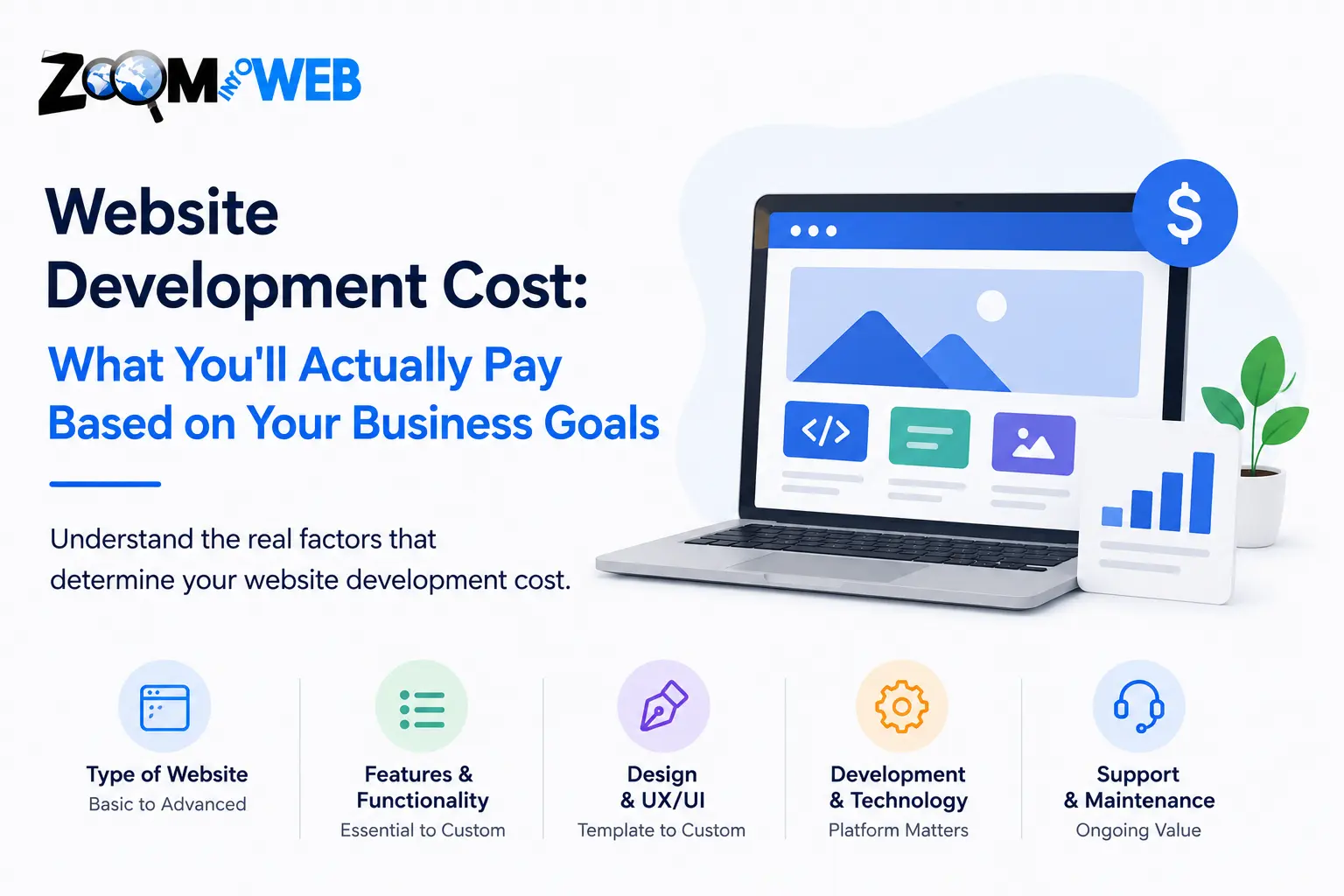
Website development costs can vary significantly, ranging from an affordable DIY website to a fully custom enterprise platform. Most small business websites fall within a moderate and predictable budget range, while e-commerce websites typically require a higher investment due to added functionality. Custom web applications and enterprise platforms sit at the top end of the spectrum because they involve advanced features, integrations, and scalable infrastructure.
Understanding what drives these cost differences is the key to setting a realistic budget. At Zoom Into Web, every project begins with a detailed consultation to evaluate your business goals, required features, growth plans, and technical needs. This ensures you invest in the right solution without paying for functionality you don’t need or overlooking features that will matter as your business grows.
Website Development Cost by Business Goal
The cost and development period of the site depend mainly on the business goals. The easiest solution for a website and the most affordable one is a brochure website or a landing page. Such types of projects are perfect for startups, consultants, and small businesses that need a good online presence.
| Business Goal | Description |
| Brochure website / Landing page | The cost and development period of the site depend mainly on the business goals. The easiest solution for a website and the most affordable one is a brochure website or a landing page. Such types of projects are perfect for startups, consultants, and small businesses that need a good online presence. |
| Lead-generation small business websites | Lead-generation small business websites need a little more investment than a simple brochure site due to some extra pages, forms, SEO, and other factors. They are very popular for local services and professionals, and their development period takes some time. |
| E-commerce websites | E-commerce websites require more expenses since they have some necessary components like a product catalog, payment handling, inventory control, and others. For this type of project, retail businesses and direct-to-consumer brands usually choose this kind of website, and its development period takes more time than regular business websites. |
| Custom web applications and MVPs | Custom web applications and MVPs require much investment and a long development period. SaaS, portal, and internal business applications choose this kind of solution. |
| Enterprise platforms | Projects at the top end of the scale will have to be built on the biggest budgets and most extended periods. This type of project is designed for large firms with demanding requirements and high traffic volumes. |
According to research done by industry experts, even though many companies spend a reasonable amount of money on their website development projects, the standards for quality and functionality are continuously growing. It should be noted that the initial cost of building a website is only one of the costs related to the project.
Why the Same Website Costs More in One Country Than Another
The primary variable that affects website prices is the location of the team working on the project. The same website project, such as a company website complete with a CMS and booking system, can be much more expensive or affordable depending on the location of the developers involved. The reasons for this difference are linked to local costs rather than to the quality of the result of the work done.
A high price does not necessarily mean good quality, and vice versa. The true worth of the service is determined by its efficiency and thoroughness. When analyzing bids from various companies and locations, one should pay attention to the scope-based prices rather than the hourly rate.
DIY vs. Freelancer vs. Agency: Which Fits Your Stage?
A website created with the help of DIY website builders such as Wix, Squarespace, and Shopify can be used if there is an urgent need for a website that will be cheap and fast to create. However, while these tools are affordable and user-friendly, they have a few limitations and cannot offer much customization or SEO.
They are suitable for creating simple websites that do not require complex integration. If a client needs custom work without extra expense, working with freelancers would be a good solution. Freelancers have direct communication and flexible rates; however, their professionalism may vary depending on the project’s requirements.
The choice of a web agency would be appropriate for the company that is going to invest its money into the development of a website for the long-term future. Web agencies combine strategy, design, development, testing, SEO, and many other services needed to create a website. Although it may be more expensive, it allows scaling a business and brings more value to the companies that need their websites to attract clients and make money through them.
Which option to choose will depend not only on how much money you have, but also on your business needs. The landing page needed for your side business will require very different skills than those required by your website, which should bring new customers and help you grow.
The Hidden Costs Most Quotes Don’t Mention
Not all costs related to website development are mentioned in the initial estimate. Make sure you will receive full rights to the CMS, source code, and website design at the end of the project. Otherwise, you’ll depend on the company that designed the website to make any modifications in the future.
Remember about ongoing expenses such as SEO, content updates, website hosting, and regular updates that need to be performed regularly to ensure that your website functions properly. Some agencies may add a markup to the cost of the hosting service.
Finally, it is essential to find out how many times you can ask for modifications and what kinds of support you will receive. Many projects involve only a limited number of design changes and bug fixes, while other changes will be billed as an additional service.
What Actually Drives the Price
It’s not a one-time cost. The build is just the starting line. Hosting, security patches, content updates, and software maintenance are recurring costs, and skipping them is what makes “finished” websites slow, outdated, or vulnerable within a year.
A higher price tag doesn’t guarantee better work. Plenty of skilled freelancers deliver strong custom sites at a fraction of agency rates. Most troubled projects trace back to one root cause: a scope that was never clearly defined, not a lack of budget.
AI has changed the “build” part, not the “think” part. Simple sites and repetitive tasks are faster and cheaper to produce now. But integrations, custom architecture, and conversion strategy still require someone who understands your business, not just a prompt.
Page count isn’t the real cost driver; unique templates are. Once a page design exists, cloning it for additional content is quick. What actually adds cost is designing new layouts, not adding more URLs.
The lowest bid is usually the most expensive one long-term. Estimates that come in far below the rest of the field have usually cut something out, like content production, SEO, testing, or accessibility, that you’ll end up paying for later, just under a different line item.
How to Budget the Right Way
- Define the site’s job first. Lead generation, direct sales, or a portal for existing customers: this single decision sets your entire budget tier before you talk to anyone.
- List every required integration up front. Payments, CRM, booking, email marketing. Surprises here are the single biggest source of mid-project cost overruns.
- Decide who writes the content. Budget separately for copywriting; if it isn’t happening in-house, it’s rarely included by default.
- Request itemized quotes, not headline totals. Ask specifically what’s excluded: SEO, hosting, maintenance, and revisions.
- Set aside a recurring yearly share of the build cost for hosting, security, and content upkeep; treat this as part of the budget, not a surprise bill.
- Schedule a regular performance review to check what’s working and plan the next iteration before the site goes stale.
- This is the exact walkthrough the Zoom Into Web team offers during a free consultation before any commitment is made.
Common Mistakes That Blow Up the Budget
- Selecting a vendor based on minimum pricing before scope normalization relative to competitors
- Neglecting mobile and Core Web Vitals optimization from day one, and spending money to do this later on
- Not thinking about the future content development after the launch of the project and losing organic visitors as a consequence.
- Implementing extra features during the middle of a project, but not modifying the agreement and budget
- Failing to take care of compliance (accessibility, data privacy) until someone files a lawsuit
FAQs
Website Development Cost – How much is website development?
The majority of small companies are paying a fairly low cost for developing a website. DIY platform builders are starting from even lower, whereas custom enterprise platforms can cost much more.
Who is cheaper, a freelancer or a web agency?
Freelancers usually cost less initially, but a web agency offers all-in-one packages including strategies, quality assurance, and maintenance that may decrease overall website costs when you need a website to drive your business growth.
What factors make websites expensive?
Custom design, integration (payment solutions, CRM, booking systems), content creation, compliance needs, and the skill set of the development team are the main cost drivers. There’s nothing else more costly than these factors in web development.
What is the time frame for creating a website?
It takes a few weeks to create a small business website, longer to create an e-commerce platform, and even longer for custom web applications.
Are AI tools capable of replacing web development companies?
Surely, AI has greatly facilitated easy website creation, but for integrations, custom architecture, and conversion strategies, professional developers like our team from Zoom Into Web make all the difference. The “build” part became cheaper, while the “thinking” remained the same.
Key Takeaways
- Website cost depends on your business goals and required features.
- Look beyond the initial price and budget for ongoing maintenance.
- Compare proposals based on scope and value, not just cost.
- Choose the right partner, DIY, freelancer, or agency, based on your growth plans.
- A well-planned website is a long-term investment, not just an expense.
Final Verdict
But there is no “right” price for a website, just the right price for your particular situation in your business, offered by a firm that is able to show you precisely where every penny is spent. Begin with the objective. Write out the scope of the project. The price will take care of itself, and if you’d prefer to avoid any guesswork in the matter, Zoom Into Web will do it for you.
Don’t know which package is right for your company? Request an itemized estimate for your project from Zoom Into Web – it’s free!
ABOUT THE AUTHOR
Content written by Nayana
Nayana is part of the expert content marketing team at ZoomIntoWeb. She has expertise in curating meaningful information that can be used by visitors in general. Nayana is also involved in creating client-specific stories and blogs.

Comments are closed