
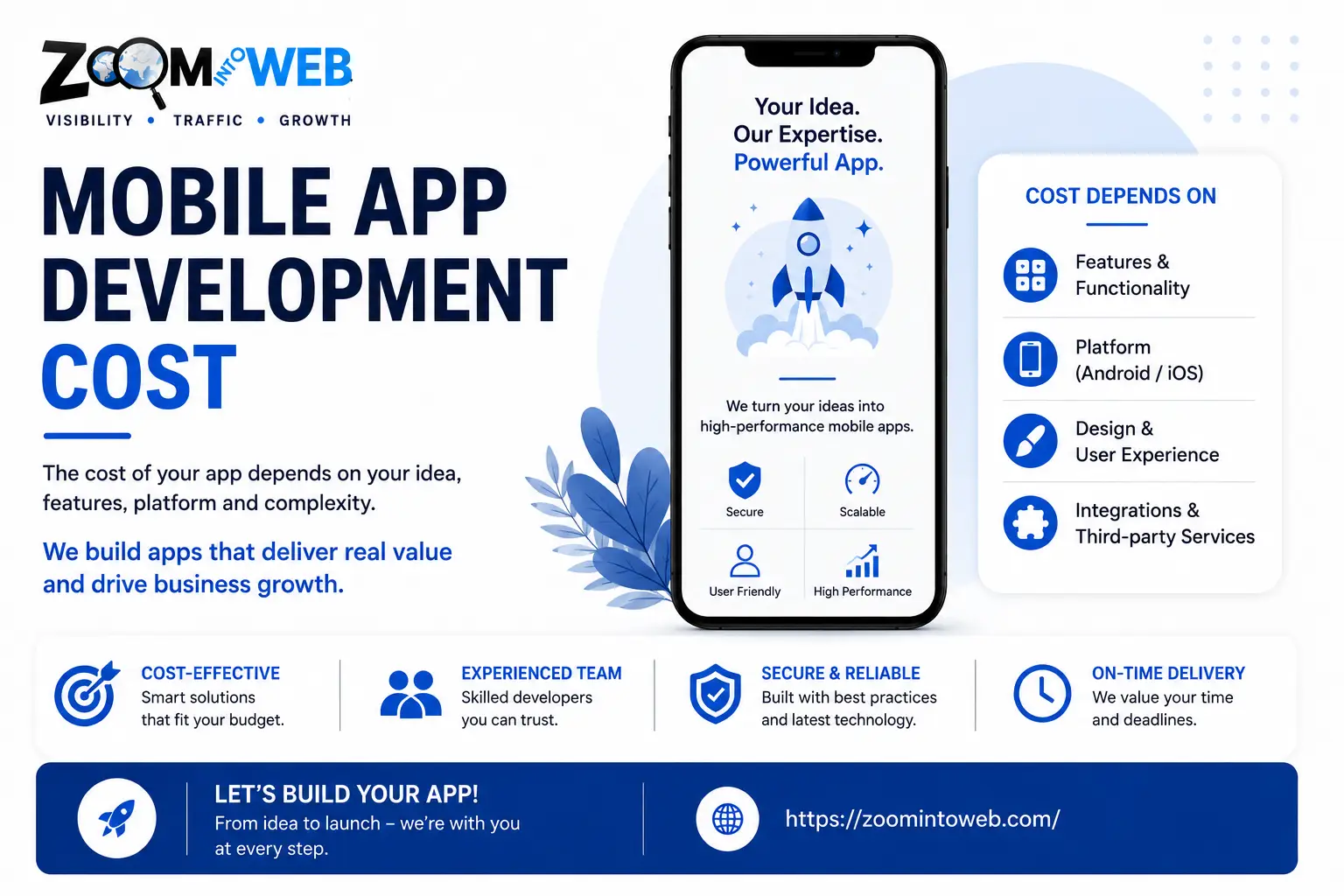
Quick Answer: Mobile app development cost in 2026 ranges from $10,000 for a simple app to $500,000+ for a complex enterprise platform. Most business apps fall between $60,000 and $150,000, depending on features, platform, and where your development team is based.
Introduction: Why Most Cost Guides Fail You
In today’s mobile-first economy, businesses of every size are investing in mobile applications – and for good reason. The global mobile app market is projected to exceed $600 billion in revenue in 2026, with worldwide app downloads expected to reach 181 billion this year. Mobile is no longer optional. It is the primary interface through which customers engage with businesses across retail, healthcare, finance, education, and logistics.
Yet when most business owners search for mobile app development cost, they get the same frustrating answer: “it depends — anywhere from $10,000 to $500,000.” While this range is technically accurate, it’s practically useless. It tells you nothing about what your specific app will cost, what is driving those numbers, or how to plan a budget that does not collapse mid-project.
This guide is different. We break down mobile app development cost using real 2026 market data — by complexity tier, platform, country, and development model — and give you a practical budgeting framework that works whether you are a first-time founder or an enterprise product manager planning a major digital investment.
Mobile App Development Cost in 2026: Full Breakdown by Complexity
The greatest factor in deciding your app’s development cost is complexity. Here’s what the market has projected for the four main categories in 2026:
| App Complexity | Estimated Cost (USD) | Development Time | Industries Served |
| Simple / MVP App | $10,000 – $60,000 | 2 – 4 months | Idea validation, internal tools, basic utilities |
| Medium Complexity | $60,000 – $150,000 | 4 – 8 months | E-commerce, booking apps, SaaS platforms |
| Complex / Feature-Rich | $150,000 – $300,000 | 8 – 14 months | Social platforms, fintech, on-demand services |
| Enterprise / AI-Powered | $300,000 – $500,000+ | 12 – 18+ months | HIPAA apps, AR/VR platforms, multi-tenant systems |
Our market research compiles thousands of assorted projects. A custom mobile app in 2026 is around $171,450. For most projects, the development teams spend about 40–55% of the funds for the entire project. Plus, it is a common mistake among first-time mobile app owners that they underestimate the yearly cost because maintaining the app will cost approximately 15–25% of the original value spent.
Knowing how your project compares is the first step, then every other app development component — platform, team location, design quality — will adjust the value from your starting point.
6 Key Influences on the Cost of Mobile App Development
1. Cost of Development for the App
The cost of app development reflects the amount of time taken to complete the app. Development will always take more time with additional complex features. The following is a rough estimate of app features and the time cost associated with them:
| Feature Type | Examples | Hours Required |
| Basic | Login, push notifications, simple UI | 30 – 100 hrs |
| Intermediate | Payments, real-time chat, geolocation | 200 – 500 hrs |
| Advanced | AI/ML, AR/VR, complex API integrations | 500 – 1,500+ hrs |
Social login is more cost effective than incorporating real-time chat. The cost for integrating complex natural language processing would take 600 hours.
Pro Tip: Before you approach your vendor to get a quote, build your feature set and choose the core app features. Development costs can be 30–50% of the final cost.
2. Cost of Platform App Development
The platform you choose as a mobile app developer will determine the cost of developing the app.
| Platform | Cost Impact | Recommended When |
| iOS Only (Swift) | Baseline cost | Audience is US, UK, Australia-heavy |
| Android Only (Kotlin) | 10–15% less than iOS | Global markets, India, Southeast Asia |
| Both Native | ~1.8x baseline | When performance is critical |
| Cross-Platform (Flutter / React Native) | 30–40% less than dual native | Most startups and business apps |
For most applications, the optimal choice would be a cross-platform app. However, if performance is a critical consideration, the cost for dual natives would be worth the investment.
3. UI/UX Designing
Understanding that design is a measurable business asset is key. Apps that achieve a high user experience earn 2–3x improved user retention. Bad user experience is responsible for 88% of iOS users abandoning an app. The cost of the design is far less than the user experience that app will provide.
There is a notable difference in cost across design methods:
- Template UI — lowest cost, fastest to implement, and ideal for minimum viable products
- Standard UI with animations — an increase of 30–50%
- Premium UI — a full design system with custom frameworks, compliant with accessibility, averaging 20–25% of the overall budget
Design pays for itself after the app implementation period. One of the most important aspects is that changes in design cost 10 times less than the changes after development, and because of that, user experience (UI/UX) is best addressed after implementation of core functionalities of the app.
4. Backend Infrastructure and Systems
All the user functionalities of a mobile app are solely reliant on the infrastructure — both visible and invisible. How complex it gets is dependent on design, frameworks, and systems.
- Simple Systems (e.g. Firebase / Supabase) — $5,000 – $20,000. Majorly for MVP and simple user tools
- Moderate Systems (thousands of users) — $20,000 – $60,000. E-commerce and various user-client interactions
- Advanced Systems (millions of users, real-time) — $60,000 – $150,000+. Social and financial (fintech) systems
There are several costs that will later burden the total development cost. The biggest cost added is third-party systems, which will add an additional operating cost of $2,000 – $5,000 each. The costs of combining systems — integration of payments, geographically based services, SMS, video/voice services, and CRM systems — can reach $15,000 – $30,000.
5. Team Location
Where your co-development team is located is a major cost control factor of mobile app development. Details regarding this are explained in the sections that follow.
6. Development Model
In-house Team
- ✅ Pros: Absolute control
- ❌ Cons: Highest all-in costs
Outsourced Agency
- ✅ Pros: Costs 40–70% less
- ❌ Cons: Demands rigorous vendor assessment
Hybrid Model
- ✅ Pros: Local product management + offshore execution
- ✅ Overall costs 40–60% less — adopted as standard for experienced product firms in 2026
Mobile App Development Costs by Country in 2026
Budget variations are the biggest in geography. Operating a mid-complexity mobile application may cost about $120,000 in the United States, but approximately $40,000–$70,000 in many other places. Offshore costs are not lower because of a lack of quality, but because of different labor costs and lower operational expenses.
| Country / Region | Hourly Rate | Simple App | Mid-Complexity | Complex App |
| USA | $100 – $250/hr | $50,000 – $100,000 | $120,000 – $200,000 | $300,000 – $500,000+ |
| Canada | $80 – $120/hr | $40,000 – $80,000 | $80,000 – $150,000 | $200,000 – $350,000 |
| UK / Western Europe | $60 – $100/hr | $30,000 – $70,000 | $70,000 – $130,000 | $150,000 – $280,000 |
| Eastern Europe | $40 – $70/hr | $20,000 – $50,000 | $50,000 – $100,000 | $100,000 – $200,000 |
| India | $20 – $50/hr | $10,000 – $40,000 | $40,000 – $80,000 | $80,000 – $150,000 |
| Southeast Asia | $15 – $40/hr | $8,000 – $35,000 | $30,000 – $70,000 | $60,000 – $120,000 |
🇺🇸 United States
High mobile app development costs are directly related to high demand, AI talent drain post-2023, reduced mobile developers, and the elevated costs of living. A mid-complexity app is expected to take approximately 500 hours to develop. Therefore, a mobile app is expected to cost $50,000–$125,000, but additional costs should be expected for design and QA as well.
There are situations where the costs are justified — for example, HIPAA-regulated healthcare mobile apps, SEC-governed fintech applications, or other mobile enterprise solutions. Some of these implementations must be built to support regulations from day one and, therefore, cannot be built without a deep understanding of the regulatory structure. Retrofitting applications built without this understanding will cost 2–3 times as much as the original cost.
🇮🇳 India
India is the #1 destination for outsourced mobile app development. The numbers speak for themselves. Development costs $20–$50/hour vs. US rates, which can go as high as $250. With India’s mobile app development market slated to grow to $20.7 billion in 2026 (21.7% CAGR), this reflects the sustained effort in education of developers as well as infrastructure resources.
With an $80,000 budget, a client can build a fully functional mid-complex app versus only a basic MVP in the US. Additionally, the developer talent pool for Android, React Native, and Flutter is concentrated in Bangalore, Hyderabad, Pune, and Ahmedabad — where development costs 15–20% lower than Bangalore to create the same level of engineering output.
The most developed Indian agencies maintain structured overlap working hours with US and EU clients, addressing time zone concerns effectively.
🇵🇱 Eastern Europe
Eastern Europe, particularly Poland and Romania, is the most suitable destination for mobile development for EU businesses. The cost is typically $40–$70 per hour, with access to high-quality engineering education, cultural affinity with Western clients, and aligned time zones. A 500-hour project that costs $75,000 in the US would cost $30,000–$35,000 in Eastern Europe.
The Hybrid Model
Based on the experiences of most consultants, the cost of mobile app development can be reduced by 40–60% by combining local product management with offshore development execution — and this has become the standard approach for experienced product firms in 2026.
Step-by-Step Budgeting Framework for Mobile App Projects
Step 1: Separate Scope Before Getting Quotes
The first step in avoiding a budget overrun is to create a clear scope statement before getting quotes. Begin by separating features into two lists — one for must-have and the other for nice-to-haves. Include only the must-haves in the first version of the app. This is the developer’s strongest tool to protect a project budget.
Step 2: Understand How Budget Splits Across Components
| Component | % of Total Budget |
| Discovery and Planning | 5 – 10% |
| UI/UX Design | 15 – 20% |
| Frontend Development | 20 – 25% |
| Backend Development | 25 – 35% |
| Testing and QA | 10 – 15% |
| Deployment and Launch | 5 – 8% |
| Contingency Buffer | 10 – 20% |
Step 3: Evaluate Vendors with an RFP
Request proposals from a minimum of 3–5 vendors and include a clear scope statement before asking for quotes. Evaluate proposals against one another — not just simple quotes — for not only development but also post-implementation support, testing, quality of intellectual property, and other deliverables.
🚩 Red Flag: Vendors not asking clarifying questions in response to an unclear brief and then providing quotes the following day do not understand the scope. The number they provide is likely to increase as the project progresses.
Step 4: Plan for Full Lifecycle Costs
| Post-Launch Expense | Annual Cost |
| App maintenance and updates | 15–25% of original development cost |
| Cloud hosting and infrastructure | $2,400 – $24,000/year |
| App Store fees | $99/year (Apple) + $25 one-time (Google) |
| Marketing and user acquisition | Can match full development cost in Year 1 |
| Security audits (regulated apps) | $5,000 – $20,000/year |
Step 5: Add a Mandatory Contingency Buffer
Always include a scope and budget buffer. Integration challenges, App Store review response times, and unforeseen technical challenges are the norm — not the exception — in any serious mobile app project.
Overlooked Business Expenses
Third-Party API Licensing: Integrating payment systems, mapping tools, SMS, and video calling results in extra costs from $2,000 to $5,000 each. Counting multiples, integration costs can reach $15,000 to $30,000. These costs typically fall outside initial vendor pricing.
Security and Penetration Testing: High-priority costs for applications processing user, financial, or medical data. Pricing from $5,000 to $20,000 is the starting range for a proper security audit.
Legal and Regulatory Compliance: Compliance with GDPR, CCPA, HIPAA, and PCI-DSS is not legal protection added at the end of the project. It costs $10,000 to $30,000 to incorporate at the start. An afterthought can easily cost three times more.
Scope Creep: An excessive number of changes to the originally planned and budgeted project can silently drain your budget. A predetermined change management process in the contract provides additional protection.
Device Fragmentation Testing (Android): Given the wide diversity of hardware and Android OS versions, the level of testing required is often comparatively more costly than what is required for iOS.
Projected Mobile App Costs in 2026
Below are estimates for building certain types of mobile apps in 2026:
| App Type | Estimated Cost (USD) |
| Dating App (Tinder-style) | $50,000 – $90,000 |
| Marketplace App (Airbnb-style) | $80,000 – $180,000 |
| E-commerce App with AR | $70,000 – $150,000 |
| Fintech / Banking App | $100,000 – $350,000+ |
| Telemedicine App | $120,000 – $450,000+ |
| On-Demand App (Uber-style) | $200,000 – $500,000+ |
| AI-Powered App | $160,000 – $500,000+ |
| Internal Business App | $15,000 – $50,000 |
Developing an App Economically
Utilize an MVP. An MVP is a way to solidify core app intentions. It provides a way to test ideas without having them to cause detrimental impact on a budget.
Use Flutter for Hybrid Apps. A greater cost-savings approach may be taken with Flutter, as opposed to other business app alternatives. Hybrid app development tends to cost significantly less than dual native development.
Use Cloud Services for Backend Apps. Cloud services offer less costly backend options. A custom solution should only be necessary if demand at your backend grows beyond what managed services can handle.
Run a Limited Discovery Sprint. A limited discovery is a tactic to assess usefulness without complex, costly, or misleading paths. This often saves a costly redoing of work later in the project.
Use a Fixed-Price Contract. Flexible contracts are tempting, but a fixed-price contract provides a level of stability and accountability for both parties.
Frequently Asked Questions
Q1: What does it cost to develop a mobile app in 2026?
Planned estimates are that the cost of app development will range from $10,000 for a simple app built for a single platform, to $500,000+ for a complex AI-based enterprise platform. Business apps generally fall in the range of $60,000 to $150,000. More generally, based on thousands of completed projects, a simple mid-complexity app will typically fall around the $171,450 range.
Q2: Which is cheaper — app development in India or in the USA?
India, and it is a significant difference. App development in India can cost anywhere from $20 to $50 per hour compared to USA developers at $100 to $250 per hour. The same app that costs $120,000 with a US agency can be developed for $40,000–$70,000 with a quality Indian agency with a demonstrated positive track record.
Q3: What factors impact the cost of app development?
App complexity and total number of features, platform choice (there is a 30–40% cost difference when opting for a cross-platform app versus a dual native build), and UI/UX design requirements are the three most significant cost drivers in any mobile app development project.
Q4: What is the most cost-effective platform choice — cross-platform or native?
For most apps built in 2026, cross-platform development will be 30–40% cheaper compared to dual native builds and will deliver 90–95% of native performance. Prioritize building native only if the app requires advanced graphics, deep platform-exclusive hardware integration, or if 60fps animation accuracy is an absolute requirement.
Q5: What recurring expenses can I expect after launching my app?
From Year 1 onward, expect app maintenance, cloud hosting, app store fees, security audits, and user acquisition expenses. App maintenance runs 15–25% of the original development cost annually. Cloud hosting costs $2,400–$24,000 per year depending on app scale. Security audits are mandatory for data handling apps. App Store fees apply whenever your app is listed for download. User acquisition marketing can equal 100% of total development costs in Year 1. Businesses that budget only for initial development costs invariably experience critical funding shortfalls.
Conclusion
Estimates for mobile app development in 2026, like all development costs, are range estimates. They assess the development of tradeoffs, cloud costs, and app lifecycles, among other itemized expenses. The lifespan of an app traverses the entire timeline of conception, development, deployment, and ongoing support costs — all of which must be budgeted before any code is written.
Mobile apps in the age of technology are all under the same continuum. For these reasons, funding the successful apps of 2026 relies more on smart budget tradeoffs and lean, accountable partners as opposed to an all-pervasive budget alone.
We are looking to help you come to terms with your mobile app development cost budget and anticipated return on investment. We are determined in our supporting role as we guide you and your app on a post-launch growth trajectory.
ABOUT THE AUTHOR
Content written by Saurabh Sharma
Saurabh is part of the expert content marketing team at ZoomIntoWeb. He has an expertise of curating meaningful information that can be used by visitors in general. Saurabh is also involved in creating client-specific stories and blogs.
👉 Get a Free Project Estimate →
Also Read:
