
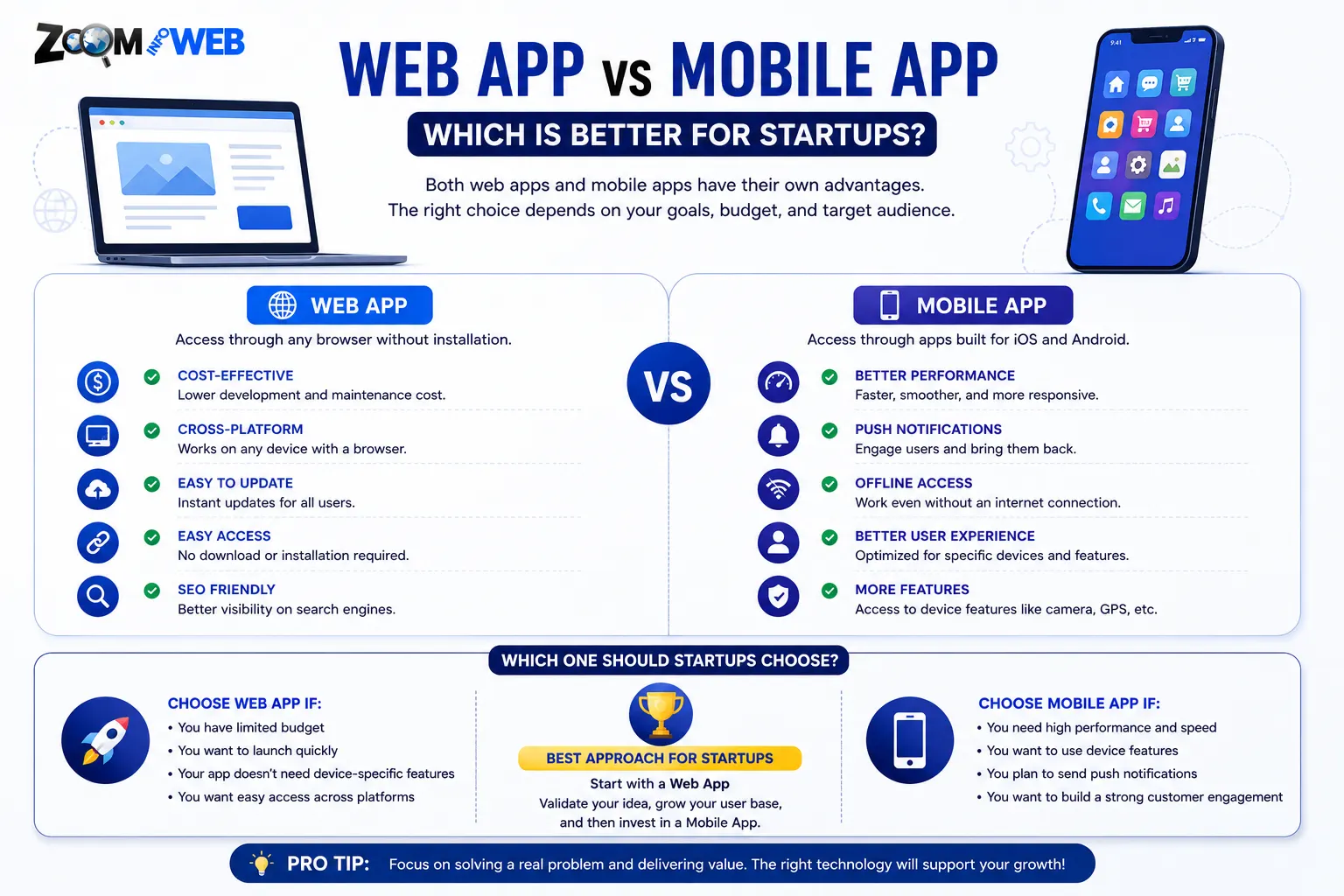
The initial dilemma startups have to solve when developing a digital product is whether to develop a web application or a mobile application first. This is a challenge faced by many of the founders in India, as budgets are tight, deadlines are strict, and the wrong platform can impact growth later on.
That’s the reason why the debate regarding Web app vs mobile app for startups India has started gaining traction, particularly among SaaS startups, ecommerce brands, service-based businesses, and tech startups.
Some startups jump right in to creating mobile apps, assuming they will have more visibility and engagement in their mobile app store. Others start with web platforms as they are typically quick and less expensive to construct.
The selection can depend on various elements such as budget, target audience, product goals, scalability and user conduct.
In this blog, we’ll explore the difference between Web Apps and Mobile Apps, cost comparison and usability and finally, which is better for startups in India.
What Is a Web App?
A web app is a software application which is not downloaded from an app store but runs within a browser.
It can be accessed straight from websites on desktop, tablet or mobile devices. This has been done in various forms such as online dashboards, booking systems, SaaS platforms, and ecommerce portals.
Web apps are one of the best ways to launch and keep running a startup during the initial stages.
These are typical use cases for web apps:
- SaaS products
- Ecommerce platforms
- Business dashboards
- Booking systems
- CRM tools
- Online marketplaces
When it comes to Mobile app vs web app comparison India, businesses typically begin with web apps as they tend to cost less to develop.
What is a Mobile App?
Mobile app – An application designed to run on smart phones or tablets that is downloaded.
These apps typically can be downloaded from the likes of the Google Play Store or Apple App Store.
Mobile apps may be utilized when companies need a more robust engagement, push alerts, offline functionality, or even a more tailored user knowledge.
Examples include:
- Ecommerce shopping apps
- Food delivery apps
- Fitness apps
- Banking apps
- Social networking platforms
Many startups opt for mobile apps because most of the interactions occur via mobile phones.
Web App vs Mobile App for Startups India: Main Difference
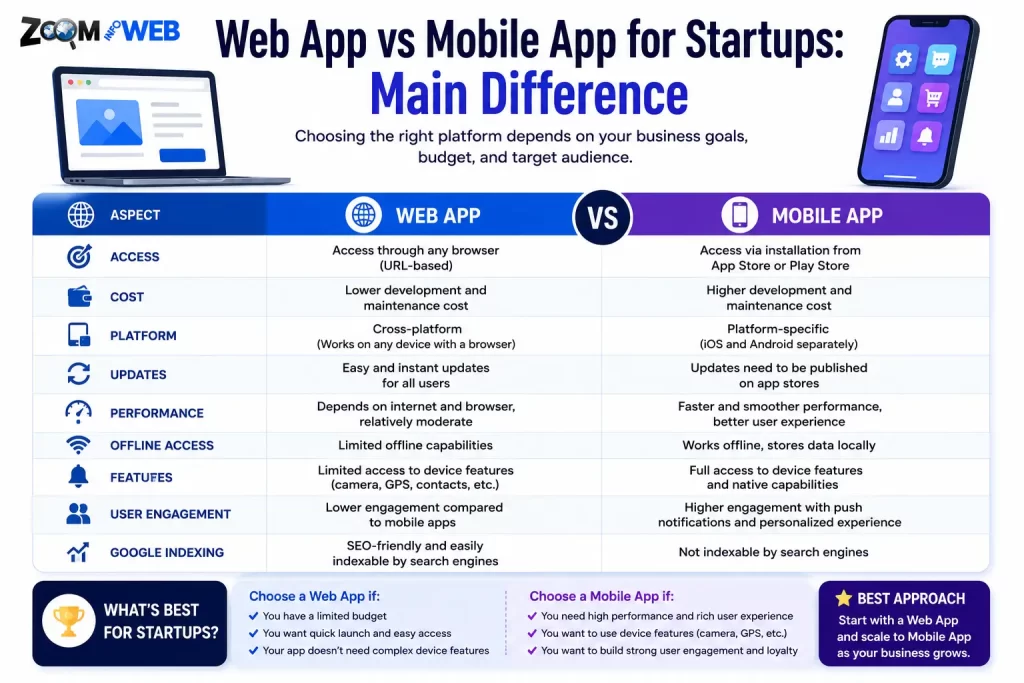
The main thing that makes a website app different from a mobile app is that it’s accessible.
A web app is accessed from a browser, and a mobile app requires to be downloaded and installed.
This impacts on a number of areas, such as:
- Development cost
- User experience
- Performance
- Accessibility
- Maintenance
- Customer engagement
It is crucial to be aware of these distinctions prior to selecting a development trajectory.
Why Startups Often Begin With Web Apps
There are many startup ventures in India that usually start with web applications as they’re generally cheaper and quicker to build.
When a start-up is about to introduce an MVP, they tend to validate the initial concept before putting in deep resources for an app.
This is where MVP development comes into play.
Instead of building a fully-featured mobile application immediately, startups can launch a web app first to:
- Test market demand
- Gather user feedback
- Validate features
- Reduce initial investment
- Launch faster
This strategy can help lower financial risk for early-stage startups.
Why Some Startups Prefer Mobile Apps
Web Apps are cost effective but for some businesses a mobile-first experience is more beneficial.
Mobile apps typically deliver higher engagement levels as users engage directly via their mobile devices.
Push notifications, camera functionality, geotracking, and offline functionality are great features for improving customer experience.
That’s one of the reasons why many startups that are built around ecommerce, fitness, food delivery or social interaction are opting for mobile apps.
The question, Which is better: web or app for startups, typically depends upon how the customers will interact with the product in day-to-day activities.
Web vs Mobile Development Cost India
Development cost is an important consideration for start-ups.
In most of the cases, the comparisons of Web vs mobile development cost India indicate that the web apps are cheap with the initial development.
Typically, a web app will have the following components:
- One platform development
- Browser compatibility testing
- Lower maintenance costs
A mobile app could need:
- Android development
- iOS development
- Separate testing
- App-store optimization
- Higher maintenance
Web Apps are generally a safer place to begin with for startups with limited resources.
But over time, mobile apps can provide higher engagement and retention based on the business model.
User Experience: Mobile vs Web
The other significant one is User experience: mobile vs web.
Generally, mobile apps offer more seamless and customized user experiences on mobile devices.
They also offer:
- Faster performance
- Better navigation
- Push notifications
- Offline functionality
The Web apps, however, are more readily accessible since the user does not have to download anything.
Users are able to just log in to the platform using their web browser.
This is helpful for web apps during their discovery phase.
PWA vs Native App: What Startups Should Know
Many startups today are also exploring PWA vs native app options.
A Progressive Web App (PWA), is a combination of both mobile and web apps.
PWAs can:
- Work through browsers
- Allow to add to home screens
- Load quickly
- Provide app-like experiences
PWAs are growing in popularity among startups looking to save development expenses and enhance their mobile experience.
However, native apps will continue to offer the highest performance and the greatest device integration.
Startup Tech Stack Matters Too
Another important consideration is the Startup tech stack when deciding between web apps and mobile apps.
Other companies develop a scalable back end system and then start designing mobile apps.
Others are straight focused on mobile-first design right from the start based on the customer behavior.
The selection of the stack of the technology that will influence:
- Scalability
- Development speed
- Maintenance
- Security
- Future upgrades
That is why startups must weigh business objectives prior to picking a platform.
Startup App Development India: Common Mistakes Businesses Make
There are lots of startups who immediately jump into app development without checking the product idea first.
Common errors are:
- Building expensive apps too early
- Ignoring user feedback
- Selecting an inappropriate platform
- Overcomplicating MVPs
- Focusing more on features than usability
Many successful startups start their business with limited versions before they start spending too much money on building full scale platforms.
This helps companies to grasp customers’ behavior prior to scaling.
How Zoom Into Web Helps Startups Build Digital Products
Startups looking for scalable digital solutions can explore Zoom Into Web.
The company operates in the fields of:
- Web development
- Mobile app development
- Software development
- AI solutions
- Ecommerce platforms
- Digital marketing
If you are a startup struggling with the question of building a web app or mobile app first, the team helps businesses determine the goals, budget, audience and scalability needs for the application they are looking to develop, before making a recommendation.
They are cross-platform, so startups can create products in line with the business growth strategy.
Conclusion
The ongoing debate of web apps vs mobile apps for startups India doesn’t have a single answer, as each startup is unique.
For some, a low-cost web app makes more sense first, for others a mobile-first experience is necessary for increased customer engagement.
The final choice depends on various factors, such as budget constraints, target audience, scalability, and product objectives.
Creating the MVP and then scaling up slowly is sometimes the most viable strategy for many startups.
To assist startups develop scalable web and mobile solutions based on their business requirements, rather than one predetermined solution, companies such as Zoom Into Web can be helpful.
With India’s startup ecosystem on an upward trajectory, making better tech choices early will often lead to more efficient scaling in the long run.
FAQs
What is the difference between a web app and a mobile app?
A web app is accessed via web browsers, and a mobile app is downloaded and installed on the smartphone.
Which is better: web or app for startups?
This depends on what the startup has to achieve, the budget, the target audience and the behavior of the customers.
Is web app development cheaper than mobile app development?
In most cases, web app development is more affordable initially compared to building separate mobile apps.
What is PWA vs native app?
The differences between the two are that a PWA is created using browsers, while native apps are created for mobile operating systems.
Why do startups begin with MVP development?
MVP development allows startups to test ideas, collect feedback, and minimize risk of financial loss before scaling up.
ABOUT THE AUTHOR
Content written by Adwrika
Adwrika is part of the expert content marketing team at ZoomIntoWeb. She has expertise in curating meaningful information that can be used by visitors in general. Adwrika is also involved in creating client-specific stories and blogs.

Comments are closed