
Searches are evolving more quickly than ever before. The public is not relying on traditional Google results to locate details, evaluate businesses, investigate the latest products, or to make purchase decisions. Google is increasingly utilizing artificial intelligence to comprehend questions, provide information in a concise manner as well as compare sources and give direct answers.
This is for businesses. SEO has become more than just about ranking a website with a certain keyword. The latest SEO solutions must be focused on the visibility across traditional results in search, AI-powered search experiences including the local market, featured answers, as well as conversational queries.
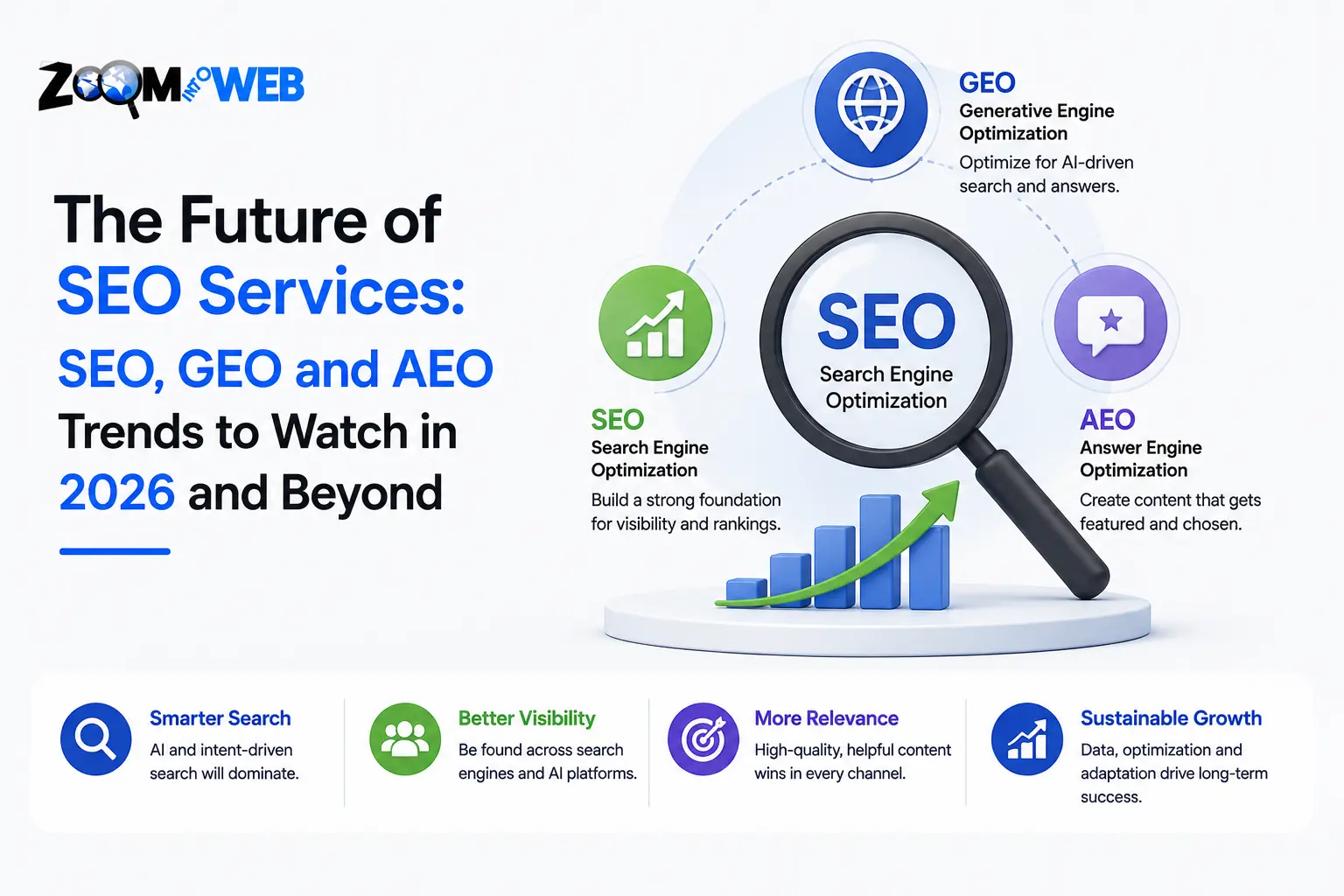
This has resulted in the creation of terms like answers Engine Optimization (AEO) and Generative Engine Optimization (GEO). Although these methods are related to traditional SEO, the objective is the same: produce useful and reliable, easily accessible content that is truly satisfying the searcher’s needs.
Businesses looking to boost organic traffic, create qualified leads, and improve their long-term online presence. Selecting a skilled SEO company in Delhi will help you turn these challenges into opportunities.
What Is Changing in SEO?
The old-fashioned SEO was heavily focused on backlinks, keywords, technical optimization, and rankings. These elements still matter however; modern SEO is now increasingly focused on the intent and context, as well as expertise, experience and value.
Google’s current guidelines confirm that the basic principles of SEO are still essential to AI-powered search experience which include AI Reviews and AI Mode. Websites should be crawlable, indexable, technologically solid, internally linked, and backed by useful trustworthy, user-centric content.
SEO’s future SEO does not revolve around replacing SEO with AI. It’s about extending SEO to adapt to the ways people use search engines in the present.
1. AI-Powered Search Will Change How Businesses Optimize Content
Artificial Intelligence is now an integral component of the way search engines process queries and contents.
Instead of linking a search term to the content of a website, modern search engines discern the intent behind the query and find relevant information from various sources. Google’s AI Overviews and AI Mode are two instances of this change. AI Mode can also explore more complicated queries and utilize several related searches to come up with an answer.
For companies This means that content needs to be designed around the user’s needs and topics rather than just keyword repetition.
For example, instead making a page that is constantly targeted:
“SEO services Delhi”
A stronger strategy for content could be able to answer questions related to:
- What SEO services are offered?
- How can SEO aid a company in generating leads?
- How long will SEO need to bring about outcomes?
- What are the key things that businesses should be looking at when choosing the services of an SEO agency?
- How much will the professional SEO cost?
- Which is more important, local SEO and national SEO?
- How can businesses be found in search results powered by AI?
This gives depth to the topic and gives users and search engines a better understanding of the topic.
2. GEO: Generative Engine Optimization Is Becoming More Important
Generative Engine Optimization (GEO) refers to increasing the visibility of a brand through AI-generated search results or answer machines.
People are increasingly asking more conversational questions instead of entering short phrases. They might have a conversation with the AI system:
“What is the best SEO agency for a small business in Delhi?”
or:
“How can a B2B company improve organic leads?”
To be regarded in these responses, the website of its business needs to be clear, reliable, and pertinent in detail.
Yet, GEO should not be considered a separate substitute for SEO. Google specifically declares that there aren’t specific technical requirements or a special schema that must be used within AI Overviews or AI Mode. The current SEO fundamentals will continue to be relevant.
A well-constructed GEO strategy should include:
- Making original and valuable content
- Answering specific questions clearly
- Showing first-hand experience
- Building brand authority on relevant websites
- Maintaining a consistent set of business information
- By using clear titles and structured text
- The strengthening of internal linkages
- Credible sources to back up claims
- Information important to keep accessible as text
The aim is simple: Make your brand and information accessible to search engines to comprehend as well as verify and refer to.
3. Answer Engine Optimization (AEO) Will Make Direct Answers Essential
More people are searching for answers and not only hyperlinks.
This is the point at which the answer to Engine Optimization (AEO) becomes valuable.
AEO concentrates on structuring content in a way it is able to effectively respond to questions using search functions, voice assistants or featured snippets, as well as AI-powered answers.
A well-written AEO-friendly article will provide clear answers prior to going into more detailed explanations.
For instance:
What is SEO?
SEO, also known as Search Engine Optimization, is the method to increase the visibility of a site on organic results by technological optimization, relevant information, relevant keywords, solid links to the internal, building authority and a more pleasant user experience.
This format is easier for users to use and is easier for search engines to comprehend.
Businesses must also develop separate FAQ sections. They should use the descriptive H2 or H3 headers to respond to questions from customers and break down complex topics into logical segments.
The intention isn’t to write content solely for AI. Google’s guidelines continue to emphasize the importance of content written specifically for humans instead of content that is created solely to manipulate search results.
4. Local SEO Will Remain Critical for Delhi Businesses
For businesses that are based in regions or cities, Local SEO is among the top effective methods of digital advertising.
A company that is targeting customers in Delhi for instance requires more than just a generic website. The local presence of the digital site must clearly convey:
- The location where the business is located
- What kind of services does it offer?
- Which regions it serves
- How can customers get in touch with it
- What do customers think about it
- The reasons why customers should select it
Google Business Profile has replaced the old “Google My Business” terminology and remains a crucial element of a local search strategy.
Companies should keep up-to-date details about their operations, pertinent categories, details about services, photos, reviews, and other information about their profile.
Local SEO should extend beyond the profile. Landing pages that are specific to your location, pertinent locally specific content, consistent information about the business internal links, as well as authentic customer reviews could all help to build a stronger local search visibility.
If a business is targeting specific search terms like “SEO company in Delhi“ or “digital marketing agency in Delhi,” local importance should be incorporated into the overall strategy for a website instead of being added as an extra thought.
5. Helpful Content and First-Hand Expertise Will Matter More
AI can create content fast however speed doesn’t automatically bring value.
As more companies publish AI-generated content, the content will have to show something other than generic data.
Google suggests creating useful quality, reliable, people-focused content. It also warns against putting out massive amounts of content solely to entice searchers.
The focus of businesses should be:
- New insights
- Practical examples
- Case studies
- Expert opinions of experts
- Direct experience
- Information about the author
- Verified references
- Unique data and research
- Clare’s explanations
If you are An SEO company, as an instance an article on SEO is more useful if it is accompanied by practical examples of campaign lessons examples, and concrete advice rather than simply repeating definitions from other websites.
6. Technical SEO and Website Experience Are Still Fundamental
AI-powered search doesn’t eliminate technical SEO.
A website must be search-engine friendly and correctly crawlable, indexable secure, mobile-friendly, and simple to navigate.
The most important technical areas are:
- Website architecture
- Internal link
- Sitemaps in XML
- Robots.txt
- Canonical URLs
- Mobile usability
- Page performance
- HTTPS
- Structured data
- Image optimization
- Management of indexation
Google recommends that the information you need is accessible in textual format, and that structured data precisely is a representation of the content visible on the page.
This is especially important since a well-constructed website can provide the basis on which authority and content will be built.
7. Content Strategy Will Shift from Keywords to Topics and Search Intent
Keyword research is still useful, however; the current SEO requires a broad strategy.
Instead of writing one article for each small keyword, companies can create topics clusters which cover a topic in depth.
A digital marketing company could create an SEO content cluster:
Main subject: SEO Services
Topics that could be supported include:
- Local SEO
- Technical SEO
- E-commerce SEO
- SEO for small and medium-sized businesses
- SEO audits
- Keyword research
- Content optimization
- Link to build
- AEO
- GEO
- AI search
- SEO reportage
The pages could then be linked through strategically placed internal hyperlinks.
Google’s SEO guidelines emphasize useful and well-organized, original and current content, rather than content designed solely for the purpose of attracting search engines.
8. Video, Visual Search and Multiformat Content Will Grow
Searching no longer must be limited to web pages written.
Users find brands via Google, YouTube, social platforms and maps, images, and more AI interfaces.
Companies should consider the possibility of creating content that can be used that can be viewed in different formats:
- Blog articles
- Videos of short form
- YouTube videos
- Infographics
- Original images
- Case studies
- Guides
- FAQs
- Product demonstrations
Visual content should be supported with descriptive text, appropriate filenames, suitable alt texts, as well as an accessible web page.
A multiformat strategy that is effective allows the same knowledge to reach customers at different phases of the buying process.
9. Brand Authority Will Become a Major Competitive Advantage
Since search is becoming more interactive and AI-driven, developing an established and trusted brand is becoming increasingly crucial.
Businesses shouldn’t rely solely on their own site.
Relevant mentions, publications from industry reviews, partnerships, professional contribution and reliable references can enhance a brand’s online presence.
It’s not about chasing backlinks randomly. The primary goal should be building authority by publishing content that is worthy of being cited.
For companies that are competing in competitive markets like Delhi, an established image and a quality SEO may prove more difficult to copy than a straightforward keyword-focused approach.
10. SEO Reporting Will Move Beyond Rankings
The ranking position alone isn’t telling the whole story.
Modern SEO campaign should be able to measure the results of a business, for example:
- Organic traffic
- Leads that are qualified
- Conversions
- Conversion rate
- Earnings from organic search
- Search visibility
- A brand is a search term
- Local visibility
- Engagement
- Top-performing landing pages for landing
- Impressions from search and clicks
Google has also launched special Search Console reporting for generative AI visibility. The company will first roll this out to just a smaller subset of sites in 2026. This is part of a larger trend to measure the effectiveness of emerging search experiences across the world.
In the future, SEO measurement will be more than “How many keywords are ranking?” and more focused on “How much business value is organic search generating?”
SEO, GEO and AEO: What Is the Difference?
| StrategyPrimary FocusMain Goal | ||
| SEO | Organic search engines and Search engines | Increase visibility of the organic |
| Local SEO | Searches based on location | Attract customers from nearby |
| AEO | Direct and immediate answers to questions | Improve the visibility of answer |
| GEO | AI-generated search experiences | Enhance brand visibility and increase results |
These strategies cannot be implemented in isolation. A well-designed digital marketing strategy should combine these.
Frequently Asked Questions
Is SEO still relevant in AI search?
Yes. Google affirms that the basic SEO methods used for traditional search are still applicable to AI features like AI Overviews, and AI Mode. Websites need to provide relevant content, accessibility to technical issues, and a smooth experience on the page, and easy to understand details.
What exactly is GEO in the field of digital marketing?
GEO (also known as Generative Engine Optimization is a strategy that focuses on increasing the visibility of brands and their representation in the generative AI experiences for search. It is based on solid SEO principles instead of replacing them.
What is AEO?
AEO or Answer Engine Optimization is a method of focusing on the creation and organization of content that provides clear answers to the questions of users and is easily comprehended by answers engines, speech assistants and AI-powered search systems.
Should companies continue to invest in SEO that is traditional?
absolutely. Quality content, technical SEO external linking, local SEO authority building and user experience continue to be the foundation of modern-day search engine visibility.
What does an SEO agency assist a company get ready in preparation for AI search?
A seasoned SEO agency will audit your site, find out the search intent as well as create content that is relevant to the search engine, improve the technical SEO improve local search engine visibility, produce relevant content that is answer-focused, improve internal linking, track the organic performance and create an action plan around the company’s specific objectives.
The Future of SEO Is Search Everywhere
The future of SEO isn’t just about getting a site to rank at the top of Google.
It’s about making sure that your company is recognized, appreciated and trusted whenever customers type in a query–whether it’s a traditional results page, Google Maps, an AI-generated answer to a question, a video platform or a search that is a conversational experience.
For businesses located in Delhi and beyond This means that SEO an increasingly vital component to the entire digital marketing plan.
At Zoom Into Web, SEO is part of a larger digital ecosystem that includes online marketing with web-based development AI, technology and digital solutions for business. The company is currently positioning itself as a full-service digital partner providing services to businesses in India and across international markets.
The most effective strategy for the coming years is simple: create genuinely useful content, create an authentic authority, improve technology, be aware of the intent behind search, and continue changing as the search industry evolves.
SEO will likely change over time, but companies that are consistently making it easier for customers to locate the information they need are well placed to benefit from organic growth in the long run.
Written by the Zoom Into Web Team
This content was written by the Zoom Into Web team, combining hands-on experience in web development, software solutions, and digital marketing. We create accurate, practical, and up-to-date content to help businesses make informed technology decisions.
