
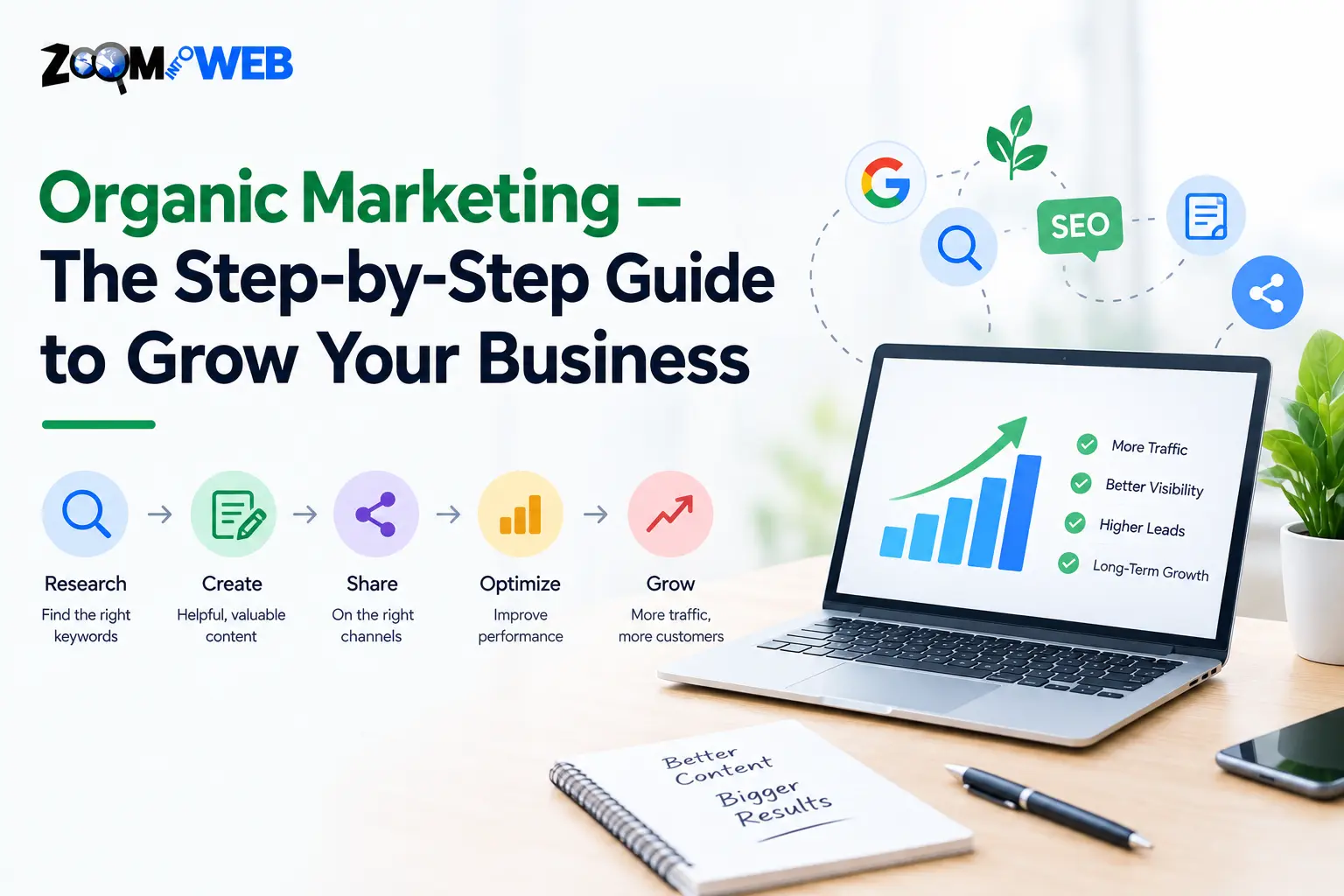
Organic marketing practices focus on building and nurturing audiences around a brand through unpaid sources such as search engines, content, social media, email, referrals, communities, and other channels. Businesses practice organic marketing by generating content and experiences that drive people to discover, share, and engage with the brand.
Outside of publishing articles or maintaining active social media accounts, businesses can develop a set of actions centered around the audience, content creation, SEO, distribution, engagement, and analytics to build long-term awareness and interest in the brand.
In this guide, you’ll learn:
What is organic marketing and how does it work?
Organic marketing strategies and best practices
The difference between organic and paid marketing
How to build an organic marketing strategy
What is organic marketing?
Organic marketing refers to marketing practices that are used to build awareness and engagement with a brand through unpaid sources.
Some common organic marketing practices are:
SEO
Content marketing
Organic social media
Email marketing
Community engagement
Referral marketing
User-generated content
Reviews and recommendations
Organic marketing focuses on building relationships with the audience by providing information and value that helps solve their problems and answer their questions. When a business creates a resource that searchers want to find and engage with, it gains visibility in search results.
As a result, people who are interested in the content are more likely to visit the business’s website and become customers.
For example, if there’s a small business that provides accounting software for small businesses, the company’s organic marketing practices could be found in resources created to help small business owners and managers learn about their industry, improve their management practices, and reduce their overhead expenses. One such resource could be an article published on the company’s blog, ‘How to close the books for small businesses. By publishing articles that provide value to the audience, the company can be found in search results when the user searches for terms related to small business accounting.
Why is organic marketing important?
Organic marketing practices help businesses leverage unpaid sources to build awareness and engagement with the brand. There are several reasons why businesses use organic marketing practices:
1. Long-term visibility and reach
Articles and other pieces of content created as a part of organic marketing practices have the potential to be continuously discovered and visited. SEO practices improve the visibility and ranking of web pages in search results for months or even years after they are published. 2. Builds trust and credibility with the audience
Many consumers conduct research before buying a product or hiring a service. Articles, guides, and other resources created as a part of content marketing allow the business to be discovered when a person is searching for solutions to a problem, learning about an industry, or browsing products and services.
When an article provides value and answers the consumer’s questions, it improves the brand’s credibility and trustworthiness.
3. Provides content that can be reused and updated
When creating a guide or a blog post, businesses can repurpose the information in the piece into multiple pieces of content.
4. Long-term audience growth
Many organic marketing practices help businesses build an audience outside of paid ads, thus creating opportunities for long-term business growth.
5. The ability to support the audience through the buyer’s journey
Organic marketing allows a business to support the audience by providing answers to their questions at multiple stages of their buyer’s journey.
While organic marketing is not free, it typically does not require direct payment for promotion. Businesses typically invest in personnel and tools that allow them to research, create, optimize, distribute, and update content.
What are the main types of organic marketing?
Organic marketing can be broken down into several categories. Businesses should invest in organic marketing practices that resonate with their audience and support the business’s marketing and sales goals.
Search Engine Optimization (SEO)
SEO refers to the set of practices aimed at improving the visibility of a web page in organic search results. An effective SEO strategy should be built around extensive research, optimization, and continuous improvement. Businesses should identify the search terms their audience is using, analyze competitors, and optimize the content to improve rankings.
Some common SEO practices are:
Keyword and topic research
Search intent analysis
On-page optimization
Technical SEO
Internal linking strategy
Improving site performance
Optimizing articles and landing pages
Acquiring high-quality backlinks
Building an informational pillar page with comprehensive guidance and recommendations
Updating existing content
Improving the website’s performance and architecture
When optimizing content, businesses should focus on creating value and addressing the audience’s questions rather than trying to stuff the page with keywords. Articles should be created to reflect the way searchers phrase their questions and what they are looking for.
Content marketing
Content marketing refers to the practice of researching and creating content that provides value to the audience. Types of content include:
Blog posts
Guides
How-to’s
Case studies
Videos
Presentations
Infographics
Checklists
Industry reports and research
FAQs
Articles, guides, and other pieces of content should be created around the common questions asked by the target audience rather than a list of keywords. For example, the content marketing strategy for an accounting software company could focus on topics related to running and managing a business because that is the expertise of the company and the area where their audience needs guidance.
Organic social media marketing
Organic social media marketing refers to publishing content and engaging with the audience on social media without directly paying to promote the business’s content.
Businesses can use organic social media marketing to strengthen their position as an industry expert, engage with the audience, and contribute to discussions. Some common content types that work well on social media are guides, how-to’s, videos, product and service showcases, and community-driven content. Businesses should tailor the content to the audience rather than simply republishing the same type of content across multiple platforms.
Email marketing
Email marketing refers to sending marketing emails to users who have subscribed to the business’s email list. Email marketing can play an important role in an organic marketing strategy by helping to nurture the relationship with the subscribers. Marketing emails can vary greatly but typically include product and service newsletters, marketing announcements, educational content, and updates about the industry.
Email marketing can be used to deliver valuable content to the subscribers. In addition, it can help to keep the business at the top of the prospect’s mind throughout the buyer’s journey.
Community and referral marketing
Organic marketing and referral marketing practices include engaging with the audience in communities, encouraging word-of-mouth recommendations, and collaborating with other businesses to promote each other’s services or products. Businesses should provide value to the community and avoid spamming self-promotional content.
How to build an organic marketing strategy
Developing an organic marketing strategy requires effort and attention to detail. Here’s how to build a strategy that resonates with the audience and delivers long-term value:
1. Define the target audience
Target audience research should be the foundation of any organic marketing strategy. Businesses should have a clear understanding of who they want to target their marketing efforts.
Some questions to consider:
• Who are the ideal customers for the business?
• What industry are they in?
• What issues are they trying to solve?
• What are they looking for?
• What products and services do they need?
• What influences their buying decisions?
• What search terms are they likely to use?
• Where are they searching?
An example of a target audience definition is small business owners. Within the small business owner’s audience, there are many different types of customers. It might be helpful to narrow the focus to small manufacturing companies that are looking for inventory management software. The more specific the definition of the target audience is, the more effective the marketing strategy will be.
2. Conduct keyword and topic research
Once a business has a general idea of who their target audience is, they should research the topics and keywords the audience is interested in. SEO tools can help identify the search terms and topics that the target audience is interested in. These tools also help analyze the competition, identify opportunities, and optimize the content to rank higher in the search results.
Some common SEO tools are Google Keyword Planner, Google Search Console, Semrush, and Ahrefs.
Rather than optimizing each keyword as a separate entity, businesses should group related questions and topics together and create comprehensive guides and resources.
For example, if a business wants to target the organic marketing space, they can publish a comprehensive guide that covers the following areas:
• What is organic marketing?
• How does organic marketing work?
• Organic marketing strategies
• Organic marketing examples
• Organic marketing vs paid marketing
• How to measure organic marketing
• Organic marketing content marketing
This approach allows the business to provide value and fully cover the topic rather than optimize separate pages for similar keywords.
3. Create valuable and informative content
Once a business has identified their target audience, analyzed the competition, and identified the topics and keywords to optimize, they can begin creating content. When creating content, it’s important to focus on the audience’s needs. Before publishing, businesses should ask themselves the following questions:
• Does the content answer the audience’s questions? Does it provide value?
• Is the information provided accurate and easy to understand?
• Does the content provide the audience with additional information that they might find useful?
• Does the content include examples, where applicable?
• Does the reader know what to do after reading this piece of content?
Avoid creating content around keywords that simply have high search volume. Focus on creating value and providing information and solutions.
4. Optimize the content
Once the content has been created, it should be optimized for better search visibility. Common optimization tasks are:
• SEO title
• H1 optimization
• H2 and H3 optimization
• Introduction optimization
• Meta description
• URL optimization
• Internal linking
• Image alt-text optimization
• Structured data
• Mobile friendliness
• Page performance
When optimizing content, businesses should use keywords that the audience is searching for. However, it is important to avoid keyword stuffing or trying to force a high-volume keyword into a sentence when it doesn’t make sense.
5. Develop an internal linking strategy
Internal links are linked to other web pages on the same domain. Internal linking is an important part of SEO and content marketing. Businesses should ensure that relevant pages are linked to each other so that the searcher can find the information they need. For example, a guide about organic marketing can have internal links to pages about SEO, content marketing, social media marketing, keyword research, and digital marketing.
The anchor text (the clickable text in a hyperlink) for internal links should indicate what the linked page is about.
6. Distribute and repurpose the content
Publishing the content on the website is only one part of the process. Businesses can continue to get value out of the content by repurposing it into multiple pieces of content. Examples of content repurposing are:
• One blog post can become multiple LinkedIn posts.
• One blog post can become an Instagram carousel.
• One blog post can be turned into an email newsletter.
• One blog post can become a video.
• One blog post can become an infographic.
• One blog post can become an FAQ section on a website
• One blog post can become a sales presentation.
• One blog post can become a YouTube video.
7. Network and build communities
Depending on the industry, businesses can strengthen their online presence and visibility by joining and actively participating in professional communities. Businesses can network in LinkedIn groups, forums, and other professional spaces, contribute to discussions, share insights, and introduce the brand in a helpful and non-promotional way. Similarly, businesses can attend online and offline events, webinars, and conferences in their industry, and network with other professionals. Companies can also collaborate with influencers and other businesses to promote each other’s services and products.
8. Improve website experience
Getting the audience to your website is one thing, but you also need to ensure that your website makes it easy for the visitor to learn about a business and what it has to offer. Businesses should regularly review website performance and focus on the following areas:
• Mobile friendliness
• Page performance
• Navigation
• Readability of content
• Broken links
• Forms and calls to action
• The conversion experience
• The website’s overall performance
An effective organic marketing strategy should deliver value to the audience and contribute to the business’s marketing and sales goals.
9. Measure performance and improve the strategy
Organic marketing is an ongoing process. Businesses should periodically review what pieces of content perform well, which content underperforms, analyze engagement, and update the organic marketing strategy. Businesses should review the following metrics:
• What web pages are driving organic traffic?
• What search terms bring traffic and engagement?
• Which web pages drive leads?
• Does the content engage the audience?
• Which topics resonate well with the audience?
• Which topics are missing?
• What web pages stop being relevant or driving traffic?
• What content drives conversions?
• What content influences the audience’s buying decisions?
What is the difference between organic and paid marketing?

Organic and paid marketing practices are fundamentally different. Here are the most common differences:
| Organic Marketing | Paid Marketing |
| Visibility Gained through unpaid practices and engagement with the audience. | Businesses pay to place and promote their ads. |
| Speed Usually takes more time to gain visibility and traction. | Can generate results fairly quickly. |
| Cost Typically requires an investment in content creation, SEO, and community engagement. | Businesses have a separately paid advertising budget. |
| Long-term value Can continue driving traffic or engagement long after publication. | Typically requires continuous spending to impact visibility and engagement. |
| Control Limited control over distribution channels. | More control over targeting, budget, and distribution. |
| Examples SEO, content marketing, email marketing, organic social media, community engagement | Google Ads, social media ads, display advertising, video advertising |
| Best used for Long-term visibility and engagement with the audience. | Rapid growth, engagement, and promotion. |
Organic and paid marketing practices are complementary. Businesses can and should use both strategies to build long-term visibility and get rapid results.
How long does organic marketing take to work?
The performance of organic marketing tactics is difficult to estimate. Organic marketing typically takes time to show results. How quickly a business will see results from their efforts depends on a variety of factors, including:
• Website authority
• Competitiveness of a niche
• Industry and demand
• Content quality
• SEO practices
• Current audience
• Content publishing and distribution
• Website’s conversion experience
An established website would typically perform better and begin to show results faster than a new website. A business targeting a highly competitive niche will also have a longer path to result compared to a business targeting a specific audience with a particular need.
As a rule of thumb, businesses should set realistic expectations and remember that there is no fixed timeframe for seeing results. For SEO, businesses may begin to see improvements in impressions, clicks, keyword rankings, and indexed pages. Ultimately, businesses should measure real-world performance, such as leads and sales, rather than focus on rankings and traffic.
How do you measure organic marketing?
Organic marketing typically drives traffic to a website, but traffic should not be the only metric that businesses use. An effective organic marketing reporting system should track visibility, engagement, and business impact.
1. Visibility
Some common visibility metrics are:
• Organic impressions
• Organic clicks
• Search visibility
• Ranking for relevant keywords
• Indexed pages
2. Engagement
Common engagement metrics include:
• Engaged sessions
• Returning visitors
• Engagement rate
• Email engagement
• Social media engagement
3. Business impact
Common business impact metrics are:
• Leads
• Qualified leads
• Submissions
• Calls
• Requests for consultation
• Sales
• Conversion rate
• Revenue influenced by organic marketing
A good rule of thumb is to follow the visibility-engagement-leads-customers-revenue framework.
Common mistakes when implementing organic marketing
Creating content that ignores search intent
Pages are often optimized around keywords, but they fail to answer questions or fulfill the searcher’s intent. Searchers are looking for something specific, and it is the job of the page to provide it.
Stuffing content with keywords
Many beginning content creators try to stuff their content with keywords in an effort to optimize their content. This practice hurts the user experience as the content becomes difficult to read. Instead, businesses should create content that provides value and covers a topic in detail using keywords where appropriate.
Publishing content without a strategy
Sometimes, businesses try to create content without strategy, research, or audience analysis. This can lead to publishing irrelevant content or creating content that fails to fulfill the audience’s needs. Content is an investment, and businesses should ensure that it serves a purpose.
Failing to improve existing content
Not all content requires a separate blog post, guide, or article. Businesses should update existing content, improve it, and enhance the user experience.
Focusing only on traffic
More traffic is typically better, but businesses should focus on quality over quantity. An engaged audience is more likely to become a customer than a large group of uninterested visitors.
Waiting for results
Organic marketing typically requires a long-term commitment. Businesses should analyze their performance regularly and update their content rather than get discouraged by slow progress.
Trying to scale the same content everywhere
A blog post, a LinkedIn post, an email newsletter, and an Instagram post, all serve different purposes. Businesses should use their content to its fullest potential rather than republish the same content everywhere.
Failing to improve the conversion journey
Organic marketing helps to drive traffic and engagement, but it is crucial for businesses to ensure that the website promotes the product or service effectively and provides a positive experience for the visitor.
Can organic and paid marketing work together?
Organic and paid marketing practices are different but complementary. They can work together to provide the best results. For example, the business can create a pillar page about a relevant topic that a target audience is looking for, optimize it for search engines, share it on organic social media, and send it to the business’s mailing list. Then, they can analyze the engagement and use the insights to inform the content strategy and use paid marketing to promote the content further.
What makes an effective organic marketing strategy?
An effective organic marketing strategy is built around the following components:
Audience + Search intent + Valuable content + Measurement
Understanding the target audience and serving their needs with valuable content is essential for building an effective organic marketing strategy.
In summary, organic marketing is not simply about ‘marketing without ads.’ It is a complex set of practices aimed at providing value and building long-term visibility. Businesses can benefit from investing in organic marketing practices that focus on the needs of the audience, provide them with valuable resources, improve the visibility of these resources, and help the audience take the desired action.
Conclusion
Organic marketing can help businesses build long-term visibility and engagement with their target audience. Businesses should invest in organic marketing practices that focus on the needs of their audience, provide them with valuable resources, improve the visibility of these resources, and help the audience take the desired action. Businesses should research their target audience, invest in SEO and content marketing, distribute their content, engage with their audiences, and measure performance. While organic marketing is not a quick solution, it can significantly impact a business’s visibility, engagement, and sales. By focusing on delivering value to the audience, businesses can get the most out of their organic marketing efforts.
If your business wants to improve its organic visibility and you are looking for guidance around SEO and content marketing, Zoom Into Web can help you identify opportunities and develop a digital marketing strategy that is right for your business. .
