
Marketing via email is an extremely efficient digital marketing strategy that can be used by businesses that are of any size. Although social networks and instant messaging applications continue to expand, the effectiveness of email marketing is consistently one of the best returns in terms of return on investment (ROI). According to research from industry professionals, the marketing of email generates an ROI that is on average $36 per dollar spent that makes it among the most profitable channels for marketing that are available.
But sending out email messages is not enough. If your customers aren’t opening, clicking or responding, your marketing campaigns aren’t delivering the results you want. This is why improving your email conversion rate is vital.
The conversion rate of you email marketing determines the percent of recipients who take the desired action following your message. The desired action could include purchases such as downloading an eBook or sign-up for a webinar, asking for a demo, or signing up to a particular service.
A higher conversion rate indicates that your emails are engaging with your readers and generating tangible business results.
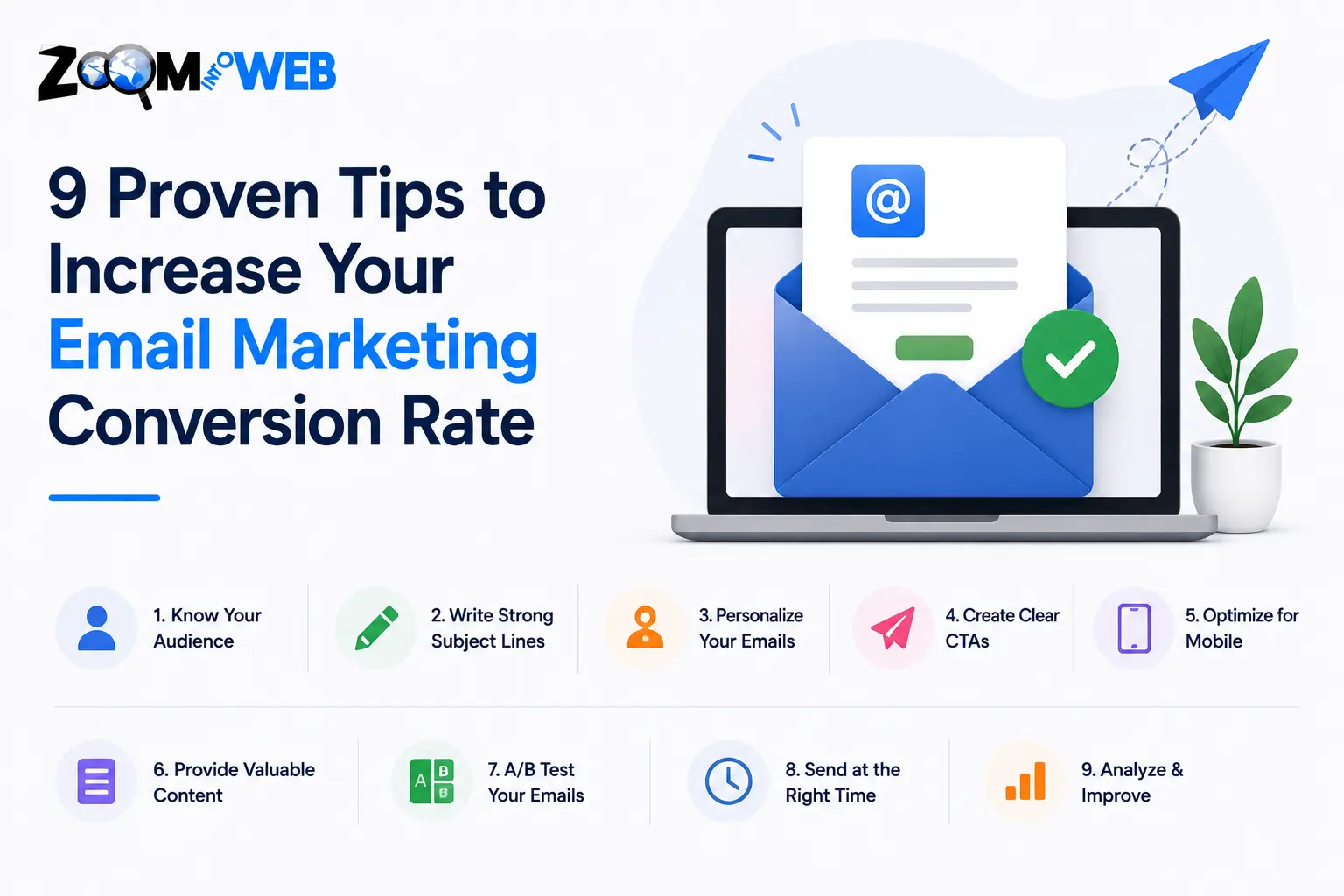
In this article we’ll look at nine strategies that have been proven that will help increase the conversion rate of your email marketing, improve engagement, and increase your ROI on marketing.
What Is an Email Marketing Conversion Rate?
A conversion rate of email marketing refers to the proportion of recipients who complete an action following clicking on your email.
It is the formula:
Email Conversion Rate = (Number of Conversions / Number of Delivered Emails) x 100
If, for instance, you send out 5,000 emails and 200 people buy your product, the percentage of conversion is 4.4%.
Although conversion rates can vary across different industries, a percentage between 2 to five percent is usually considered to be good, and well-designed campaigns usually have higher conversion rates.
Why Is Email Marketing Conversion Rate Important?
Achieving a higher conversion rate can help companies:
| Benefits of a Higher Email Marketing Conversion Rate |
| Increase sales without increasing marketing costs. |
| Improve customer engagement. |
| Build stronger customer relationships. |
| Increase the return from investments (ROI). |
| Enhance campaign performance by using optimization based on data. |
Instead of focusing solely on open rates, effective marketers focus on actions that directly impact the growth of their business.
1. Segment Your Email List
One of the best methods to increase your conversion rate for email marketing is to segment the email lists of your subscribers.
Instead of giving your same messages to each subscriber, break your audience into smaller segments according to:
- Age
- Location
- Purchase History
- Interests
- Web site behavior
- Customer lifecycle stage
When users receive content that is customized to their preferences, they are much more likely to interact and convert.
For instance, the online clothing store may send out winter jacket sales only to those who live in regions with colder temperatures instead of sending a similar email to all customers.
Segmentation lets businesses deliver personal experiences that improve the number of clicks, open rates, and conversions.
Expert Tips: Behavioral segmentation based on browsing history as well as previous purchases typically results in the highest conversion rates.
2. Write Compelling Subject Lines
Subject lines are the very first impression that your email sends.
If your email isn’t able to grab the attention of readers, the recipient may not even open your email.
A good subject line would be:
- Short and simple
- Personalized
- Benefit-driven
- Curiosity-inducing
- Action-oriented
As an alternative to writing
Weekly Newsletter
Try:
- Your Exclusive Offer Ends Tonight
- Save 30% Before Midnight
- Raman, Here’s Something You’ll Love
- Don’t Miss This Limited-Time Deal
The testing of multiple subject lines with A/B testing will help determine the messages that resonate most with your audience.
3. Personalize Every Email
Personalization is more than adding the subscriber’s initial name.
The latest email marketing platforms permit companies to personalize their emails based on information about customers, for example:
- Purchase History
- Browsing behavior
- Product-related interests
- Location
- Previous interactions
For instance, if a potential customer has recently visited a running shoe on your site and you want to send specific recommendations to similar products is much more effective than an unrelated promotional email.
Customized emails strengthen customer relationships and can significantly increase the rate of engagement and conversion.
4. Optimize Emails for Mobile Devices
Over half of all emails are read on smartphones.
If your email is mobile-friendly and isn’t compatible, users could leave without taking any action.
To improve the efficiency of mobile email:
| Mobile Email Optimization Checklist |
| Use responsive email templates. |
| Keep your paragraphs brief. |
| Make sure you use fonts that are readable. |
| Create CTA buttons big enough to tap. |
| Convert images to make them faster to load. |
| Test emails on different devices before sending them. |
An intuitive mobile experience helps lessen friction and boosts conversions.
5. Use Clear and Actionable Calls-to-Action (CTAs)
Every email must have one principal goal.
The users you wish to:
- Purchase an item
- Book a demo
- Download a book
- Join an online webinar
It is important that your CTA should make the step clear.
Examples of powerful CTAs include:
| Powerful CTA Examples |
| Shop Now |
| Download Free Guide |
| Claim Your Discount |
| Start Free Trial |
| Book Your Demo |
Make sure that CTA buttons are prominently visible and place them where readers naturally are focused on while reading.
Beware of combining several competing CTAs since they may hinder conversions and cause decision fatigue.
6. Test and Analyze Your Campaigns
Effective email marketers don’t depend on the whims of.
They constantly improve their campaigns via testing and analysis.
Conduct A/B test for:
| Elements to Test |
| Subject lines |
| CTA Text |
| Images |
| Email layouts |
| Send times |
| Personalization strategies |
Monitor key metrics like:
| Important Email Marketing Metrics |
| Open rate |
| CTR = click-through (CTR) |
| Conversion rate |
| Rate of bounce |
| Unsubscribe cost |
Analyzing the performance of your campaign helps you identify what is most effective and enables you to make improvements based on data in the future.
7. Use Engaging Visual Content
Visuals help make emails more appealing and easier to comprehend.
Include:
| Engaging Visual Content |
| Product images |
| Infographics |
| GIFs |
| Videos |
| Icons |
But be careful not to overcrowd your email with images that are large that can cause slow loading times.
Make use of high-quality images that reinforce your message and motivate readers to engage in action.
Keep a balance between visuals and text to ensure the most enjoyable user experience.
8. Send Emails at the Right Time
Timing is a key factor in the effectiveness of email marketing.
Even the most well-designed email could not work if the recipients are not active.
Examine the behavior of your audience to identify:
| Best Time Factors |
| The most beautiful time of week |
| Best time to be awake |
| Preferential engagement hours |
Most email marketing platforms offer statistics that suggest optimal time for sending, in relation to subscriber behavior.
Be sure not to overwhelm customers with too many emails.
Finding the ideal frequency can help reduce the rate of unsubscribes, while also ensuring that subscribers remain engaged.
9. Deliver Valuable Content
Subscribers shouldn’t join your mailing list solely to receive marketing messages.
Give genuine value through:
| Valuable Content Ideas |
| Educational materials |
| Industry perspectives |
| Case studies |
| Exclusive discounts |
| Product tutorials |
| Resources for help |
For instance, if your target audience is comprised of digital marketers, then send them practical marketing advice along with promotions.
When your customers are regularly provided with valuable information, they will eventually believe in your company’s name.
The trust built through trust can lead to better customer relations and better conversion rates over time.
Common Mistakes That Reduce Email Marketing Conversion Rates
Many businesses are unaware of the harm they can do to their email performance through unavoidable errors.
The most popular are:
| Common Email Marketing Mistakes |
| The sending of generic emails to each subscriber |
| Ignoring personalization |
| Writing subject lines that are weak |
| Making use of several confusing CTAs |
| Not optimizing emails for mobile devices |
| Not sending emails as often |
| Not taking advantage of A/B testing |
| Utilizing low-quality images |
| Not cleaning inactive subscribers |
| Not paying attention to campaign metrics |
Making these mistakes is a great way to increase the overall performance of your campaign.
Best Email Marketing Tools to Improve Conversion Rates
The best email marketing software can automate campaigns, increase personalization, and boost conversion rates.
Some of the most popular choices are:
| Email Marketing Tool | Description |
| Mailchimp | Mailchimp is ideal for newbies as well as small businesses. |
| HubSpot | HubSpot HubSpot HTML0 Fantastic to integrate CRM with automation and integration. |
| Brevo (formerly Sendinblue) | Ideal for marketing and transactional emails. |
| Klaviyo | Klaviyo is designed to be used by eCommerce businesses. |
| ActiveCampaign | ActiveCampaign ActiveCampaign HTML0 Effective automation as well as customer-centric journeys. |
| ConvertKit | ConvertKit ConvertKit HTML0 is a favorite among bloggers and creators. |
| MailerLite | It is affordable and simple to use for new businesses. |
Select a platform that works with your company’s goals as well as your audience size and requirements for automation.
Frequently Asked Questions (FAQs)
1. What is the best email conversion rate for marketing?
A successful email marketing conversion rate typically is between 2% to 5 percent, but it is dependent on the type of campaign and industry. Companies that employ audience segmentation, personalization, and powerful CTAs usually achieve even more conversion rates.
2. How can I improve my email marketing conversion rate?
You can increase the conversion rates of your customer base and writing engaging subject lines, customizing email content, enhancing emails for mobile devices with simple CTAs conducting A/B testing and continuously analyzing you’re the performance of your campaign.
3. Why is personalization important in email marketing?
Personalization allows emails to be more relevant to every recipient by using data from customers like purchasing history, browsing patterns, and preferences. The personalization of emails increases engagement, click-through rate, and conversions due to the fact that they offer content that aligns with the user’s preferences.
4. What factors affect email marketing conversion rates?
The most important factors are the segmentation of your audience, design of emails personalization, subject lines of mobile optimization, CTA location, quality of content sending time and landing page experience, and continuous campaign testing.
5. Which email marketing tools help increase conversions?
The most popular tools are Mailchimp, HubSpot, Brevo, Klaviyo, ActiveCampaign, ConvertKit and MailerLite. These platforms can provide automated, analytics personalization, segmentation, and A/B test features which help to improve the performance of campaigns.
Key Takeaways
To increase your conversion rate takes more than sending only promotional emails. Successful campaigns are focused on providing targeted, relevant, and relevant content to an appropriate audience at the right moment.
By implementing these nine proven strategies–segmenting your email list, crafting compelling subject lines, personalizing content, optimizing for mobile devices, using clear CTAs, testing campaigns, incorporating engaging visuals, sending emails strategically, and consistently providing value–you can increase customer engagement, generate more conversions, and maximize your email marketing ROI.
Keep in mind that marketing through email is an ongoing process of optimization. Check out your results, try innovative ideas, and improve your strategies regularly to attain long-term success, and to build stronger relationships with your customers.
Written by the Zoom Into Web Team
This content was written by the Zoom Into Web team, combining hands-on experience in web development, software solutions, and digital marketing. We create accurate, practical, and up-to-date content to help businesses make informed technology decisions.
Read Also:
