
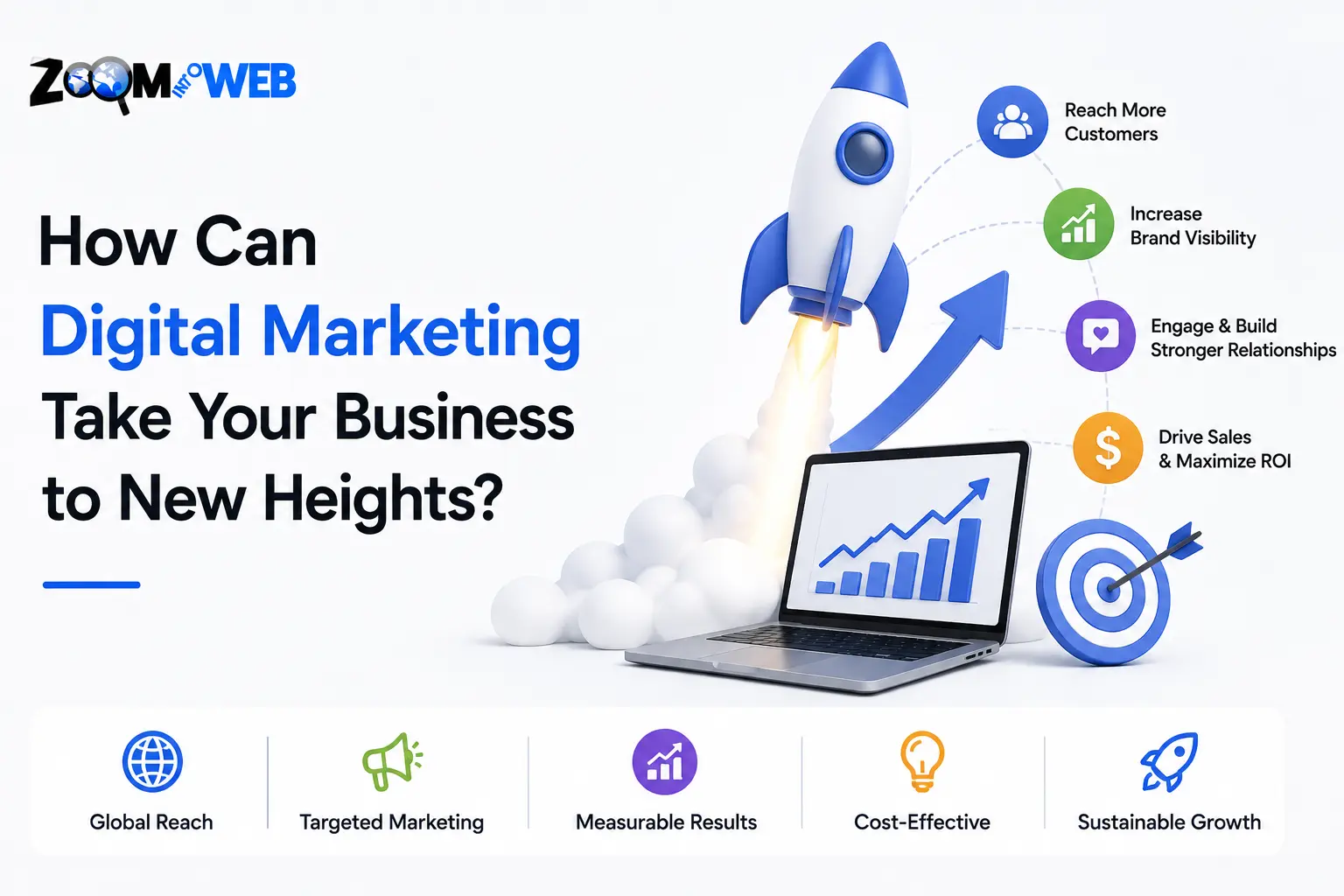
Digital marketing has transformed the way companies attract customers and build trust, create leads, and boost revenues. If you own a small-scale local business or an online store or startup or a reputable firm, your customers are using online channels to browse and compare, exchange information, and make purchase decisions.
Digital marketing is not only about posting to social media or displaying ads. When it is strategically planned, it can create a seamless route from the discovery of a brand to conversion and loyalty over time.
What can you do to help digital marketing help your company grow to new highs?
It can assist you in reaching the right audience, improving online visibility, producing qualified leads, establishing relationships with customers, evaluating the performance of your marketing, and increasing the processes that result in results.
What Is Digital Marketing?
Digital marketing refers to the marketing of the business, product or service via digital channels like websites, search engines for social media, emails and online advertising, video platforms, and many other digital points of contact.
Its greatest benefit is the fact that companies can link their marketing efforts with quantifiable results. Instead of spending money on advertising, companies can monitor metrics like site traffic, engagement leads, and cost of customer acquisition, conversions, and revenue.
Digital marketing usually includes:
- Search Engine Optimization (SEO)
- Marketing content
- Marketing via social media
- Pay-Per-Click (PPC) advertising
- Marketing with influencers
- Marketing through affiliates
- Marketing via video
- Marketing via messaging and mobile
The ideal combination will depend on your industry, audience goals, budget, and the customer journey.
Why Is Digital Marketing Important for Business Growth?
Customers are no longer relying on a single source for information prior to making a purchase. They can discover an organization through Google and then go to its website or social media pages and reviews, as well as evaluate competitors, and finally reach out to the company via messages or email.
Digital presence is an essential element of customer experience.
A solid digital marketing plan can help your company appear at various stages along the way instead of relying on one single marketing or advertising channel. It helps you identify which aspects are generating outcomes and continually improve them.
1. Reach the Right Audience
One of the most significant benefits that digital advertising has is its audience targeted.
Traditional advertising could place your message in front of a huge audience; however, not everyone who sees it is likely to have an interest in your service or product. Digital channels permit businesses to determine their audiences based on various factors like location, interest in search, intent to search and demographics, past interactions, and online behavior.
For example, a nearby dental practice could focus its SEO and marketing efforts on people who are looking for dental services in the area. Online fashion stores could target customers who are looking for specific categories of merchandise.
The goal isn’t just to make more contact. It’s to connect with more appropriate people.
2. Increase Your Brand Visibility
A business can’t expand if prospective customers don’t know they exist.
SEO and content marketing, as well as video, social media, and paid ads, can boost the number of sites that people will see in your brand.
For instance, a user seeking the “best digital marketing agency for small businesses” might find the company via the natural Google result. Another person could find the same business through LinkedIn or other content on Instagram, YouTube, or through a commercial.
Repetition and effective exposure can increase brand recognition and increase the amount of familiarity.
But visibility shouldn’t be the sole goal. The information behind this visibility should be able to show expertise, resolve issues, and provide customers with confidence in the company.
3. Generate More Qualified Leads
Digital marketing could turn internet attention into potential customers.
Companies can generate leads by:
- Contact forms
- Pages that land on the page
- Free consultations
- Downloadable resources
- Newsletter subscriptions
- Social media campaigns
- Search ads
- WhatsApp and messaging campaign
- Online events and webinars
The main benefit is that businesses can pinpoint the source of leads and identify which channels are generating the most opportunities.
For instance, if SEO generates 100 leads, however PPC generates 40 leads with an incredibly higher conversion rate, it is possible for the business to compare the quality and price of these leads instead of simply analyzing traffic figures.
These shifts marketing beyond “How many people saw us?” to “How many valuable business opportunities did we create?”
4. Build Trust Before the Customer Contacts You
Customers usually research a company before contacting it or purchasing it.
Your blog, website reviews and social media profiles videos, case studies testimonials, and other educational content could influence the decision.
This is the place where SEO and content marketing can be extremely important.
Instead of continuously telling consumers to buy, produce content that addresses the questions that they’re already asking.
A software company might publish:
- What is the best business management software?
- The most common mistakes when choosing business software
- Software guide to compare software
- Solutions that are specific to the industry
- Stories of customer success
Content that is helpful can build credibility and draw attention to those who are actively looking into the issue.
5. Improve Your Search Engine Visibility With SEO
SEO is among the most essential long-term aspects of digital marketing as it allows businesses to gain exposure by allowing users to seek relevant information, products, or services.
A solid SEO strategy could comprise:
- Keyword research
- Analysis of intent to search
- Original, helpful content
- Optimization of the page
- Internal link
- Technical SEO
- Local SEO
- Link building and Digital PR
- Optimization of conversion
Modern SEO shouldn’t focus solely on adding keywords to an article. Search engines are increasingly evaluating whether content truly meets the users’ needs and offers relevant information.
Your content should provide the reader with a clear answer to provide relevant subtopics, show experience and knowledge, and clearly define the next step.
SEO will also increase accessibility across the latest search experience and AI-generated solutions which makes a strong authority on the topic ever more crucial.
6. Make Your Marketing More Measurable
One of the most significant benefits for digital advertising is the ability to measure it.
Business can monitor various metrics, including:
- Traffic to websites
- Organic search visibility
- Click-through rates
- Cost per click
- Leads generated
- Conversion rate
- Costs for customer acquisition
- Return on Ad Spend
- Email engagement
- Revenue and sales
This data helps companies determine the areas that are working and which aren’t working and what needs to be improved.
For instance, the landing page could attract thousands of people but only generate a few inquiries. This suggests that the issue might not be with traffic, but it might be due to the offer message page experience, the user experience, or a call to act.
Digital marketing offers businesses the chance to try, study, and improve instead of making each marketing decision by relying on preconceived notions.
7. Increase Conversions, Not Just Traffic
Inviting people to visit your website is just one aspect of growth.
Next, the question becomes: What happens after they arrive?
Conversion-focused digital marketing considers the whole experience.
Businesses can boost conversion rates through:
- Making clearer calls to actions
- Improved the landing pages
- Simple inquiry forms for inquiries
- Add customer testimonials
- Highlighting the benefits of the product clearly
- Enhancing the speed of website loading and user experience
- Common objections to be addressed
- Making relevant deals
- Designing follow-ups that are personalized
For instance, if 10,000 visitors visit your site but only 50 converts into leads, increasing the number of visitors isn’t enough to fix the issue. Achieving a higher conversion rate could generate significantly more leads from the same group of people.
This is why efficient digital marketing combines the generation of traffic with the optimization of conversion.
8. Build Stronger Customer Relationships
Digital marketing isn’t only about getting new customers.
It also helps businesses keep in touch with their customers via email as well as the internet, media platforms, messages, loyalty programs, as well as customized communications.
If someone buys through you, you can provide value via:
- Product education
- Practical tips
- Customer support
- New product announcements
- Individualized recommendations
- Rewards offer for loyalty
- Educational newsletters
This can lead to more frequent purchases and better customer relations.
Digital channels also allow for two-way communication. Customers are able to ask questions, post reviews, give feedback, and even communicate in person with the brands.
9. Compete With Larger Businesses
Marketing through digital channels can aid small companies compete better with larger businesses.
A small-sized business might not have the resources for a large-scale television advertising campaign. However, it could increase visibility by utilizing local SEO, relevant material, targeted advertising and email marketing, social media, and a properly optimized website.
A smaller business can be competitive in specific search terms where its experience and expertise are superior to those of the larger rivals.
This makes digital marketing especially useful for small and start-up enterprises that must manage their marketing budgets effectively.
10. Scale What Works
Another benefit is the possibility of scaling.
You can begin with a specific plan and then expand your strategy as you discover profitable channels.
For instance:
1. Create a site and create an online presence.
Stage 2. Create content that is SEO-focused and increase the visibility of local businesses.
Stage 3. Include social media and email marketing.
Stage 4. Introduce paid ads to increase demand.
5. Review performance to determine if it is adequate and spend more money on channels that are generating qualified customers.
This strategy is longer than trying to utilize all the channels for digital marketing at the same time.
A sound strategy isn’t about doing everything. It’s about determining the most effective strategy for your company and implementing it in a smart way.
How to Create an Effective Digital Marketing Strategy
An effective digital marketing strategy should be based on business objectives, rather than focusing on platforms.
Begin with these steps:
1. Define Your Business Goal
Determine what you want to accomplish with digital marketing.
Is your goal to:
- How can you increase website traffic?
- How do you generate leads?
- Are you able to increase sales online?
- How can you increase brand recognition?
- Do you want to be a part of a new market?
- How can you improve customer retention?
2. Understand Your Target Audience
Find out who your ideal customers are, what challenges they face, what problems they look for, what they go online, and what affects their buying decisions.
3. Choose the Right Channels
There is no need to be all the time.
Pick channels based on the areas where your target audience is most active, and where your company can generate consistent value.
4. Create Useful Content
Create content around real-world customer concerns, issues such as comparisons, questions, and purchase decision-making.
5. Measure the Right KPIs
Measurements that track the business and marketing goals, not just vanity metrics.
6. Test and Optimize
Make use of your data to optimize campaigns such as content, landing pages, messaging, and targeting.
Digital marketing strategies from the top source also focus on defining the audience, establishing goals, choosing the appropriate channels and mapping the customer journey, and tracking the performance.
How Can a Digital Marketing Agency Help Your Business?
The management of SEO and content online social networks, ads Analytics, website optimization and customer marketing requires a lot of expertise and constant effort.
A digital marketing agency can help businesses:
- Create a digital marketing plan
- Conduct keyword research and competitor research
- Improve search visibility
- Create content
- Manage social media campaigns
- Run PPC advertising
- Create and nurture leads
- Optimize landing pages and websites
- Track marketing performance
- Find growth opportunities
The worth of an agency shouldn’t solely be determined by how many advertisements or posts it creates. A reputable agency must link marketing activities with meaningful business goals, like qualified leads, as well as customer acquisition, conversions, and revenue.
The Future of Digital Marketing: More Data, Personalization and AI
The field of digital marketing is constantly evolving.
AI is increasingly utilized for analysis of audience behavior as well as content workflows and campaign optimization, as well as personalization, forecasting, as well as interactions with customers. However, companies must focus more on authenticity and trust, as well as customer experience as well as the quality of content they release.
The most likely businesses to succeed are not just those who use the latest tools. They’ll be those that integrate technology with a knowledge of their clients.
Final Thoughts
Digital marketing can propel your company to new heights if it is viewed as a growth method instead of a set of different strategies.
SEO can help people discover you. Content can help build confidence. Social media can improve relationships. Paid advertising can accelerate demand. Marketing and email can be used to encourage customers to sign up as new or existing customers. Analytics will show you what is effective.
The real chance lies in the way these two aspects work together.
Instead of asking “Which digital marketing channel should my business use?” Ask:
“How can I use digital marketing to reach the right customer, solve their problem, earn their trust, convert their interest into action, and build a long-term relationship?”
The shift from simply being visible online to generating tangible customer value is what will transform digital marketing into an actual driving force for business expansion.
Frequently Asked Questions About Digital Marketing
What are the major advantages of digital marketing for businesses?
The primary benefits are increased online visibility, a targeted audience, lead generation measured performance, higher customer engagement, increased visibility of brands scaling marketing, and possibilities to boost the amount of revenue and sales.
Are digital marketing strategies ideal for small-sized companies?
Yes. Digital marketing can be advantageous for small companies because various channels permit businesses to start with small budgets and then expand based on their results. SEO the local market, marketing content email, social media and targeted advertising are all able to be customized to suit different budgets.
How can digital marketing help boost sales?
Digital marketing can boost sales by helping prospective customers find your company by educating them about the products and services you offer creating trust, producing targeted leads and retargeting prospects who are interested and enhancing the process of conversion.
How long will it take to deliver the results?
It’s dependent on the method and the goal. Social and PPC can bring leads and traffic quickly, whereas SEO as well as content marketing typically require a longer time to establish organic authority and visibility. Continuous measurement and optimization are crucial regardless of the medium.
Which strategy for digital marketing is most suitable for a company?
There isn’t one strategy that will work for every company. The most effective approach will depend on your business’s industry, audience locations, competitions, budget, and the customer’s journey. Combining SEO and social media, content, emails, as well as paid advertisements might be ideal for one company, while another might gain the most from local SEO as well as search advertising.
Is SEO still important for digital marketing?
Yes. SEO remains a vital method for companies to increase their organic recognition when potential customers are searching on the internet for info, items, or services. Modern SEO should concentrate on satisfying the searcher’s intent by creating relevant content as well as building authority in the field and providing a positive web experience.
What is the best way to gauge the impact of digital marketing?
Set business-focused KPIs, such as qualified leads, conversion rates and cost of acquisition for customers and revenue, sales as well as return on investment organic traffic, and retention of customers. The most effective metrics are based on the business goal you have in mind.
Do you think a company should employ a digital marketing company?
A professional agency is useful for businesses that require expert expertise, consistency in execution, or assistance across a variety of digital channels. Before hiring an agency, establish your goals and inquire about how the agency will determine its success. The emphasis should be on the results for business instead of just the number of clicks, posts, or impressions that are delivered.
Written by the Zoom Into Web Team
This content was written by the Zoom Into Web team, combining hands-on experience in web development, software solutions, and digital marketing. We create accurate, practical, and up-to-date content to help businesses make informed technology decisions.
