
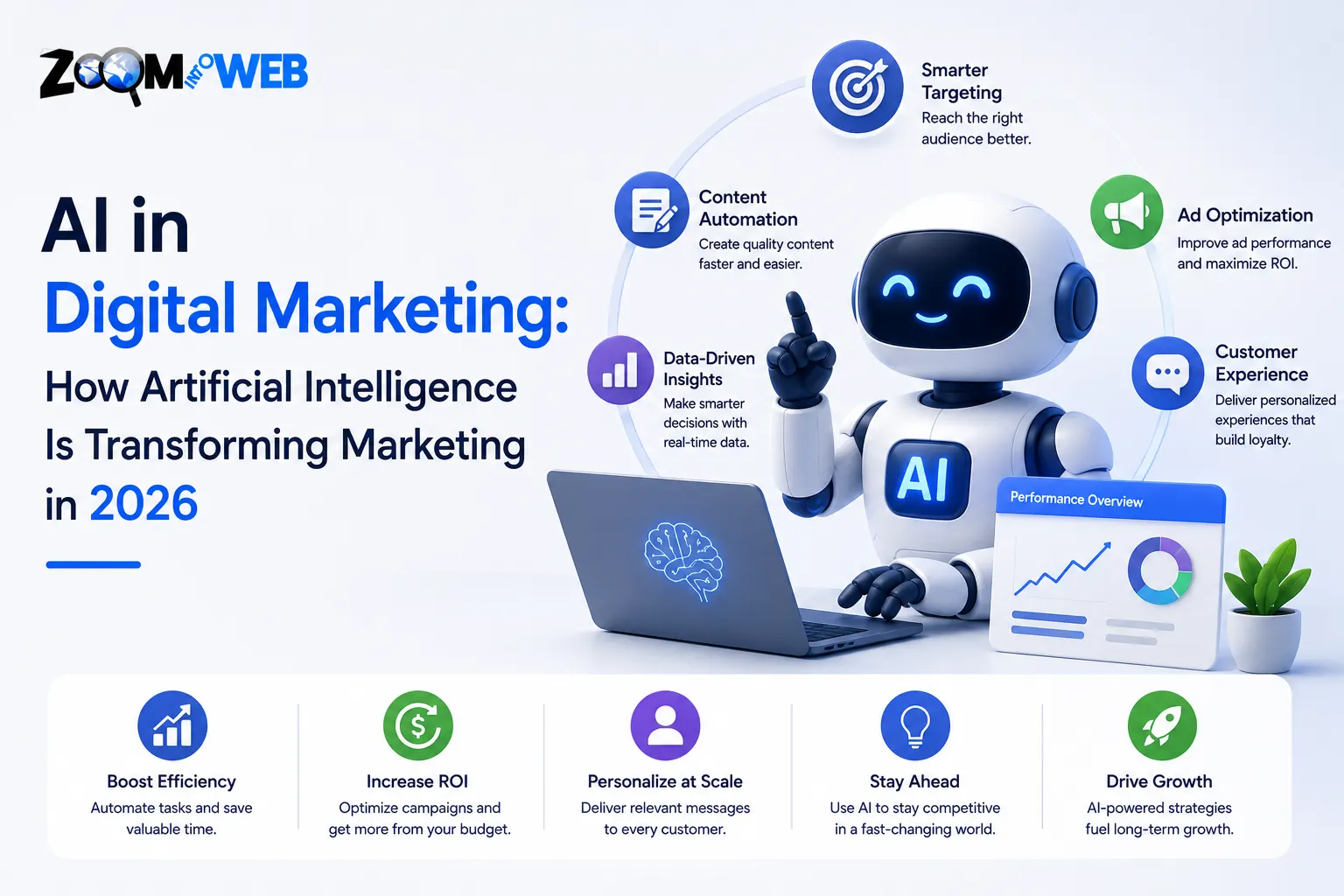
Artificial Intelligence (AI) has revolutionized the way companies plan, implement, and monitor digital marketing. From studying customer behavior to improving advertising campaigns, to producing content and addressing customer queries, AI can help marketing teams to work more efficiently and make better choices.
Yet, AI is not simply focused on automating every marketing process. The most effective method is to combine AI’s capacity in processing data to do repetitive tasks, with human intelligence and strategically minded thinking, brand awareness, and judgement.
This guide will explain the meaning of AI is in the field of digital marketing entails and how companies use it across all major channels of marketing It also explains the benefits and potential dangers, the tools used and the best way for businesses to develop a strong AI-powered marketing strategy by 2026.
What Is AI in Digital Marketing?
AI used in marketing digitally is the process of using artificial intelligence to analyze data, comprehend customer behavior, produce content automate processes, forecast outcomes, customize experiences, and improve marketing campaigns.
Modern AI marketing incorporates machine learning and natural language processing generative AI predictive analytics recommendation systems, conversational AI and increasingly AI agents. These tools enable marketers to go beyond just analyzing what has occurred to determine what might be the next thing that happens and determining the best actions can be taken.
How Does AI Work in Digital Marketing?
AI systems process huge amounts of data, including the behavior of users on websites, search results for customers’ data campaign performance, purchases history, and engagement indicators. Machine learning is able to detect patterns, and it can generate AI can create images, text and other marketing assets.
For instance, AI can identify customers who are most likely to be converted, suggest relevant products, design an initial email marketing campaign, or identify an unreliable advertisement that requires focus.
What Is the Difference Between Traditional Marketing and AI-Driven Marketing?
Traditional marketing relies heavily on research conducted manually as well as predefined groups, fixed campaigns, and historical reports. AI-driven marketing analyzes data in real-time, finds patterns, customizes customer experiences, and facilitates more efficient improvement.
The objective isn’t to eradicate traditional marketing expertise. However, AI allows marketers to reduce the time they spend on repetitive tasks and focus on strategic thinking, innovation, and relationships with customers.
What Are the Main Types of AI Used in Marketing?
- Artificial Intelligence Predictive: It predicts consumer behavior and conversions, churn, and the outcomes of campaigns.
- Generative Artificial Intelligence: Drafts email messages, content, ad images, and additional marketing resources.
- Artificial Intelligence: Chatbots are powered by AI and provide interactive experiences for customers.
- Recommendation and personalization methods: Suggest products, brands, or services according to the behavior of customers.
- AI Agents: Complete multi-step tasks with approved information guidelines, instructions, and workflows.
Artificial Intelligence agents have become more crucial because they can go beyond responding to individual requests and can support multi-step marketing workflows.
Why Is AI Becoming Important for Digital Marketing in 2026?
The expectations of customers are growing while marketing teams have to deal with an increase in data, channels content requirements and competition. AI can assist businesses in responding quicker and more efficiently to personalize marketing on an amount that’s difficult to do manually.
Salesforce’s 2026 research shows that 81 percent of the marketers from India have embraced AI and that fragmented customer information remains a major obstacle to AI-driven engagement that is effective.
How Is AI Used in Digital Marketing?
1. AI for Search Engine Optimization (SEO)
AI is able to assist with SEO analysis, research content planning, and optimization.
AI Keyword and Search Intent Analysis
AI can manage huge sets of keywords, recognize relevant queries, categorize search intent, and discover the connections between topics.
AI-Powered Content Optimization
AI helps to identify the missing subtopics, enhance the structure of content, and also evaluate pages against search intent. Human review is still essential for quality, accuracy, and experience.
Competitor and SERP Analysis
AI can analyze pages to find common themes of gaps in content or patterns of search intent, and even opportunities to differentiate.
Technical SEO Analysis
AI assists in the identification of issues like damaged links, indexing issues of meta-data inconsistencies, and other signals from the technical world.
Internal Linking and Content Gap Analysis
AI recognizes connections between pages and suggests appropriate internal links or subjects.
Predictive SEO and Traffic Forecasting
Predictive models allow you to look at historical performance and predict possible trends in conversion or traffic. These forecasts must be considered as decision-support tools, not sure-fire predictions.
2. AI for Content Marketing
AI can assist in almost every step of creation, from research to distribution.
Content Ideation and Topic Research
AI can help customers identify questions as well as related topics, content gaps, as well as potential angles.
Content Briefs and Outlines
AI transforms research into structured shorts which help writers tackle important subjects and understand search intent.
AI-Assisted Content Creation
Generative AI can create drafts, summarize headlines, social media posts, and many other types of assets. But publishing unrefined AI-generated content may cause brands, factual and originality problems.
Content Repurposing
A long-form article may be turned into emails from Twitter posts, shorter-form scripts for FAQs, and many other formats.
Personalization at Scale
AI can alter content to suit the needs of customers based on their behaviors, interests, stages in the buying process, or prior interactions.
Content Quality and Human Editorial Review
Human experts must verify the evidence such as examples, claims, style, originality, and the brand’s positioning prior to publication.
3. AI for Search, AEO and Generative Search
Search is evolving beyond the traditional list of links. Google offers AI-powered experience like AI Overviews, and AI Mode as well as Search Console has begun introducing specific reporting to help users understand AI-powered generative AI features.
How AI Is Changing the Way People Search
Users are increasingly able to ask complicated conversational questions and anticipate automated answers instead of browsing through several websites.
What Are AI Overviews and AI Search?
AI-powered search results draw data from a variety of sources to provide answers to difficult questions. This is why authority, relevance, as well as clarity, and supporting data are increasingly crucial.
How Can AI Help Businesses Optimize Answer-Based Search?
AI helps marketers understand questions in conversation and determine the most frequently asked questions. It can also help arrange information in a clear manner, and design content that is specifically tailored to user demands.
Creating Content That AI Systems Can Understand and Cite
Companies should concentrate on clear and concise headings, clear structure of clear answers, evidence-based proof, unique information with strong internal links, and pages that are accessible to technical users.
Why Original Expertise Matters in AI Search
Google’s guideline emphasizes the importance of unique, valuable, and people-focused content, rather than efforts to alter AI search engines using artificial “GEO” techniques.
4. AI for Pay-Per-Click (PPC) and Paid Advertising
AI can analyze audiences and automate bidding. AI can also generate advertisements with different advertising formats, determine conversion patterns, and improve campaign performance.
It could aid in the targeting of audiences and budget allocation, copywriting as well as test of creativity, prediction of conversion, and analysis of performance. Human marketers must still oversee the objectives of their campaigns, their budgets, positioning, brand guidelines, and strategic choices.
5. AI for Social Media Marketing
AI can assist marketers in creating social media content and analyzing engagement, monitoring the mood, spot trends, and automate the process of customer interaction and publishing.
Social listening tools are able to identify conversations that surround products, brands, or even an industry. AI-assisted personalizedization can assist businesses in making more meaningful interactions.
6. AI for Email Marketing
AI can divide groups based on their behavior and personalize content for email as well as suggest times to send emails and generate subject-line variations and assist with lead nurture.
Instead of bombarding the customers with identical messages to each subscriber, companies can make use of customer information to send more relevant messages at various points along the customer’s journey.
7. AI-Powered Chatbots and Conversational Marketing
AI chatbots can answer frequently asked questions, identify leads, give details about products, and assist customers 24/7.
For businesses that receive a lot of repetitive requests A conversational AI system can cut down the time to respond while allowing human staff to focus on the more complicated customer needs.
8. AI for Marketing Analytics and Predictive Insights
AI can transform large amounts of data into actionable information by identifying patterns that might be difficult to spot manually.
Applications include analysis of customer behavior and predictive lead scoring forecasting conversions estimates of the lifetime value of a customer as well as churn prediction. campaign measurement.
9. AI for Marketing Automation
AI can automate repetitive tasks such as lead nurturing reporting, segmentation of customers following ups, and campaign workflows.
The next step is called agentic marketing. AI agents monitor data to identify opportunities, make recommendations for actions, and execute approved multi-step tasks.
What Are the Benefits of AI in Digital Marketing?
The most important benefits are:
- Increased efficiency in marketing by reducing manual repetitive work.
- More efficient content creation by using AI-assisted research and drafts.
- Improved personalization by analyzing customer behavior and preferences.
- Enhance customer insight by analyzing large-scale data.
- Better targeted by identifying the most relevant audiences.
- Improved campaign optimization by continuous analysis of performance.
- More efficient decision-making through the transformation of information into useful insights.
- Reduction of repetitive work so that marketers can concentrate on more valuable activities.
- Better customer experience by facilitating faster and better-informed interactions.
- Potentially higher ROI on marketing if AI is implemented in line with measurable business goals.
Salesforce’s 2026 research on marketing provides higher ROI, better customer satisfaction, higher conversion rates and lower marketing expenses for companies using AI but the outcomes are contingent on the implementation the quality of data, implementation, and the business context.
What Are the Challenges and Risks of AI in Digital Marketing?
AI can also pose significant risks. Data of customers must be handled with care, and AI-generated data can be inaccurate or even hallucinations. The algorithms can replicate biases, and over-automation can damage customer relations and brand voice.
Companies should also think about intellectual property, copyrights as well as third-party platform dependence on cybersecurity, employee education, and the necessity of human supervision.
AI vs Human Marketers: What Should Be Automated and What Shouldn’t?
AI is ideal for routine, data-intensive and pattern-based processes like segmentation, reporting as well as preliminary study, writing content as well as performance tracking.
Human-powered marketers are vital to branding strategies, position, innovative direction, building relationships and ethical choices, customer understanding, and ultimately, their approval.
The best model is humans + AI and not AI against humans.
What Are the Best AI Tools for Digital Marketing?
The ideal tool will depend on the business’s marketing goals. Businesses can evaluate AI tools based on:
| Category | Primary use |
| SEO | Keyword research and content analysis, as well as technical audits |
| Content | Drafting, research, ideation and editing |
| Social media | Content creation, scheduling, sentiment analysis |
| Personalization, segmentation, optimization | |
| PPC | Bidding, targeting, and creative testing |
| Analytics | Forecasting, insights, attribution |
| Customer support | Chatbots and lead qualifiers chat-based marketing |
When choosing a tool, you should think about the accuracy of integrations, accuracy, and data privacy, as well as scaling, pricing, and the need for human review instead of selecting a tool solely because it is widely used.
How to Build an AI-Powered Digital Marketing Strategy
The process of implementation in practice is:
- Identify your marketing goals.
- Audit existing marketing processes.
- Find repetitive jobs that can be automated.
- Select the tools you need in accordance with business needs.
- Connect AI to the marketing tech stack.
- Human review, as well as guidelines for branding.
- Check AI-based workflows using small-scale campaigns.
- Monitor performance and optimize.
- Scale only workflows that show worth.
The most crucial thing to remember is to begin with the problem and not use AI software. The current guidance from HubSpot also suggests finding a specific business challenge prior to deciding on an AI application that can solve the issue.
How to Measure the ROI of AI in Digital Marketing
AI is best measured by business results, not the quantity of tasks that are performed by AI.
Key KPIs to consider include the cost per lead and conversion rate as well as the cost to acquire customers, return on advertising spend as well as the lifetime value of customers, organic engagement, traffic lead qualified by marketing as well as revenue and time saved.
Simple solutions are:
AI Marketing ROI = (Additional Revenue + Cost Savings – AI Investment) / AI Investment x 100
The precise calculation must be adjusted to the company model and the campaign’s goal.
Real-World Examples of AI in Digital Marketing
AI is currently being applied to recommendations for products, personal customer journeys, the creation of content Chatbots, advertising optimization, and even predictive analytics.
For instance, an e-commerce business can make use of AI to suggest items based upon browsing patterns and buying habits. A B2B business can make use of the predictive scoring of leads to rank potential customers. Marketing teams can make use of artificial intelligence to design the initial variations of a campaign while human experts approve the final message.
How AI Is Changing Digital Marketing for Indian Businesses
AI is a great option for Indian businesses due to its diverse audience, languages, and regions, and rapid growth in digital adoption.
Businesses can make use of AI to improve local SEO Multilingual local and national content personalized campaigns, lead generation, e-commerce suggestions and for performance marketing.
For smaller and mid-sized enterprises, the most effective starting point is not necessarily a complicated AI transformation. Automating a single, quantifiable issue like lead follow-ups, reports on content, research into the customer or customer FAQs–may provide an effective foundation for further adoption.
What Is the Future of AI in Digital Marketing?
The future is moving toward AI agents, predictive campaign optimization, hyper-personalization, multimodal content, conversational search, and AI-powered discovery.
AI agents will increasingly manage multi-step workflows as marketers focus on strategy, innovation governance, strategy, and customer relations. HubSpot’s 2026 research also includes AI agents as well as hyper-personalized marketing as well as AI-driven content and increasingly autonomous workflows as key changes.
However, first-party data and privacy will become more important as AI performance is heavily dependent upon the accessibility and quality of information from customers.
How Should Businesses Prepare for the AI-Driven Future of Marketing?
Businesses should develop solid first-party data strategies, educate marketing teams and create AI governance, keep up with the standards of editorial excellence, and concentrate always on customer experience.
The most important thing is to be wary of adopting AI because of the fact that competitors are already using it. Each AI investment must be based on a clearly defined objective, clearly defined workflow, responsible humans in charge, and a a measurable business result.
Frequently Asked Questions About AI in Digital Marketing
What exactly is AI in the field of digital marketing?
AI is used in the field of digital marketing. It refers to the use of artificial intelligence in digital marketing to analyze data, predict behavior, customize experiences, create material, streamline workflows, and enhance marketing campaigns.
What is AI utilized in the field of digital marketing?
AI is employed in the field of digital marketing in SEO Content marketing PPC as well as emails marketing, social media chatbots analysis, personalization, and marketing automation.
What are the advantages of AI marketing via digital channels?
AI can boost efficiency and personalization data analysis, marketing optimization and customer experience and possibly even marketing ROI.
What are the top AI tools for digital marketing?
The ideal tool will depend on the goal of the business. SEO and content, as well as marketing, analytics, email and customer support platforms all have various AI capabilities.
What is AI? How can AI aid SEO?
AI can help with keyword analysis, research-intent search, as well as content optimization analysis of competitors’ internal linking audits, technical audits and forecasting.
Can AI replace digital marketers?
AI can automate a variety of routine tasks, but it doesn’t remove the need for human decision-making and creativity, judgement, skills, and ethical supervision.
Does AI-generated content help SEO?
AI-generated content is useful in the event that it can help create useful data. Companies should focus on accuracy, authenticity, knowledge, and utility over producing huge amounts of content that are generic.
What is the impact of AI influence Google Search?
AI is changing the way that users search for information using experiences like AI overviews as well as AI Mode. Google continues to promote useful, original content as well as the fundamental SEO practices that are used in these experiences.
What is the term “generative”? AI in the field of digital marketing?
Generative AI creates new content, such as images, text, proposals, summaries, and advertisements along with other advertising assets based upon instructions and the information that is available.
What is the difference between AI marketing and automation of marketing?
Marketing automation typically follows predefined workflows, whereas AI can analyze data to identify patterns, produce outputs, predict, and more often, support flexible or multi-step decision making.
What can small-scale businesses do with AI to enhance their digital marketing?
Small-scale businesses can start with practical examples of use cases like content research, FAQs for customers, and lead follow-ups. They can also use reporting SEO analysis, emails for personalization, as well as social media-related workflows.
What are the dangers of making use of AI to market?
Risks include incorrect data, privacy concerns as well as bias, copyright issues as well as weak brand voice security concerns, over-automation and reliance of third-party AI systems.
What can companies do to measure AI in the ROI of marketing?
Companies should evaluate the ROI of AI-related investments against tangible improvements like increased revenue, lower cost of acquisition, more conversions, reduced time for employees, and lower operating expenses.
Final Takeaway: AI Should Augment Marketing, Not Replace It
AI transforms digital marketing, enabling businesses to comprehend their customers, automate repetitive tasks to personalize customer experiences, analyze data, develop content, and improve campaigns more efficiently.
However, the success of AI marketing isn’t about giving the entire marketing process to machines. The best results result from mixing AI’s agility and analytical abilities with human-like strategy, imagination as well as expertise and judgement.
Businesses that are preparing to 2026 or beyond, the focus is to clearly define the most important issues in marketing, and adopt AI to create tangible improvements, safeguard customers’ data, keep the oversight of humans, and continually monitor the outcomes.
If implemented in a strategic manner, AI can become more than just a tool for creating content. It can be an integral element of a modern online marketing platform that can help companies compete, change, and expand.
Written by the Zoom Into Web Team
This content was written by the Zoom Into Web team, combining hands-on experience in web development, software solutions, and digital marketing. We create accurate, practical, and up-to-date content to help businesses make informed technology decisions.
