
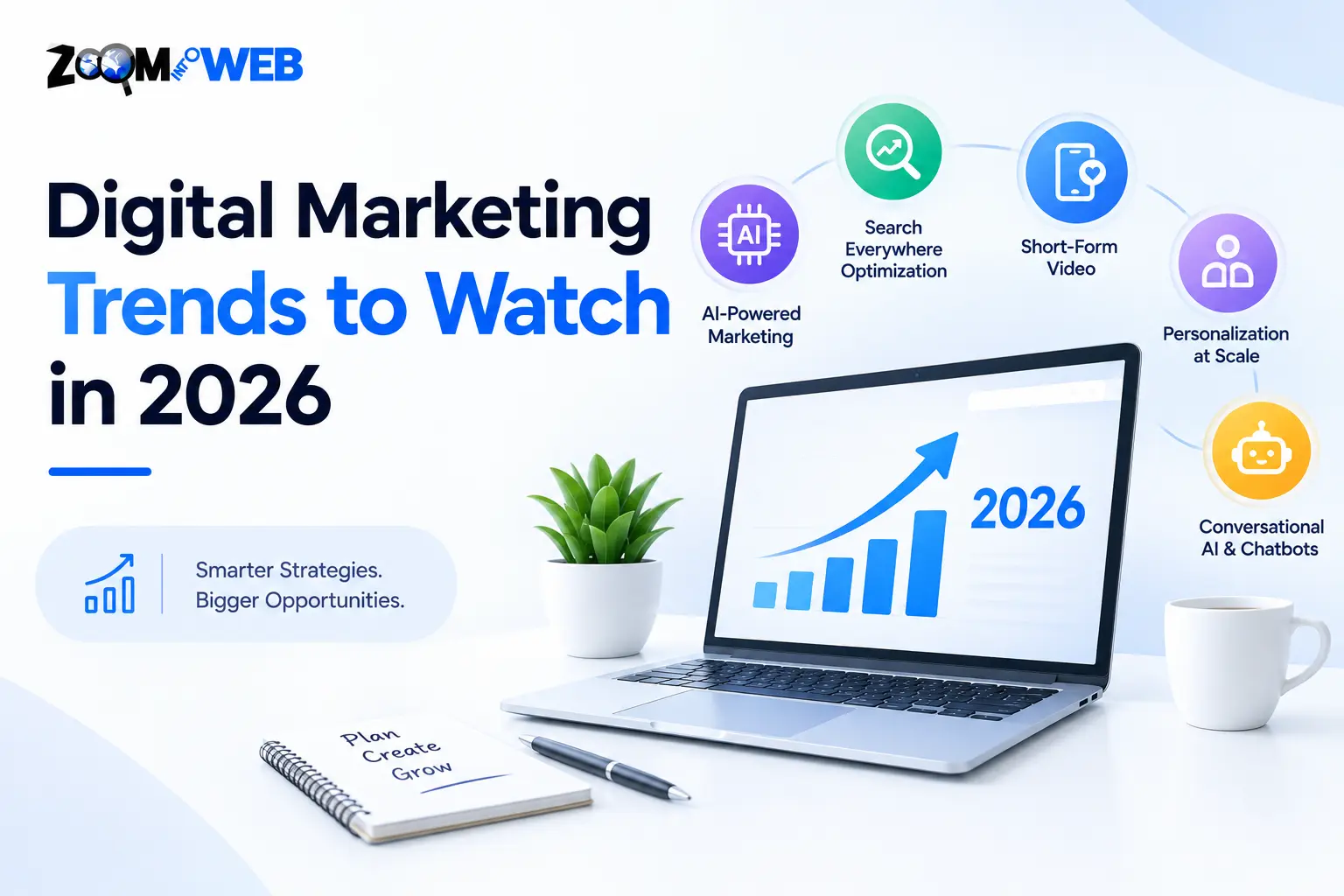
In 2026, traditional search engine optimization (SEO) and social media marketing will yield diminishing returns. Innovative businesses will embrace marketing in the first party data and AI realm, and embrace the use of personalized, shorter content in the work-up to the sale, as well as integrated, experienced-centric marketing.
Although the pace of marketing change will appear rapid to the outside observer, there are numerous opportunities to implement marketing strategies in alignment with the objectives of your business, in the channels most frequented by your customers. It is the responsible marketing management imperative to integrate such strategies.
The market-facing strategies most likely to dominate marketing in 2026 are integrated strategies in:
- AI marketing
- AI search and GEO
- Social marketing and platforms
- Privacy marketing and strategy
- Personalized and customized content
- Short-form content
- Creator marketing
- Social commerce
- Loyalty marketing
Marketing strategies designed to influence customer loyalty will also promote and augment marketing strategies designed to facilitate customer retention and increase lifetime value (LTV). Marketing in 2026 will also witness continued emphasis on marketing funnel and customer journey alignment. Marketing efforts will remain centered on influencing customer attraction, conversion, and retention.
2. AI Search, AEO and GEO
Traditional search engines aren’t the only options for finding information online anymore. More people are turning to AI and other alternative search methods.
With the growing interest in these methods, new forms of search engine optimization are developing as well. These include AEO (Answer Engine Optimization) and GEO (Generative Engine Optimization).
Write easy to understand content that contains the information your audience is looking for. To do this effectively, incorporate relevant and reliable citations to support your points and maintain a clear and logical content structure.
It’s important to stay current with the latest changes in traditional search engines (i.e. Google) as well as the other alternative search methods (i.e. AI) to help your audience find the information they need.
3. Search Beyond Google
Users are aware of several different methods they can use to find the information they need. Traditional search engines aren’t the only options. People can find information on various social media sites and other streaming services. They can also find information using various AI and voice search engines.
Because of this, a broader approach to search engine optimization is necessary.
When creating content, determine what information your audience needs and how best to reach them. It’s also important to understand where your audience goes to find the information they need to make informed decisions.
4. The Rise of First Party Data and Privacy in Marketing
The focus of marketing is shifting toward privacy. Because of increased restrictions and restrictions on marketing, the value of first party data is increasing.
First party data is collected directly from customers. It can be collected from customers simply using a company’s web site and services.
Transparent data collection and automatic, apparent, and responsible algorithms lead to higher trust and acceptance among the users. And who would not want to gather as much information as possible?
5. Personalization with Artificial Intelligence
Consumers are willing to accept marketing messages only if they are relevant. Irrelevant messages are simply ignored.
Marketing messages are only one type of automated and personalized content. Based on customer data and artificial intelligence, websites can personalize product recommendations.
Editing the website to show or hide different content elements can be done using artificial intelligence and personalization to show different website content to different users.
It is important that the messages and recommendations offered be personally valuable to the consumer and not invade the consumer’s privacy.
6. The Rise of Tik Tok and Other Interactive Media
Short videos are easy to consume and help businesses quickly communicate and promote a product or service.
Videos can be personalized and interactive. Other short video content can facilitate and teach consumers how to use a product and can answer consumers’ questions.
Every business video should be goal-oriented to promote a service or product, build or increase consumer awareness or knowledge, or entertain consumers.
7. Social Media is a Search Engine
Posts on social media can be optimized to improve their ranking.
Users often turn to social media to find products and services, as well as information on how to do something or explain something.
These types of posts should include pertinent information and answers to common consumer questions to increase their likelihood of being found.
Content created by users and firsthand testimonials from customers are important for discovery and trust.
8. Increasing Importance of Authenticity in Creator and Influencer Marketing
Trust and relevance are important for choosing influencers.
Micro and nano creators are important to reach niche markets.
When working with an influencer, it is important for a brand to establish a partnership where the creator can maintain control over their content.
The customer journey is becoming abbreviated because of the integration of multiple functions (i.e. content and recommendations) within social platforms.
Social platforms have integrated functions to allow users to discover, recommend, and purchase products. Creators and influencers can help educate consumers about a product and lead them to purchase. User generated content can also help consumers make purchasing decisions.
Having a number of touchpoints allows customers to interact with a brand across multiple channels.
Using CRM and other tools to integrate and unify a customer experience across multiple touchpoints allows a customer to seamlessly move from one touchpoint to another.
The Value of Real-World Experience Will Increase
AI has made content creation faster, but less distinct.
Standing out will rely more on profound understanding, rather than speed, when it comes to content creation.
There are many ways to give content an edge. Content can be informed by first-hand experience and/or research. Additionally, case studies and examples can help give content an edge. Also, content can distinguish itself by employing a memorable brand of voice.
Ultimately, the goal of content creation should be providing information and insight that is not available from generic sources. While the use of AI in content creation can help brainstorm and organize information, unique and profound content should go beyond what is generatable.
12. Video, Live and Real-Time Marketing
There are many opportunities beyond traditional, edited, short format videos, to use real-time interactions to engage customers.
Examples of live, real-time interactions include virtual classes and demonstrations. And there is a growing trend of using live, real-time connections to engage customers during the shopping process.
13. Marketing Using AR, VR and Other Real-world, Immersive Technologies
There are many opportunities for brands to engage and inform customers by using products and services that integrate AR and VR.
Brands should focus on customer value and experience using immersive technology, and not on using the latest and most advanced technology.
14. Marketing Trust and Transparency
Customers are more discerning about how brands manage data, create and communicate offers, work with partners, and manage sustainability.
There is a growing requirement for trust and transparency in all areas of marketing.
Communication plays a part, but practices must also be supported by actionable strategies and evidence. Eventually, consumers will stop trusting a brand if the brand makes unsubstantiated claims.
Marketing is measuring and analyzing business outcomes instead of marketing outputs.
It is important to measure and analyze marketing activities that lead to the generation of business revenue.
The customer journey requires a holistic view of marketing. Marketers must determine which channels drive customers to complete a purchase.
To measure the marketing funnel, there must be an understanding of channel and business priorities.
AI, automation, and other software innovations have altered every aspect of the customer’s journey. It is important to understand the best channels to communicate with customers at every stage of the marketing funnel. How will your business communicate with customers to educate them about your brand? What channels will you use to engage and create customers? Will you utilize marketing channels to increase customer retention and advocacy? How will you use marketing to facilitate customers purchasing your products?
Marketing strategies for 2026 will be heavily reliant on automation to generate insights for first party data, and assist with content and software development, all while implementing strategies to gain and retain customers.
Create clear, thorough content that increases discoverability through search and AI.
Create short-form content to address customer questions and business goals.
Create TikToks or other short-form content to answer customer questions.
Create a unified customer experience across all channels through the integration of your analytics and CRM.
Prioritize business outcomes over website metrics.
Our Digital Marketing Trends for 2025 and 2026
In 2025, most businesses were still evaluating various technologies. By 2026, most businesses had integrated multiple technologies to create better customer experiences.
What are the most important Digital Marketing Trends?
Ultimately, the most critical trends for your business will depend on your business goals.
To Improve Your Business Visibility
You will want to focus on multiple areas including content, search, social, geo, eo, and pedology.
To Improve Your Business Leads
You can focus on personalization and automation.
To Improve Your Business Revenues
You can focus on first-party data, personalization, and pedology.
To Improve Your Business Retention
You can focus on first-party data, pedology, and experience.
Digital Marketing Trends FAQs
What are the most important Digital Marketing Trends for 2026?
Trends to watch include the integration of AI and pedology, GEO and AEO, marketing automation, short-form video, content personalization, social search, omnichannel marketing, and Creator and Social Commerce.
What role does AI play in digital marketing?
AI already helps marketers automate and augment various aspects of their jobs, from data analysis to campaign and content creation. The marketers that use these tools will continue to gain a competitive edge in the marketplace.
Will search engine optimization (SEO) still be relevant in 2026?
Yes. While there will be additional ways to find online information beyond traditional search engines, SEO will remain critical to help marketers ensure their content is optimized for various online platforms and to position their brands and products to compete for customer attention and interactions.
What is Generative Engine Optimization (GEO)?
Like traditional SEO, GEO aims to help marketers optimize their content and brands to appear in AI response summaries.
What is Answer Engine Optimization (AEO)?
This strategy focuses on helping marketers develop content to respond to customer questions and other types of searches and interact with various AI interfaces.
Why is first-party data important?
Marketers who use first-party data are better positioned to develop long-term, mutually beneficial, and moral business relationships with their customers.
Will marketing via short-form videos still be effective in 2026?
Short-form videos are effective marketing tools to raise awareness and promote products. Marketers should consider the preferences of their target audiences when using this format.
What changes in digital marketing should local businesses be concerned about?
Local businesses should be concerned about meeting the needs of their customers. Other strategies to improve their business and position their products and services for success should include improving their websites, utilizing various social media platforms, developing first-party data relationships, and strategically utilizing AI tools.
To succeed, a business must provide quality content, provide honest services, protect a customer’s privacy, and preserve a profitable business. A business must evolve with the consumer.
Channels that comprise a business’s marketing strategy may overlap with the consumer’s preferences. For instance, the consumer may appreciate short video content, and the marketing strategy may incorporate short videos, as well as different formats, in a range of digital channels.
The Zoom Into Web team encompasses a wealth of knowledge in various facets of digital marketing. If you seek to gain a marketing edge over your competition, contact Zoom Into Web for a free marketing analysis. .
