
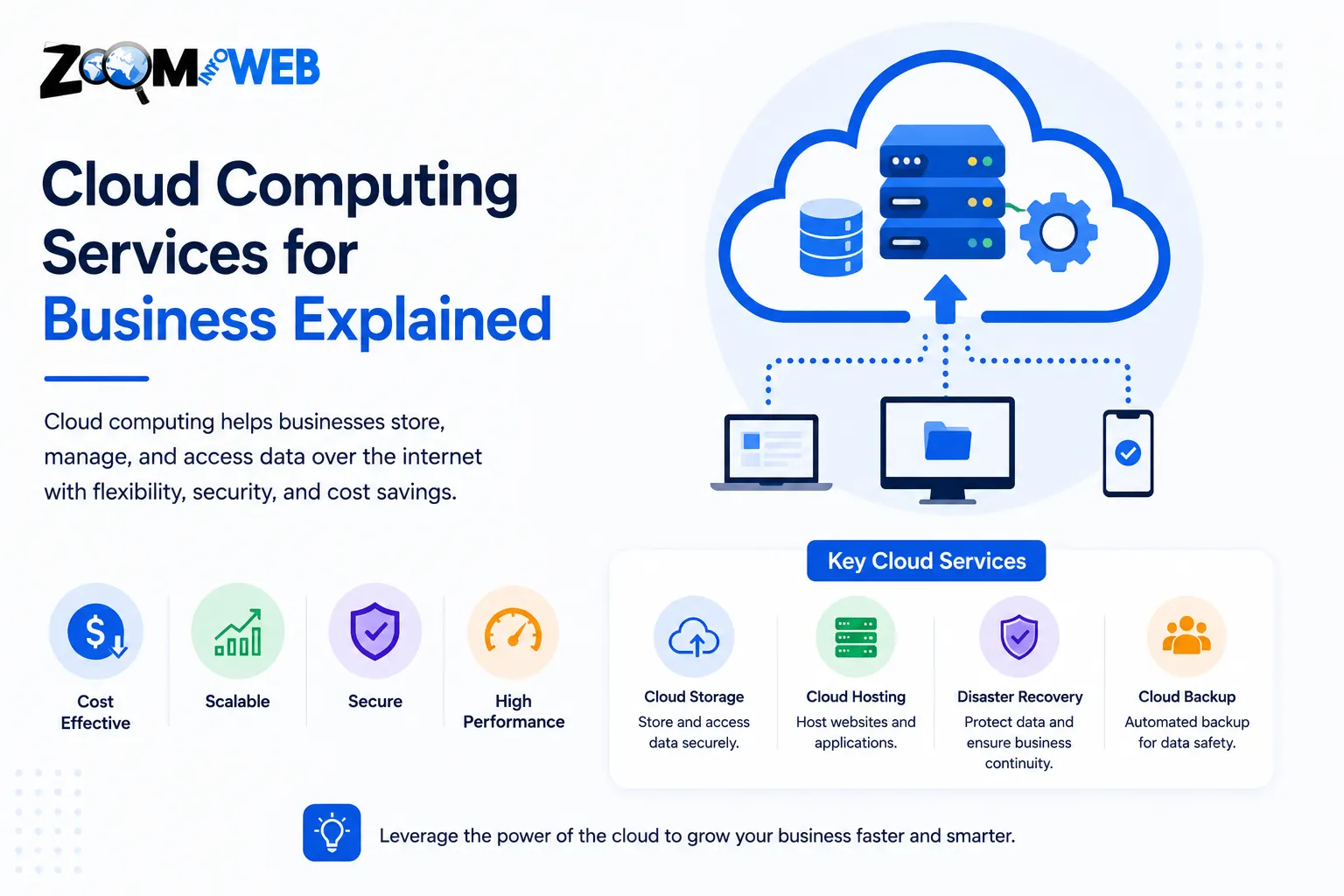
The adoption of cloud computing is happening at a fast pace among companies due to its intelligent, quick, and efficient way of doing business without the need for costly equipment and huge internal IT departments.
This technology solves common tech problems in a manner that is easily accessible to all types of companies. On the other hand, those firms that are reluctant to adopt cloud computing will have to bear more costs in setting up and maintaining their infrastructures compared to their competitors who have already made progress.
What are cloud computing services for business?
Cloud computing refers to delivering computing services, including servers, storage, databases, networking, software, and analytics. Over the internet instead of relying on physical hardware on-site.
Businesses can access technology resources whenever they need them without investing heavily in infrastructure.
Some common business cloud software includes:
- Cloud storage and backup
- Business applications and software
- Data analytics platforms
- Email and collaboration tools
- Customer relationship management (CRM) systems
- Virtual servers and databases.
For example, a company using online accounting software doesn’t need to install programs on every computer. Employees simply log in through the internet and access the system from anywhere.
The importance of cloud migration services
Moving existing systems to the cloud can be complex. This is why many businesses use professional cloud migration services.
Cloud migration typically involves assessing current infrastructure, planning migration strategies, moving applications and data, testing systems, and optimizing performance.
A manufacturing company, for instance, may migrate its inventory management system to the cloud to improve accessibility and reduce maintenance costs.
Working with experts helps businesses avoid disruptions and ensures a smooth transition.
Key Benefits of Cloud Computing Services for Business
The deployment of IT infrastructure has always been costly because of expensive servers, hardware, and IT professionals. What concerns cloud services, then? You should expect to pay either on demand or subscribe to a bundle of services under budget constraints.
For example, a growing retail company would be able to increase storage capacity during peak times without having to buy additional hardware.
Scalability is another advantage of cloud computing. It would be possible to add more resources when needed and to reduce their number in case they are not required to avoid any wasted spending on idle infrastructure.
The modern cloud providers offer good security measures like encryption and multi-factor authentication. They analyze threats, do data backups, and help with compliance, thus making data security better through increased control and visibility.
Employees will be able to access applications and files regardless of their location: at home, at the office, or via mobile devices. In this way, employees become productive and flexible.
Some other benefits of cloud services include automatic backup and disaster recovery services, which allow faster recovery after disruptions.
Types of cloud services for business
Infrastructure as a Service (IaaS) provides virtual servers, networking, and storage resources over the internet.
Platform as a Service (PaaS) offers a complete environment for application development and deployment. Developers can build, test, and launch applications without managing the underlying infrastructure.
Software as a Service (SaaS) provides software applications through a web browser. Businesses prefer SaaS because it eliminates installation and maintenance requirements.
Best Practices for Cloud Adoption
Proper cloud deployment involves developing a strategy.
It is important for enterprises to undertake an analysis of the existing IT infrastructure before switching to the cloud. Knowledge about the existing systems and applications and the degree of security needed enables understanding the scope of possible transitions and actions that have to be taken.
Having a well-developed cloud deployment strategy ensures that the investment into cloud computing serves the purposes of the enterprise. Such a strategy should involve aspects like identification of services that will be moved to the cloud, business goals, timeline, and resources.
Security is also a key aspect of cloud deployment. In order to ensure the security of the data, to protect and manage it, and to comply with all industry standards, regular analysis and monitoring of the system are needed.
Choosing a specific cloud model is an important part of cloud deployment since it defines the balance between flexibility, security, and cost. The choice of cloud deployment model depends on various factors, including the needs of the business.
The future of cloud computing for businesses
Cloud technology is evolving faster than ever, and it is becoming a key driver of digital transformation across industries. What started as software for online storage and data backup has now grown into a powerful ecosystem that supports innovation, automation, and business growth.
Companies that invest in cloud computing services for business today are building a strong foundation for the future.
Artificial intelligence (AI) and machine learning (ML) are increasingly being integrated into cloud platforms. Businesses can now use cloud-based AI tools to analyze customer behavior, automate repetitive tasks, improve decision-making, predict market trends, and deliver personalized customer experiences.
FAQs: Cloud Computing Services for Business
What are the advantages of cloud computing for businesses?
Businesses benefit from cloud computing because it promotes growth, allows saving money, protects the information, and enables collaboration.
What will be the cost of migration to the cloud?
There is no exact answer when it comes to migrating to the cloud. The cost is different for each organization, and it depends on several factors such as migration complexity, amount of information transferred, and other business specifics.
Is cloud computing beneficial for small businesses?
Absolutely, small businesses benefit a lot from cloud computing because they reduce IT costs substantially and enjoy the flexibility of scaling operations.
Which industries use cloud computing more?
Healthcare, finance, retail, manufacturing, education, and technology are those industries that use cloud computing solutions mostly.
Is cloud computing beneficial for teams?
Cloud computing is beneficial for teams because it provides the possibility to access information and applications from everywhere securely.
Conclusion
Cloud computing technology forms a key element in the modern corporate world. Cloud technology makes it easy for a business to grow or contract as necessary, safeguarding its data and making significant cost savings and helping the company function more efficiently.
This kind of technology is very helpful in online storage, application hosting, and other digital solutions for business. This is one of those things that can revolutionize your business when used correctly.
With careful planning, consideration for security, and choosing the best cloud service provider for your business, you can make sure that you are well placed for success. The integration of cloud technology with our digital and IT consulting services can help improve the efficiency of your business and make better technological decisions.
ABOUT THE AUTHOR
Content written by Nayana
Nayana is part of the expert content marketing team at ZoomIntoWeb. She has expertise in curating meaningful information that can be used by visitors in general. Nayana is also involved in creating client-specific stories and blogs.

Comments are closed