
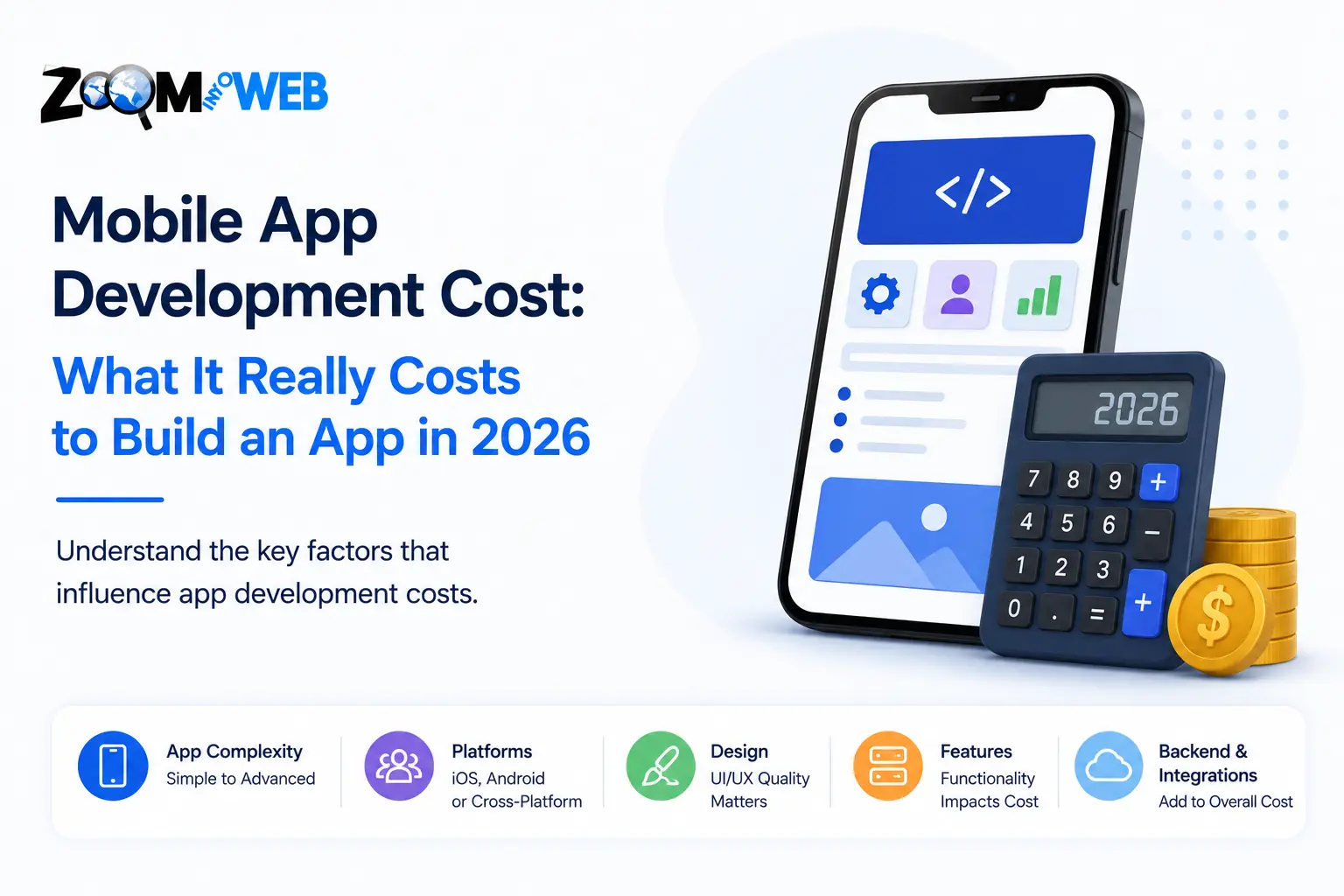
In 2026, app development cost varies greatly from $10,000 to over $500,000. The exact cost is determined by such factors as the number of complex features in your app, the platforms it supports, and the cost of your development team. Most startups and SMEs that need a fully functional product should expect to pay $40,000-$150,000 for development, while MVPs cost much less. Advanced enterprise apps may also cost much more.
At Zoom Into Web, we assist businesses in making an accurate cost estimation according to their needs to ensure that all features added are valuable. In this guide, we will analyze all major factors affecting development costs and provide examples of apps and the costs associated with their development.
Cost by App Complexity, With Real Feature Examples
App Development Cost by Complexity
| Complexity | Features | Typical Cost | Timeline |
| MVP or Simple Apps | User login, basic forms, non-dynamic/static content, minimum backend operations, no payment gateways | Lower five-figure range | 6–12 weeks |
| Mid-Level Complexity Apps | User accounts, dynamic content, in-app payments, custom UI, multiple third-party integrations | Mid-five-figure to low-six-figure range | 3–6 months |
| Enterprise Applications | Real-time syncing, AI-driven solutions, multiple user roles, compliance, enterprise integrations | Starts at six figures | 6–12+ months |
MVP or Simple Apps
Simple apps usually contain features such as user login, basic forms, non-dynamic/static content, minimum backend operations, and no payment gateways. Such projects usually cost somewhere in the lower five-figure range and take about 6 to 12 weeks to build.
Mid-Level Complexity Apps
Apps that have user accounts, dynamic content from databases, in-app payments, custom user interfaces, and multiple third-party integrations will need more development effort and testing time. They usually cost somewhere between the mid-five-figure and low-six-figure range and take around 3 to 6 months.
Enterprise Applications
Enterprise-level apps may feature real-time data syncing capabilities, AI-driven solutions, various user roles, compliance with regulations, and integration with other systems. The development process for such software typically starts at six figures and takes 6-12+ months to be completed.
For instance, an application for booking appointments that includes a calendar function, user authentication, and payments falls into the middle category. At the same time, an online health care portal that provides video consultations, HIPAA-level security, and EHR integration is a type of an enterprise-level application.
Real Apps, Priced Out Line by Line
General ranges provide useful information, but costs will vary according to the features your app needs. In Zoom Into Web, we assess our estimates for each project on the basis of its functionality, complexity, and business goals.
Habit Tracking App (Low Complexity)
This app type includes a user login, daily checks, streaks, notifications, and some form of data storage and, therefore, is a rather straightforward project without any complex backend, making it one of the cheapest app categories to develop.
Local Services Marketplace (Medium Complexity)
An app that includes customer and service provider accounts, a search engine, bookings, payments, ratings/reviews, and push notifications is more difficult to develop, test, and integrate, thus falling into the mid-complexity category.
On-Demand Delivery App (High Complexity)
Such an app involves developing customer and driver apps, geolocation features, order matching, payments/payouts, an admin panel, and other advanced backend functions and, therefore, is a high-complexity project.
The main lesson from all this is quite simple: feature complexity and real-time functionality, not size, drive the app development cost.
Where Every Dollar Goes: The Phase-by-Phase Breakdown
Discovery & Strategy
Even though this stage takes the smallest part of the budget, it is still among the most critical parts. The discovery process involves research and analysis of competitors, technical feasibility, and setting the project scope to minimize potential risks prior to development.
UI/UX Design
This stage generally comprises one-fourth of the budget. UI/UX design includes user flows, wireframes, interactive prototypes, and a full visual design system to ensure a great user experience.
Development
This stage is the largest expense, taking up nearly half of the entire budget. Development includes frontend and backend development, API integration, database development, and implementing all features of the application.
Quality Assurance & Launch
This stage centers on quality assurance, fixing bugs, testing performance across all devices, and launching the application to both Apple’s App Store and Google Play.
Here at Zoom Into Web, we believe in discovery since it avoids unnecessary costs in the future. It will help us avoid rework, stay on track, and ensure that your money goes into building the right product.
Freelancer vs. Agency vs. In-House: Who Should Actually Build It
Freelancer
Freelancers are a good fit for simple MVPs and startups with limited budgets. They typically offer the lowest hourly rates, but quality, availability, and turnaround times can vary. Since most freelancers work independently, project management, quality assurance, and long-term support may be limited.
Agency
Agencies are ideal for businesses building mid- to high-complexity applications. While the upfront investment is higher, you gain access to a complete team of developers, designers, project managers, and QA specialists. At Zoom Into Web, we provide end-to-end app development services, ensuring every stage from planning and design to testing and post-launch support is handled by experienced professionals.
In-House Team
An in-house development team is best suited for businesses with long-term product roadmaps and continuous development needs. Although it offers greater control, it also comes with the highest ongoing costs, including salaries, benefits, software, and infrastructure.
For a simple MVP, a skilled freelancer may be enough. However, as your app grows in complexity, working with an experienced agency like Zoom Into Web often delivers better long-term value through structured project management, rigorous testing, and reliable post-launch support.
What AI Features Add to Your 2026 Budget
AI-native features are now expected as the norm, and their inclusion influences app development budgets significantly.
Some of the most expensive AI-native features to implement are:
- AI chatbots and virtual assistants: Their cost depends on whether you will use LLM API integration or develop AI workflows yourself.
- Personalization and recommendation engines: These need data pipelines and machine learning to function, making them one of the most expensive AI features to develop.
- AI-native content and image generation: Cost factors for developing them include API integration, scalability, and content moderation.
We at Zoom Into Web know how to make your business hit the sweet spot between AI capability and app development budgets. While coding AI has never been easier, thanks to the new tools, user expectations have increased too because of the added AI functionality.
Common Assumptions Worth Double-Checking
- “iOS costs more than Android” is outdated thinking. Cross-platform frameworks and standardized store processes have narrowed that gap in 2026. Budget by audience, not by platform reputation.
- A low bid isn’t a deal; it’s a question mark. When a quote comes in well under the rest, ask what’s missing before you ask why it’s cheap. QA and maintenance are the first things to get quietly dropped.
- AI shortens the timeline, not the skill requirement. Repetitive coding and testing get faster with AI tooling. Architecture, security, and system integration still need a developer who understands the tradeoffs, not just the syntax.
- The invoice doesn’t end at launch. Every app needs ongoing patches, OS updates, and bug fixes to keep functioning. Treat year-one maintenance as part of the original budget, not a follow-up ask.
- Feature count and app quality aren’t the same metric. Each additional feature adds cost, testing time, and a new way for users to get lost. The apps that perform best are usually the ones that shipped with less, not more.
Mistakes That Quietly Double Your Budget
- Skipping discovery to “save time,” then rebuilding core assumptions mid-project.
- Feature creep: approving “just one more thing” without adjusting the timeline or budget in writing.
- Defaulting to native-for-both without a specific technical reason tied to performance or hardware access.
- Choosing the lowest bid without confirming QA and maintenance are actually included in scope.
- Budgeting only through launch day, then facing a maintenance bill nobody planned for.
How to Budget for Your App: A Step-by-Step Process
- Identify the sole necessary action you have to enable a user to accomplish—everything else follows after you get that right.
- Prioritize necessary versus nice-to-have functionality; one exercise alone will drastically reduce your projected v1 cost estimate.
- Pick your development approach according to requirements of the hardware you’re supporting, and don’t rely on personal inclination.
- Get a handful of itemized estimates and compare feature-hours versus the total cost quote.
- Budget for a year’s worth of maintenance upfront before signing your first contract.
- Get your MVP live, gather the usage stats, and then invest in growth stage functionality based on user behavior, not assumptions.
This is essentially the same process we guide our new clients through at Zoom Into Web before ever putting numbers to paper.
FAQs
How much will it cost to develop a basic app in 2026?
The price of developing a basic app will lie somewhere in the lower five figures range. This cost varies based on the level of design and number of integrations required by the application.
Which one is easier or cheaper to build on iOS or Android?
Building on both platforms has become equally expensive. The choice must be based on where your potential customers hang out.
What will be the ongoing costs after the launch of my app?
Set aside a yearly proportion of your initial development cost for maintenance, plus app store costs and all additional costs associated with any third-party services you use to support your application.
How much would AI components increase the cost of developing the application in 2026?
Popular AI implementations such as a customer support chatbot or recommendation engine may increase your cost by a significant margin due to the necessity of adding a new data pipeline rather than just creating a new screen.
Freelancer or an agency for my first app?
A freelancer is a viable option for a highly basic MVP; however, agencies include quality assurance and project management in the price, something that may cost you quite a bit in the middle of a project for anything other than a single-feature application.
Key Takeaways
- App costs are driven by features and complexity.
- Start with an MVP and scale over time.
- Don’t skip planning; it saves money later.
- Budget for maintenance, not just launch.
- Zoom Into Web delivers transparent estimates and end-to-end app development.
Final Verdict
There is not one honest number that defines what an app costs; any consultant trying to give you a number without getting information on your unique app’s features, platform choice, and development team’s geographic location is guessing, not consulting. The only thing you can control is the process: Scope your one key user experience, define your platform strategy according to true hardware requirements, gather detailed itemized quotes you can compare, and plan for future years, not just the first invoice. This discipline is the secret ingredient for making money vs. quietly shelving the app after its first anniversary of being online.
Want a specific number instead of guessing? We’ve scoped and delivered apps of all types discussed above. Request a detailed estimate based on your own set of features.
ABOUT THE AUTHOR
Content written by Nayana
Nayana is part of the expert content marketing team at ZoomIntoWeb. She has expertise in curating meaningful information that can be used by visitors in general. Nayana is also involved in creating client-specific stories and blogs.

Comments are closed