
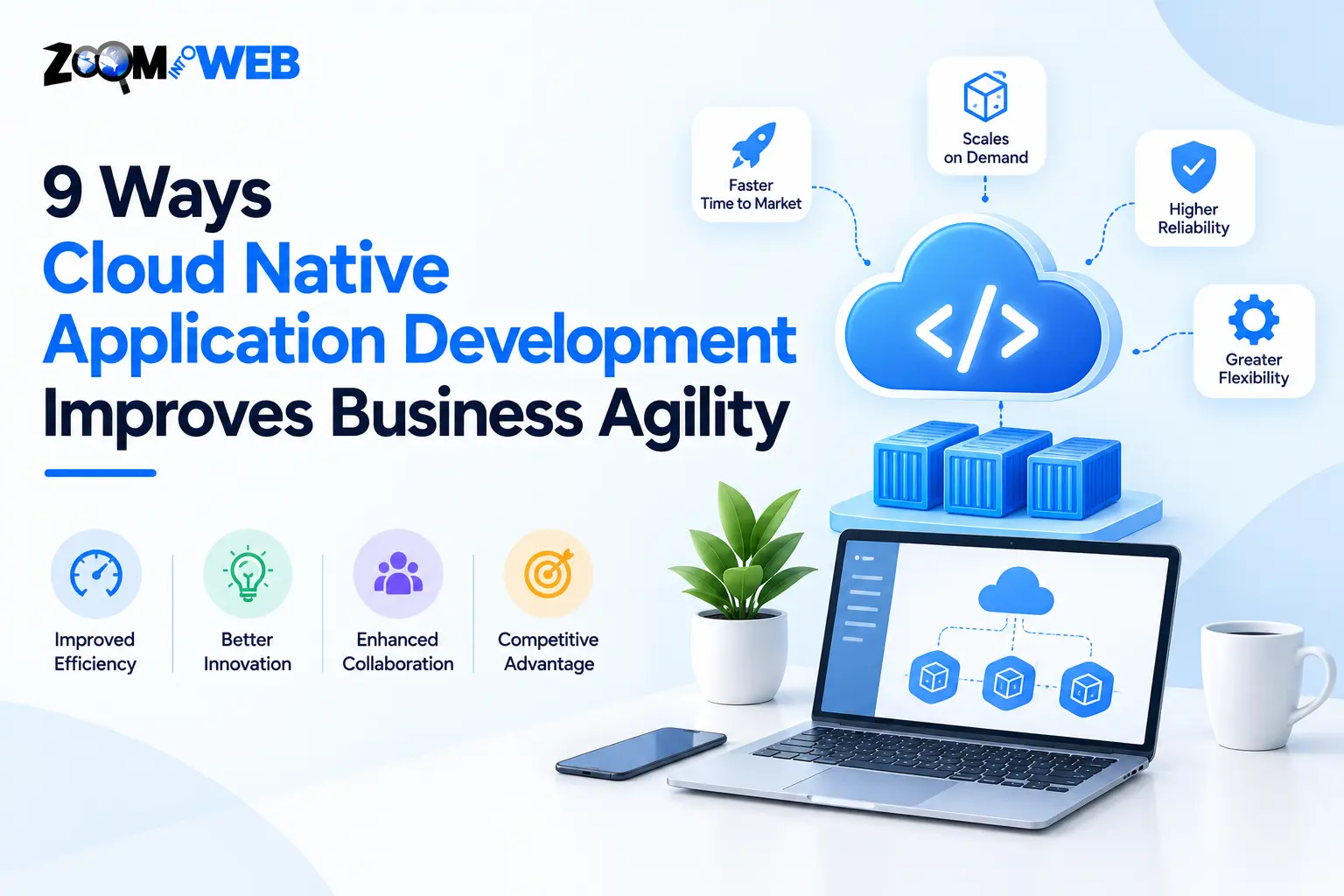
Business requirements change quickly. The demand to rapidly change and enhance applications to meet the needs of the market has increased.
The question becomes; how quickly can application changes be implemented without increasing the risk and expense of each change?
With cloud-native development, the answer becomes; changes can be implemented rapidly and at a lower cost.
Cloud-native development means incorporating cloud-based services and principles into application development. Cloud-native applications can be easily scaled, deployed, and changed.
Migrating an application to the cloud does not mean the application employs cloud-native principles. True cloud-native principles mean a process, and architecture is designed to be as flexible as the cloud environment it is employed in.
Ultimately, a focus on process and architecture design to incorporate cloud-based principles means a business can achieve the agility necessary to change and pivot its processes to meet the needs of the market quickly and easily.
Cloud-native application development allows software to be built and deployed with cloud platform services in mind.
Different implementation strategies of cloud-native application development include:
- Using containers and container orchestration.
- Composable services integrated through HTTP(S) interfaces.
- Cloud-provided relational and/or NoSQL databases.
- DevOps automation and continuous integration/delivery tools.
- Infrastructure and application code automation.
- Runtime application and service code automation.
- Serverless computing.
Not every application should utilize all of the above technologies. Many simple applications should not need to utilize complex service architectures and still benefit from automation and abstraction provided by cloud computing platforms.
The general goal of cloud-native application development is to enable applications to be developed and deployed quickly to meet the changing business needs.
1. The primary goal of cloud-native application development is to reduce the time it takes to build an application and get it in the hands of end users.
Long development and release cycles make it difficult to deliver changes to end users in traditional application development.
Many of the conceptual differences between cloud-native development and traditional development simplify deployment and reduce the risk of software releases.
Cloud-native development helps software teams become more responsive to their end users and the market.
Changes to software can be automatically tested and delivered to end users through CI/CD. Should a change cause issues, it can be rolled back.
For application developers, the biggest advantage of the cloud is the ability to produce software products that are easily changing. This requires less effort and carries less risk.
2. Cloud applications need to be scalable to address fluctuating levels of demand.

Many factors can cause unpredictable spikes in demand (e.g. promotion, an event, an initiative, a launch, a disruption). Demand can also have a clear, repeating pattern (e.g. a seasonal trend).
The nature of cloud-based architectures gives application developers the ability to address scalability by using a variety of techniques including:
- Resize compute resources based on demand
- Automatically provision and manage load balancing
- Enable container orchestration
- Use a managed database
- Implement application caching
Scalable applications give organizations the ability to address demand beyond what current infrastructure constraints would allow. This includes demand that occurs outside of the organizations in the normal business cycle (e.g. support a new region, support a new business event).
3. Automation of various operational activities allows application development and IT teams to focus on more strategic and differentiating activities for the business.
Automation has also been shown to reduce the time and effort required for undifferentiated and repetitive activities.
Automation helps build sustainable systems.
4. It is common for businesses to use many digital channels and applications.
Internally, a business may use a variety of applications to facilitate interactions with customers and/or process payments. Further, a business may use various applications to assist with customer relationship management. These may be integrated with other applications through various channels.
cloud-native applications allow various applications to be integrated through a variety of digital channels with minimal friction.
Adding, removing, and replacing application integration may be as easy as using or implementing an Application Programming Interface (API).
5. Cloud-native development allows organizations to rapidly deliver products and services in a manner that flexibly adapts to changing market conditions.
The rapid pace of software development allows multiple teams to work on different elements of a product or service at the same time. These teams can include product, development, design, operation, security, and other business teams.
In cloud-native development, the software delivery process is automated and integrated with the operations processes. This creates a virtual continuum where software development and delivery are integrated and continuous.
Miscommunication and unclear processes are the main reasons delays occur in a software development process. If multiple teams share a unified view of the software delivery process, they can efficiently coordinate work.
6. The goal of rightsizing and resource-monitoring is to use resources in an optimized manner and efficiently meet the demands of the users.
Cloud-native resources can facilitate this and help in auto-scaling the resources to meet the varying demands.
Business impact
Resource management helps businesses:
- Save money on unneeded business expenses
- Balance costs with use of company technology
- Enhance financial predictions and planning
- Increase productivity by directing employees towards more important tasks
Managing costs is important for effective Cloud computing. Continuous and unmanaged cloud computing can rapidly increase expenses.
7. Forecasting Technological Trends
The goal is not to forecast every relevant technology.
The goal is to shape the environment so that changing technology can be easily integrated.
Examples:
An e-commerce company with fluctuating user demand may be able to develop a system that allows the check-out page to scale independently from the product catalog. Additionally, the system may allow other components of the application to scale and/or integrate new, third-party services to support payment and inventory. Furthermore, the company may use the new system to enable deployment and release the application to production faster. The company may also use the new system to improve the performance of the application and automate the process of changing infrastructure to respond to user demand. Lastly, the company may use the new system to change the underlying services used to support the application.
8. Better Resilience and Continuity of Business Operations
Some negative effects of application downtime include loss of business, reduced productivity, and poor experience for customers and employees.
Resilience of cloud-based applications can be enhanced by using redundant resources, automated recovery, isolation of faults, and timed backups.
Depending on business requirements, resilience of cloud-based applications can also be enhanced using resources in multiple zones and regions.
9. Improved Potential for Changes in Business
Flexibility of a systems architecture can help a business more easily react to the ever-changing requirements of the market.
The architectural style of cloud-computing can help facilitate a business’s ability to modify and enhance its systems and services.
Companies can do the following:
- Create new offerings
- Incorporate new tools
- Update applications
- Move into other locations
- Change processes
- Adjust offerings based on user requests
A key aspect of using modern methods and services to upgrade legacy systems is the ability to change one small portion of the system at a time.
Cloud-native applications are built leveraging modern services and techniques offered by cloud providers.
Differences Between Cloud-Based and Cloud-Native Applications
Cloud-based applications may be deployed to a cloud provider, but the application may not have been designed with cloud capabilities in mind.
Traditionally designed applications can retain architecture with a centralized control unit and outlying units which can result in design inefficiencies.
The scale and flexibility of the application may be limited.
Deployment may still require manual processes.
Maintaining and managing the required infrastructure may require manual processes.
Just because an application is designed using a modular architecture, does not mean it should. A more complex application may benefit from a modular design if it is aligned to the budget and expected growth of the application.
Cloud-native practices enable businesses to reap the benefits of cloud technologies. However, not all cloud-native practices may be beneficial for a business. Therefore, it is important to analyze which cloud-native features contribute to a business and positively impact an organization.
Zoom Into Web helps clients incorporate cloud-native application development strategies to achieve their business objectives.
Our goal is to transform how companies interact with their customers and employees online. Using a hybrid work model, we provide software solutions to revolutionize your business. We provide a wide range of services in digital solution development, from designing cloud and web applications to building mobile applications and APIs. Additionally, we offer services in business process automation, application modernization, and digital transformation.
While working on a project, we identify the most fitting technology and architecture for the application rather than implementing a generic solution.
What is cloud-native application development?
Cloud-native application development is a methodology for creating applications using techniques and concepts implemented by cloud computing service providers. This may include automated deployment and scaling of applications.
How does cloud-native application development affect a business?
Cloud-native development helps businesses automate and streamline processes, integrate various applications, and monitor and adjust applications in real-time based on changing requirements.
Is cloud-native and cloud-based the same?
No, a cloud-based application is one that uses cloud infrastructure for application hosting. A cloud-native application is an application that has been modernized to leverage the advantages of the cloud.
What are some development tools and concepts for cloud computing?
Some development tools and concepts for cloud computing may include containers, APIs, continuous integration and/or continuous delivery/deployment (CI/CD), automated testing, and other DevOps tools and practices.
Could cloud-native development be used by smaller businesses?
Yes, however smaller businesses don’t always need the more complex structures of a true cloud-native architecture. Look for cloud solutions that give your business automation and infrastructure that are flexible and scalable by default.
Is cloud-based computing the same as cloud-native?
Not necessarily. Cloud computing just means that an application has been deployed to a cloud provider. Several factors must still be considered, including the architecture of the application, how it is deployed, whether it can be automated to scale, and how it is operated and maintained.
What is cloud-native development?
Cloud-native development is a method of software architecture and development that promotes software that is easy to develop, deploy, scale, integrate, automate, and modify.
What are the advantages of cloud-native architecture?
There are several advantages of using a cloud-native architecture, including the potential to improve the speed and efficiency of your business to meet the needs of your customers and the market. Cloud-native architectures also improve the flexibility of your business to integrate various software and services. Other advantages may include improvement of your business’ continuity, resilience, and efficiency. Additionally, using a cloud-native architecture may improve your business’s ability to be flexible and responsive to the needs of your customers while also enhancing your employee’s ability to collaborate. Lastly, a cloud-native architecture may improve the overall effectiveness of your business and provide a stable foundation for further digital and business transformations.
Where should a business begin when evaluating Digital Product Development or Cloud and Application Services?
The answer should always begin with evaluating your business’s core challenges. These challenges should primarily drive and inform the choices you make for Digital Product Development. If cloud-based technology is designed to meet these core challenges of your business, it may enable your business to be continuously adaptable to the needs of the market and your customers.

Comments are closed